
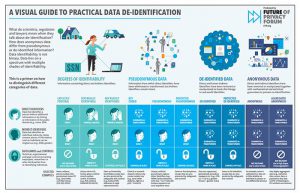
One key method for ensuring privacy while processing large amounts of data is de-identification. De-identified data refers to data through which a link to a particular individual cannot be established. This often involves “scrubbing” the identifiable elements of personal data, making it “safe” in privacy terms while attempting to retain its commercial and scientific value.
In the era of big data, the debate over the definition of personal information, de-identification and re-identification has never been more important. Privacy regimes often rely on data being considered Personal in order to require the application of privacy rights and protections. Data that is anonymous is considered free of privacy risk and available for public use.
Yet much data that is collected and used exists somewhere on a spectrum between these stages. FPF’s De-ID Project has examined practical frameworks for applying privacy restrictions to data based on the nature of data that is collected, the risks of de-identification, and the additional legal and administrative protections that may be applied.

FPF Releases Practitioner Guides on Privacy Enhancing Technologies for Education Stakeholders
The Future of Privacy Forum (FPF) has released a suite of practitioner resources on Privacy Enhancing Technologies (PETs) for the education sector. Building on FPF’s 2025 landscape analysis of PETs adoption by State Education Agencies, the new resources move from landscape analysis to implementation considerations — providing audience-specific guidance for the three practitioner communities most […]
FERPA Exceptions: A Study in Studies
The Family Educational Rights and Privacy Act, or FERPA, protects personally identifiable information from education records from unauthorized disclosure. The Law has been affording parents privacy rights over their children’s education records for almost half a century now; indeed, the fiftieth anniversary of FERPA’s passage is this August 2024. As FERPA’s golden birthday approaches, FPF is […]
FPF in 2021: Delivering Privacy Insights & Expert Analysis
With the last days of 2021 upon us, we wanted to take a moment to reflect on this exciting year that saw FPF expand its presence both domestically and around the globe, while producing engaging events, thought-provoking analysis, and insightful reports with real-world impact. Growing Global Expertise The scope of FPF’s international work continued to […]

The First National Model Student Data Privacy Agreement Launches
Protections for student data privacy took an important step forward this summer when the Student Data Privacy Consortium (SDPC) released the first model National Data Privacy Agreement (NDPA) for school districts to use with their technology service providers. Ever since education technology (edtech) emerged as a key tool in classrooms, both schools and edtech companies […]

FPF Comments on the California Consumer Privacy Act (CCPA)
On Friday, the Future of Privacy Forum submitted comments to the Office of the California Attorney General (AG), Xavier Becerra. Read FPF’s Full Comments (11-page letter) See Attachment 1: Comparing Privacy Laws: GDPR vs. CCPA See Attachment 2: A Visual Guide to Practical De-identification In FPF’s outreach to the AG, we commended the office for its […]

States and the District of Columbia Introduce ACLU Sponsored Legislation to Address Student Privacy
Recently, the ACLU, in partnership with the Tenth Amendment Center, created model legislation for states to “take control of their privacy in a digital age.” On January 20th, 2016 the ACLU coordinated with legislators in 16 states and the District of Columbia to roll out a variety of privacy bills simultaneously, many of which addressed […]
White House/MIT Big Data Privacy Workshop Recap
Speaking for everyone snowed-in in DC, White House Counselor John Podesta remarked that “big snow trumped big data,” while on the phone to open the first of the Obama Administration’s three big data and privacy workshops. This first workshop focused on advancing the “start of the art” in technology and practice. While these workshops are ultimately the […]