
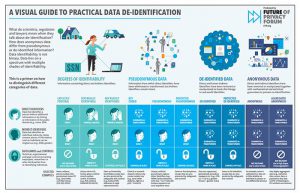
One key method for ensuring privacy while processing large amounts of data is de-identification. De-identified data refers to data through which a link to a particular individual cannot be established. This often involves “scrubbing” the identifiable elements of personal data, making it “safe” in privacy terms while attempting to retain its commercial and scientific value.
In the era of big data, the debate over the definition of personal information, de-identification and re-identification has never been more important. Privacy regimes often rely on data being considered Personal in order to require the application of privacy rights and protections. Data that is anonymous is considered free of privacy risk and available for public use.
Yet much data that is collected and used exists somewhere on a spectrum between these stages. FPF’s De-ID Project has examined practical frameworks for applying privacy restrictions to data based on the nature of data that is collected, the risks of de-identification, and the additional legal and administrative protections that may be applied.


Mandating “Evidence-Based” Suicide Detection in Chatbots
Co-authored by Sarah Hanson, FPF Health & Wellness Intern This article discusses suicidal ideation, which may be distressing for some readers. (If you or someone you know is struggling, help is available. You can call or text the Suicide & Crisis Lifeline at 988 or visit 988 Lifeline for free, confidential, 24/7 support.) As many […]

Celebrating Another Year of Privacy and AI Governance: FPF at the 2026 IAPP Global Summit
Authored by FPF Communications Intern Celeste Valentino FPF experts participated in the 2026 IAPP Global Summit and hosted FPF privacy executive convenings in Washington, D.C. from March 31 to April 2. As a major gathering for privacy professionals, the event featured a heavy schedule of workshops and panels focused on the intersection of U.S. and […]

2026: A Year at the Crossroads for Global Data Protection and Privacy
There are three forces twirling and swirling to create a perfect storm for global data protection and privacy this year: the surprise reopening of the General Data Protection Regulation (GDPR) which will largely play out in Brussels over the following months, the complexity and velocity of AI developments, and the push and pull over the […]

FPF Year in Review 2025
Co-authored by FPF Communications Intern Celeste Valentino with contributions from FPF Global Communications Manager Joana Bala This year, FPF continued to broaden its footprint across priority areas of data governance, further expanding activities across a range of cross-sector topics, including AI, Youth, Conflict of Laws, AgeTech (seniors), and Cyber-Security. We have engaged extensively at the local […]
Chile’s New Data Protection Law: Context, Overview, and Key Takeaways
On August 26, 2024, the Chilean Congress approved Law 21.719, on the Protection of Personal Data (“LPPD”) after eight years of legislative debate. The legislation was published on December 13, 2024, and will become fully effective twenty-four months after that date (in December 2026). The LPPD was introduced in the Senate in 2017 to replace […]

Twelve Privacy Investments for Your Company for a Stronger 2025
FPF has put together a list of Twelve Privacy Investments for Your Company for a Stronger 2025 that reflects on new perspectives on the work that privacy teams do at their organizations. We hope there is something here that’s useful where you work, and we’d love to hear other ideas and feedback. Privacy Investments for Your […]
Processing of Personal Data for AI Training in Brazil: Takeaways from ANPD’s Preliminary Decisions in the Meta Case
Data Protection Authorities (DPAs) across the globe are currently wrestling with fundamental questions raised by the emergence of generative AI and its compatibility with data protection laws. A key issue is under which legal basis companies might be able to process personal data for training AI models. Another one is how the rights of individuals […]
FERPA Exceptions: A Study in Studies
The Family Educational Rights and Privacy Act, or FERPA, protects personally identifiable information from education records from unauthorized disclosure. The Law has been affording parents privacy rights over their children’s education records for almost half a century now; indeed, the fiftieth anniversary of FERPA’s passage is this August 2024. As FERPA’s golden birthday approaches, FPF is […]

The North Star State Joins the State Privacy Law Constellation
On May 19, 2024, the Minnesota Legislature passed HF 4757, an omnibus budget bill that includes the Minnesota Consumer Data Privacy Act (MNCDPA). The bill now heads to Governor Walz for signature. Developed by State Representative Steve Elkins over nearly five years and multiple legislative sessions, the MNCDPA is among the strongest iterations of the […]

The Old Line State Does Something New on Privacy
On April 6, the Maryland Senate concurred with House amendments to SB 541, the Maryland Online Data Privacy Act (MODPA), sending the bill to Governor Moore for signature. If enacted, MODPA could be a paradigm-shifting addition to the state privacy law landscape. While recent state comprehensive privacy laws generally have added to the existing landscape […]