
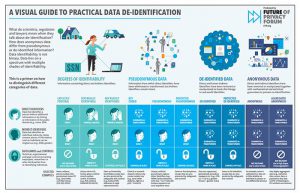
One key method for ensuring privacy while processing large amounts of data is de-identification. De-identified data refers to data through which a link to a particular individual cannot be established. This often involves “scrubbing” the identifiable elements of personal data, making it “safe” in privacy terms while attempting to retain its commercial and scientific value.
In the era of big data, the debate over the definition of personal information, de-identification and re-identification has never been more important. Privacy regimes often rely on data being considered Personal in order to require the application of privacy rights and protections. Data that is anonymous is considered free of privacy risk and available for public use.
Yet much data that is collected and used exists somewhere on a spectrum between these stages. FPF’s De-ID Project has examined practical frameworks for applying privacy restrictions to data based on the nature of data that is collected, the risks of de-identification, and the additional legal and administrative protections that may be applied.
FPF Releases Practitioner Guides on Privacy Enhancing Technologies for Education Stakeholders
The Future of Privacy Forum (FPF) has released a suite of practitioner resources on Privacy Enhancing Technologies (PETs) for the education sector. Building on FPF’s 2025 landscape analysis of PETs adoption by State Education Agencies, the new resources move from landscape analysis to implementation considerations — providing audience-specific guidance for the three practitioner communities most […]

FPF Year in Review 2025
Co-authored by FPF Communications Intern Celeste Valentino with contributions from FPF Global Communications Manager Joana Bala This year, FPF continued to broaden its footprint across priority areas of data governance, further expanding activities across a range of cross-sector topics, including AI, Youth, Conflict of Laws, AgeTech (seniors), and Cyber-Security. We have engaged extensively at the local […]
FERPA Exceptions: A Study in Studies
The Family Educational Rights and Privacy Act, or FERPA, protects personally identifiable information from education records from unauthorized disclosure. The Law has been affording parents privacy rights over their children’s education records for almost half a century now; indeed, the fiftieth anniversary of FERPA’s passage is this August 2024. As FERPA’s golden birthday approaches, FPF is […]
FPF in 2021: Delivering Privacy Insights & Expert Analysis
With the last days of 2021 upon us, we wanted to take a moment to reflect on this exciting year that saw FPF expand its presence both domestically and around the globe, while producing engaging events, thought-provoking analysis, and insightful reports with real-world impact. Growing Global Expertise The scope of FPF’s international work continued to […]

FPF Best Practices and Contract Guidelines Help Companies Share Data with Academic Researchers
Does your company have data that could help academic researchers unravel the mysteries of human health, behavior, education, or other areas of study? Data held by private organizations has the potential to lead to scientific insights that can benefit society and improve lives – if it can be accessed in a responsible manner that respects […]

The First National Model Student Data Privacy Agreement Launches
Protections for student data privacy took an important step forward this summer when the Student Data Privacy Consortium (SDPC) released the first model National Data Privacy Agreement (NDPA) for school districts to use with their technology service providers. Ever since education technology (edtech) emerged as a key tool in classrooms, both schools and edtech companies […]

FPF Comments on the California Consumer Privacy Act (CCPA)
On Friday, the Future of Privacy Forum submitted comments to the Office of the California Attorney General (AG), Xavier Becerra. Read FPF’s Full Comments (11-page letter) See Attachment 1: Comparing Privacy Laws: GDPR vs. CCPA See Attachment 2: A Visual Guide to Practical De-identification In FPF’s outreach to the AG, we commended the office for its […]
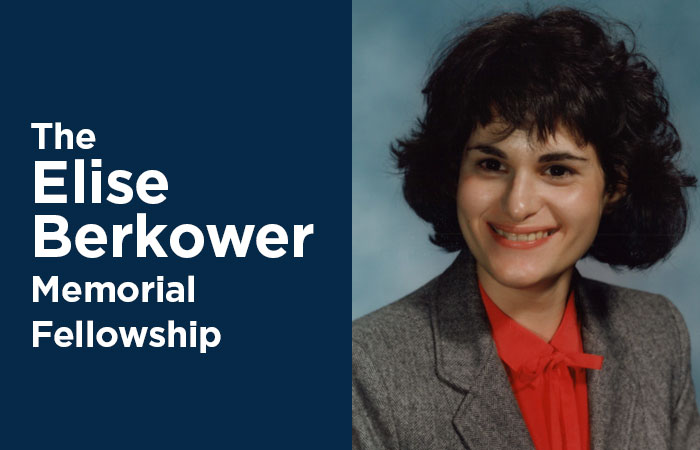
The Elise Berkower Memorial Fellowship
FPF launched a new fellowship in memory of Elise Berkower. Elise was a senior privacy executive at global measurement and data analytics company Nielsen for nearly a decade and was a valued, longtime member of the FPF Advisory Board. FPF graciously acknowledges the Berkower Family and the Nielsen Foundation as founding sponsors of the Elise Berkower Memorial Fellowship.
Bipartisan Report: Feds Should Connect Student Data While Protecting Privacy
Today, the Commission on Evidence-Based Policymaking released their final report. The Commission was created through bi-partisan legislation in 2016 to “consider how to strengthen government’s evidence-building and policymaking efforts” (page 16). One of the key issues that the Commission heard from advocates on all sides about whether to overturn the current federal ban on connecting education data collected by the federal government in order to provide students, postsecondary institutions, and the public with information that could be used to improve policies or better target federal funding.

Should Colleges Report When They Get Government Data Requests?
Last year, the University of California, Berkeley, announced that it was publishing a transparency report detailing government requests for data, similar to what tech companies including Google and Facebook have been doing for years.