
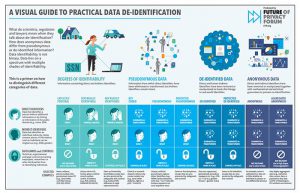
One key method for ensuring privacy while processing large amounts of data is de-identification. De-identified data refers to data through which a link to a particular individual cannot be established. This often involves “scrubbing” the identifiable elements of personal data, making it “safe” in privacy terms while attempting to retain its commercial and scientific value.
In the era of big data, the debate over the definition of personal information, de-identification and re-identification has never been more important. Privacy regimes often rely on data being considered Personal in order to require the application of privacy rights and protections. Data that is anonymous is considered free of privacy risk and available for public use.
Yet much data that is collected and used exists somewhere on a spectrum between these stages. FPF’s De-ID Project has examined practical frameworks for applying privacy restrictions to data based on the nature of data that is collected, the risks of de-identification, and the additional legal and administrative protections that may be applied.

FPF Files Comments with the Consumer Financial Protection Bureau Regarding Personal Financial Data Rights
On December 21st, 2023, the Future of Privacy Forum filed comments with the Consumer Financial Protection Bureau (CFPB) in response to the notice of proposed rulemaking (NPRM) regarding personal financial data rights. FPF’s comments focus on promoting privacy as a core tenet in the U.S. open banking ecosystem in order to protect individuals’ personal information […]

FPF in 2021: Delivering Privacy Insights & Expert Analysis
With the last days of 2021 upon us, we wanted to take a moment to reflect on this exciting year that saw FPF expand its presence both domestically and around the globe, while producing engaging events, thought-provoking analysis, and insightful reports with real-world impact. Growing Global Expertise The scope of FPF’s international work continued to […]