
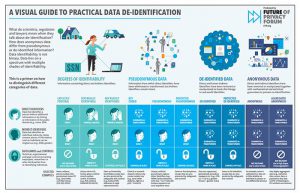
One key method for ensuring privacy while processing large amounts of data is de-identification. De-identified data refers to data through which a link to a particular individual cannot be established. This often involves “scrubbing” the identifiable elements of personal data, making it “safe” in privacy terms while attempting to retain its commercial and scientific value.
In the era of big data, the debate over the definition of personal information, de-identification and re-identification has never been more important. Privacy regimes often rely on data being considered Personal in order to require the application of privacy rights and protections. Data that is anonymous is considered free of privacy risk and available for public use.
Yet much data that is collected and used exists somewhere on a spectrum between these stages. FPF’s De-ID Project has examined practical frameworks for applying privacy restrictions to data based on the nature of data that is collected, the risks of de-identification, and the additional legal and administrative protections that may be applied.
No Silver Bullet, But a Silver Lining? PETs and International Data Transfers
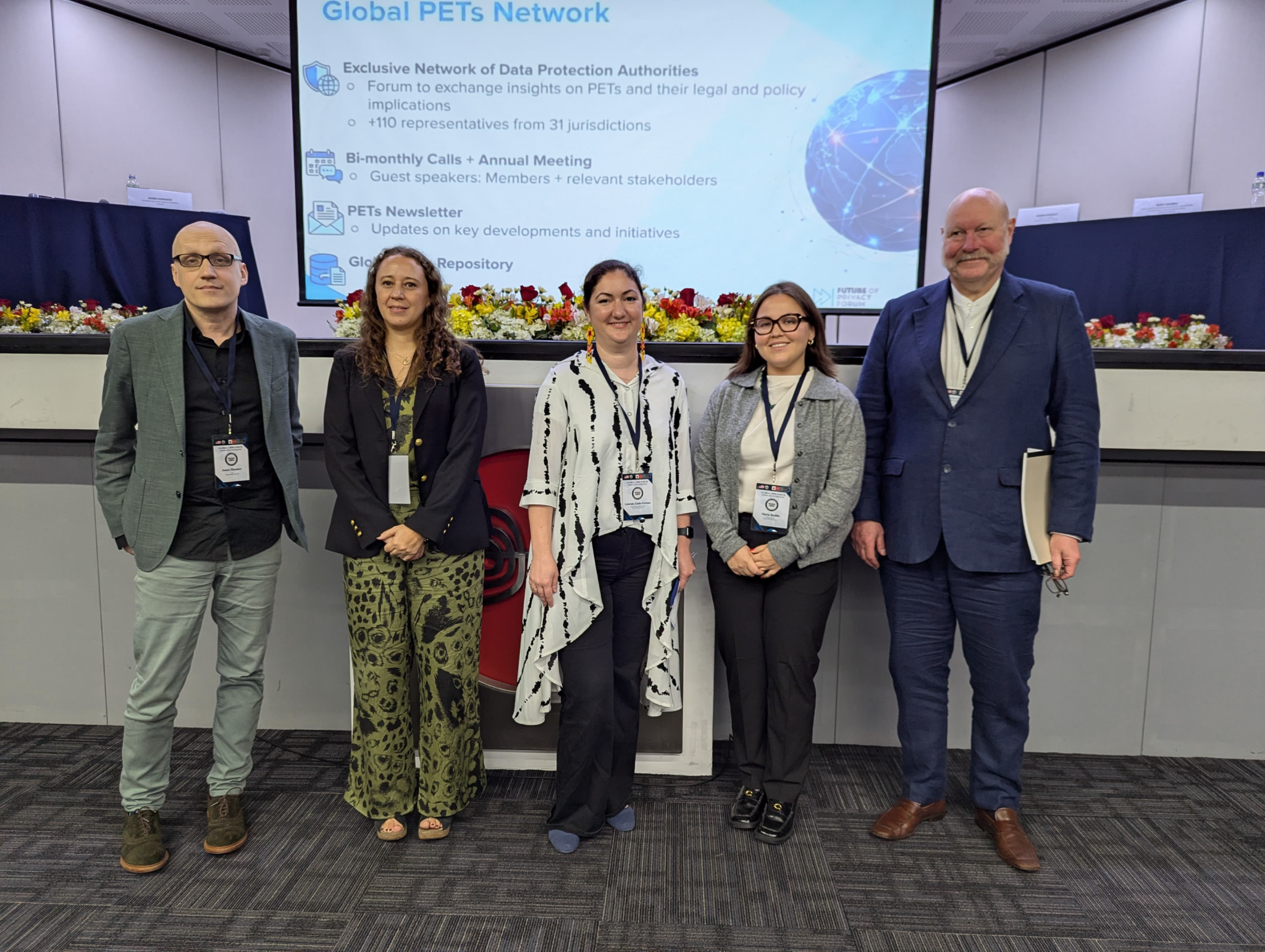
Is there a role for Privacy Enhancing Technologies (PETs) to play in the context of international data transfers? The answer to this question could be one of the keys to unlock trusted cross-border data flows at scale in the age of AI. This was the topic explored in a session organized by the Future of […]

FPF Releases Practitioner Guides on Privacy Enhancing Technologies for Education Stakeholders
The Future of Privacy Forum (FPF) has released a suite of practitioner resources on Privacy Enhancing Technologies (PETs) for the education sector. Building on FPF’s 2025 landscape analysis of PETs adoption by State Education Agencies, the new resources move from landscape analysis to implementation considerations — providing audience-specific guidance for the three practitioner communities most […]

Innovation and Data Privacy Are Not Natural Enemies: Insights from Korea’s Experience
The following is a guest post to the FPF blog authored by Dr. Haksoo Ko, Professor at Seoul National University School of Law, FPF Senior Fellow and former Chairperson of South Korea’s Personal Information Protection Commission. The guest post reflects the opinion of the author only and does not necessarily reflect the position or views […]

FPF Year in Review 2025
Co-authored by FPF Communications Intern Celeste Valentino with contributions from FPF Global Communications Manager Joana Bala This year, FPF continued to broaden its footprint across priority areas of data governance, further expanding activities across a range of cross-sector topics, including AI, Youth, Conflict of Laws, AgeTech (seniors), and Cyber-Security. We have engaged extensively at the local […]

Rethinking Personal Data: The CJEU’s Contextual Turn in EDPS vs. SRB
Author: Cédric Burton The following is a guest post to the FPF blog authored by Cédric Burton, Partner and Global Co-Chair Data, Privacy and Cybersecurity, Wilson Sonsini Brussels. The guest post reflects the opinion of the author only and does not necessarily reflect the position or views of FPF and our stakeholder communities. FPF provides […]

Practical Takeaways from FPF’s Privacy Enhancing Technologies Workshop
In April, the Future of Privacy Forum and the Mozilla Foundation hosted an all-day workshop with technology, legal, and policy experts to explore Privacy Enhancing Technologies (PETs). During the workshop, multiple companies presented technologies they developed and implemented to preserve individuals’ privacy. In addition, the participants discussed steps for broadening the adoption of these technologies […]

Nature of Data in Pre-Trained Large Language Models
The following is a guest post to the FPF blog by Yeong Zee Kin, the Chief Executive of the Singapore Academy of Law and FPF Senior Fellow. The guest blog reflects the opinion of the author only. Guest blog posts do not necessarily reflect the views of FPF. The phenomenon of memorisation has fomented significant […]
The Curse of Dimensionality: De-identification Challenges in the Sharing of Highly Dimensional Datasets
The 2006 release by AOL of search queries linked to individual users and the re-identification of some of those users is one of the best known privacy disasters in internet history. Less well known is that AOL had released the data to meet intense demand from academic researchers who saw this valuable data set as essential […]
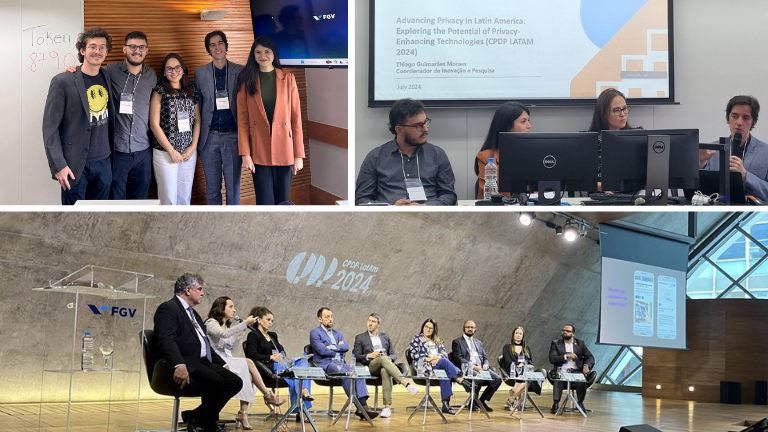
CPDP LatAm 2024: What is Top of Mind in Latin American Data Protection and Privacy? From data sovereignty, to PETs
On July 17-18, the fourth edition of the Computers, Privacy, and Data Protection Conference Latin America (CPDP LatAm) was held in Rio de Janeiro, Brazil. This year’s theme was on “Data Governance: From Latin America to the G20,” highlighting Brazil’s current presidency of the international cooperation forum. As in previous years, FPF participated on the […]

Connecting Experts to Make Privacy-Enhancing Tech and AI Work for Everyone
The Future of Privacy Forum (FPF) launched its Research Coordination Network (RCN) for Privacy-Preserving Data Sharing and Analytics on Tuesday, July 9th. Industry experts, policymakers, civil society, and academics met to discuss the possibilities afforded by Privacy Enhancing Technologies (PETs), the inherent regulatory challenges, and how PETs interact with rapidly developing AI systems. FPF experts […]