
Across the United States, evolving data collection and processing practices and advances in artificial intelligence are driving new digital services, technologies, and socially beneficial research – while also raising new opportunities, risks, and questions for individuals and communities. In response, state and federal policymakers are considering new legislative and regulatory frameworks on three interconnected fronts: comprehensive consumer privacy laws that establish baseline rights and protections for personal data across the economy; frameworks that target specific sectors and practices such as automated decisionmaking, biometric identification, companion chatbots, data-driven pricing, data brokerage, frontier AI model safety, genetic data, and health data; and youth-specific privacy and online safety laws that set distinct rules for minors. These three tracks rarely stay in their lanes: a comprehensive privacy law may include AI provisions, an AI safety bill may carve out rules for minors, a youth online safety law may hinge on biometric age verification. Understanding the landscape requires understanding both the individual pieces and how they fit together.
FPF’s U.S. Legislation team provides expert, independent, pragmatic analysis of state and federal legislative and regulatory approaches to privacy, AI, and youth online safety – three distinct but increasingly intertwined issue areas. The team tracks emerging proposals, compares new laws against existing frameworks, analyzes implementation and compliance implications, and helps policymakers and stakeholders understand how legal requirements interact with current technologies, business practices, and data uses.
Through reports, blog posts, legislative and policy analyses, webinars, in-person and virtual peer-to-peer gatherings, and educational programs, FPF helps the broader technology policy and governance community understand the mechanisms and strategies available to protect privacy, promote responsible AI development and deployment, and advance youth online safety. FPF does not typically support or oppose particular bills. Instead, the U.S. Legislation team focuses on explaining the practical and legal implications of proposals – individually and as they interact with one another. This work helps ensure that privacy, AI, and youth safety compliance and policy strategies remain future-looking, adaptable, and workable for the continued, beneficial use of data and AI.
FPF’s U.S. Legislation team is led by Tatiana Rice, Senior Director.






Taking stock: The Impact of the India AI Impact Summit 2026
India’s hosting of the AI Impact Summit 2026 was an ambitious undertaking. With 600,000 attendees and 92 signatories to the New Delhi Declaration, the Summit was a showcase of a Global South country taking a leading role in shaping the AI governance agenda. The Summit’s official framing centered on infrastructure, compute, and equitable access to […]

FPF Year in Review 2025
Co-authored by FPF Communications Intern Celeste Valentino with contributions from FPF Global Communications Manager Joana Bala This year, FPF continued to broaden its footprint across priority areas of data governance, further expanding activities across a range of cross-sector topics, including AI, Youth, Conflict of Laws, AgeTech (seniors), and Cyber-Security. We have engaged extensively at the local […]

FPF’s Year in Review 2024
With contributions from Judy Wang, Communications Intern 2024 was a landmark year for the Future of Privacy Forum, as we continued to grow our privacy leadership through research and analysis, domestic and global meetings, expert testimony, and more – all while commemorating our 15th anniversary. Expanding our AI Footprint While 2023 was the year of […]

FPF Develops Checklist & Guide to Help Schools Vet AI Tools for Legal Compliance
FPF’s Youth and Education team has developed a checklist and accompanying policy brief to help schools vet generative AI tools for compliance with student privacy laws. Vetting Generative AI Tools for Use in Schools is a crucial resource as the use of generative AI tools continues to increase in educational settings. It’s critical for school […]

Consumer Acceptance, Transparency, and Unique Privacy Considerations at the Forefront of FPF’s Discussion on Privacy and Vehicle Safety Systems
On March 21, the Future of Privacy Forum (FPF) hosted a conversation on “Driving the Conversation on Privacy and Vehicle Safety Systems” to discuss the future of certain technologies in vehicles. The panel discussion was moderated by Adonne Washington, FPF Policy Counsel for Data, Mobility, and Location, and included Hilary Cain (Senior Vice President for […]
FPF in 2023: A Year in Review
As 2023 comes to an end, we want to reflect on a year that saw the Future of Privacy Forum (FPF) continue to expand its presence globally and domestically while organizing engaging events, publishing thought-provoking analysis, providing the latest expert updates, and more. FPF continues to convene industry experts, academics, consumer advocates, and other experts […]
FPF Offers Input on Massachusetts Student Data Privacy Proposal
On October 30, FPF provided testimony before a hearing of the Massachusetts Joint Committee on Education regarding H.532/S.280, an Act Relative to Student and Educator Data Privacy. Read our written testimony in full. Our testimony focused on highlighting relevant FPF resources for policymakers (including a case study on student privacy in Utah, our state student […]
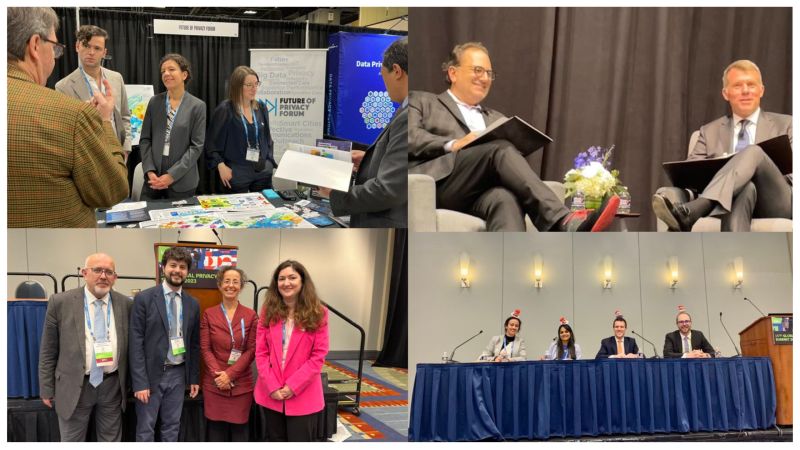
FPF at the 2023 IAPP Global Privacy Summit
Earlier this month, IAPP held its annual Global Privacy Summit (GPS) in Washington, DC. FPF played a major role in bringing together a team of seven renowned privacy experts on 11 panel discussions and varying peer-to-peer roundtables ranging from U.S. privacy law to AI tech and regulation to regional contractual frameworks for data transfers. FPF […]

FPF in 2022: A Year in Review
As 2022 comes to an end, we wanted to reflect on a year that saw the Future of Privacy Forum (FPF) expand its presence both domestically and around the globe, while producing engaging events, thought-provoking analysis, and insightful publications. Global Expansion In 2022, FPF closely followed and advised upon significant developments in Asia, the European […]

FPF Provides Input on Draft Colorado Privacy Act Regulations
On September 30th, The Colorado Department of Law released draft regulations to implement the Colorado Privacy Act. The Future of Privacy Forum (FPF) filed written comments in response to the proposed rules on November 7th. Furthermore, FPF’s Keir Lamont and Felicity Slater participated in public stakeholder sessions hosted by the Colorado Attorney General’s Office as […]