Bridging State Aging Plans and AgeTech Development
As the U.S. population ages, technology developers, health care providers, and policymakers are increasingly interested in “AgeTech”—consumer technologies designed to support older adults and their caregivers. However, building effective, privacy-preserving technology for older adults requires more than technical innovation; it requires alignment with public policy structures.
State Aging Plans, federally mandated comprehensive blueprints under the Older Americans Act (OAA), outline how federal and state resources are allocated to support older adults in home and community-based settings. For AgeTech developers and privacy professionals, these state plans offer strategic insight into public sector service models, funding mechanisms, and real-world implementation barriers.
This blog post explores why State Aging Plans are essential to the future of AgeTech development, examines how technology categories across state strategies intersect with data privacy and consumer protection, and outlines key takeaways for building a trustworthy, privacy-preserving digital ecosystem for older adults and their caregivers.
What Are State Aging Plans and Why Do They Matter for AgeTech?
State Aging Plans are multi-year strategic frameworks maintained by all 50 U.S. states and territories to qualify for federal funding under the OAA. Administered through a nationwide network of Area Agencies on Aging (AAAs) and state units on aging, these plans direct local service delivery for nutrition, caregiver support, transportation, and home-based care.
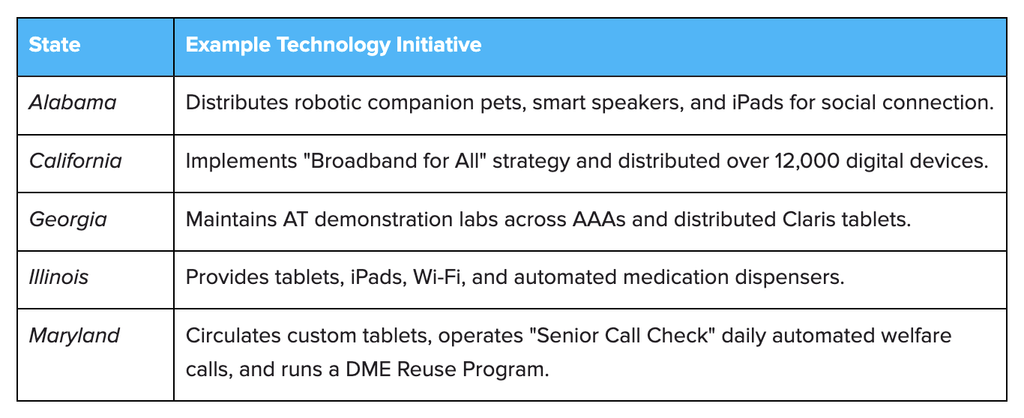
For the AgeTech sector, State Aging Plans represent a critical bridge between private innovation and public sector distribution. They signal how state governments intend to modernize aging services and where public funds—including OAA funds, American Rescue Plan allocations, and Medicaid Home and Community-Based Services (HCBS) waivers—will be deployed.
While all states share foundational goals established by federal mandates, the integration of technology varies widely across jurisdictions:
- Tech-Integrated Leaders: Several states proactively incorporate AgeTech as a primary pillar of service delivery. These states explicitly fund assistive technology lending libraries, loan communication tablets, deploy robotic companion pets, and support digital literacy initiatives.
- Traditional Models: Other states treat technology as an emerging or peripheral interest, relying predominantly on traditional, non-digital service delivery models.
- Public-Private State Partnerships: States increasingly contract directly with private AgeTech vendors to distribute solutions statewide. For instance, the Washington State Department of Social and Health Services (DSHS) partners with Intuition Robotics to provide the AI companion robot ElliQ at no cost to eligible Medicaid recipients. Similarly, Oregon’s “Help to Connect” program—a partnership between the Aging and Disability Resource Connection of Oregon and Access Technologies, Inc.—distributes free computers, tablets, and animatronic pets. New York (via NYSOFA) operates a robust portfolio of partnerships with vendors such as Ageless Innovation (animatronic pets), GetSetUp (virtual learning), and Trualta (caregiver support), while GetSetUp has expanded across multiple state networks including Michigan, Rhode Island, and Nebraska.
Models of State Partnership and Procurement
State agencies typically employ four primary public-private partnership models to procure and deploy AgeTech solutions:
- Technology-as-a-Public-Benefit: Direct procurement and distribution of hardware or devices to qualifying older adults (e.g., Washington’s ElliQ rollout or Oregon’s animatronic pet distribution).
- Statewide Technology Platforms: State-funded enterprise access to digital platforms made freely available to residents, such as GetSetUp in Michigan and Rhode Island.
- Caregiver-Facing Infrastructure: Procurement of platforms specifically engineered to support unpaid family caregivers, such as Trualta in New York and North Carolina.
- Tech-Enabled Aging-in-Place Services: Embedding digital functionality into existing service infrastructure, such as transportation or Medicaid home-based care.
Understanding this heterogeneous landscape enables developers to tailor product strategies, identify pilot opportunities with local AAAs, and align product designs with state funding streams and distribution networks.
Technology’s Expanding Role in Aging in Place and Caregiver Support
Across state plans, technology initiatives are organized around two main objectives: enabling older adults to “age in place” independently and mitigating stress for family and professional caregivers.
1. Empowering Older Adults to Age in Place
State plans emphasize four key categories of technology designed to foster independence:
- Assistive Technology (AT): State-supported AT programs offer adaptive devices, mobility equipment, visual and hearing aids, and communication tools that improve daily functional capabilities.
- Telehealth and Remote Health Monitoring: Expanding virtual care access is a top priority, particularly in rural and underserved areas where geographic distance creates barriers to specialist care.
- Mitigating Social Isolation: Recognizing social isolation as a major public health hazard, many states fund simplified communication devices, smart speakers or home assistants, and AI-driven robotic pets or digital companions to foster emotional well-being.
- Home Safety and Environmental Monitoring: Technologies including Personal Emergency Response Systems (PERS), automated medication dispensers, fall-detection sensors, and smart home environmental monitors help ensure personal safety without requiring institutional care.
2. Supporting Family and Unpaid Caregivers
Unpaid family caregivers represent a vital foundation of the care economy. State plans increasingly integrate digital tools to support them:
- Interactive Education Platforms: States partner with platforms like Trualta and GetSetUp to provide self-paced instruction on dementia care, injury prevention, and caregiver wellness.
- Care Assessment Tools: Tech-enabled assessment frameworks, such as TCARE, analyze caregiver stress factors to generate personalized intervention plans.
- Care Coordination and Communication: Virtual support groups, shared calendar apps, and remote monitoring tools allow caregivers to coordinate duties and maintain peace of mind.
The Policy and Privacy Imperative in AgeTech Development
While state plans celebrate the promise of AgeTech, they also highlight significant operational, ethical, and privacy challenges. When state aging agencies distribute privately developed technologies as part of public services, critical questions arise regarding procurement, vendor data sharing, user expectations, and state eligibility data protection. For technology to succeed in public aging ecosystems, developers and policymakers must address three critical data privacy and policy intersections.
Resolving the Caregiver “Proxy Consent” and Co-Management Gap
Home safety and remote monitoring systems—such as motion sensors, wearable trackers, ambient cameras, and smart medication dispensers—collect continuous, highly granular data about an individual’s intimate daily routines. Without strict data protection standards, these technologies risk transforming supportive home environments into ones where older adults feel surveilled and limited in their autonomy.
A major policy friction point in AgeTech is the tension between older adults’ desire for digital autonomy and the practical necessity of caregiver assistance. In many caregiving relationships, family members assist with device setup, password management, and monitoring.
This shared management dynamic creates legal and privacy ambiguities regarding data consent:
- Individual Consent Models Fall Short: Traditional privacy policies assume a single user granting informed consent. However, when caregivers hold account credentials, consent may be granted by a proxy rather than the individual being monitored.
- Co-Management Frameworks: AgeTech platforms need multi-user account architectures that distinguish between administrative caregiver functions and individual user profiles. Establishing auditable logs and dual-consent mechanisms ensures that caregiver assistance does not erode the older adult’s fundamental right to data privacy.
Overcoming Fraud Concerns and the Digital Divide
State plans consistently emphasize that hardware distribution alone does not guarantee successful technology adoption. Two structural barriers repeatedly surface across state analyses:
- Fear of Scams and Identity Theft: Anxiety over online fraud, phishing, and financial exploitation is a primary reason older adults hesitate to adopt connected devices. Privacy-by-default features, robust encryption, built-in scam protections, and clear data protection policies are essential to establishing consumer trust.
- Broadband Access and Digital Literacy: Significant portions of older populations, particularly in rural communities, lack affordable, high-speed internet or the digital skills needed to operate complex interfaces. State plans advocate for “hybrid” service models that blend digital innovation with in-person support, phone alternatives, and offline capabilities.
Key Takeaways for AgeTech Developers and Policymakers
To foster integration of consumer AgeTech into state public health infrastructure while protecting user rights, those developing state aging plans should focus on advancing three strategic priorities:
- Advance Privacy-by-Default as a Core Differentiator: Ensure all non-essential data collection, location tracking, and audio/video recording are turned off by default. Out-of-the-box privacy protection eliminates ambiguity and builds confidence among risk-averse consumers.
- Architect for Co-Management and User Agency: Design multi-tiered access models that allow family caregivers to assist with management without granting unrestricted access to sensitive personal data or overriding user preferences.
- Combine Hardware with Robust Human Support: Pair intuitive hardware design with ongoing technical training, multi-modal support channels, and offline functionality to ensure tools remain accessible across diverse socioeconomic and geographic populations.
Conclusion
State Aging Plans offer a vital roadmap for aligning AgeTech development with public sector needs, funding streams, and delivery networks. By addressing the real-world barriers identified in these plans—specifically broadband equity, digital literacy, and data privacy—developers can build sustainable, impactful technologies. Ultimately, a balanced approach that combines digital innovation, strong privacy safeguards, and essential human connection will ensure AgeTech serves as an empowering bridge for older adults aging in place.