
One key method for ensuring privacy while processing large amounts of data is de-identification. De-identified data refers to data through which a link to a particular individual cannot be established. This often involves “scrubbing” the identifiable elements of personal data, making it “safe” in privacy terms while attempting to retain its commercial and scientific value.
In the era of big data, the debate over the definition of personal information, de-identification and re-identification has never been more important. Privacy regimes often rely on data being considered Personal in order to require the application of privacy rights and protections. Data that is anonymous is considered free of privacy risk and available for public use.
Yet much data that is collected and used exists somewhere on a spectrum between these stages. FPF’s De-ID Project has examined practical frameworks for applying privacy restrictions to data based on the nature of data that is collected, the risks of de-identification, and the additional legal and administrative protections that may be applied.
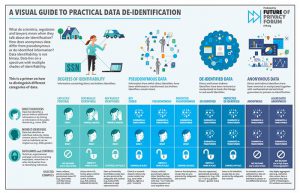


Student Data and De-Identification
FPF has released its newest paper, Student Data and De-Identification: Understanding De-Identification of Education Records and Related Requirements of …

Student Data and De-Identification
Today, FPF has released its newest paper, Student Data and De-Identification: Understanding De-Identification of Education Records and Related Requirements of FERPA. Prepared in partnership with Reg Leichty of Foresight Law + Policy, this paper provides an overview of the different tools used to de-identify data to various degrees, based on the type of information involved, […]
Practical De-Identification Workshop
“Practical De-Identification” was held on July 9, 2015. The event was attended by industry and policy leaders from a range of sectors, who joined in a lively and in-depth discussion about what it means …
FPF Senior Fellow Peter Swire Provide Comments to the FCC on Broadband Consumer Privacy
Later today, Peter Swire, FPF Senior Fellow, will participate at the FCC’s public workshop on broadband consumer privacy. He also prepared written comments expanding on his thoughts. Professor Swire summarizes his research as follows: First, I examine the effect of the Section 222(a) definition of “proprietary information” as compared with the Section 222(c) definition of […]
Comparing the Data Broker Bill to the Consumer Privacy Bill of Rights
Considering the privacy concerns raised by data brokers, we thought it would be useful to compare how data brokers are treated under Senator Edward Markey’s recent data broker bill, which has considerable support from privacy and consumer advocates (as well as Senators Blumenthal, Franken, and Whitehouse), and under the Consumer Privacy Bill of Rights. The different receptions […]

FPF Senior Fellow Peter Swire Receives Privacy Leadership Award
The Future of Privacy Forum congratulates our Senior Fellow, Peter Swire, on receiving the 2015 Privacy Leadership Award from the International Association of Privacy Professionals. Peter has worked with FPF since 2010 on a wide range of privacy and cyber-security issues, such as encryption, Big Data, and many more. His current work with FPF includes […]
A Practical Privacy Paradigm for Wearables
A Practical Privacy Paradigm for Wearables is available to read here. * * * * * * Only a week into 2015, and already it looks to be the year of wearable technologies. At this year’s International Consumer Electronics Show (CES), wearables and the Internet of Things have dominated the conversations and the exhibition halls. […]
Cross Border Privacy Rules Advance at Beijing Meetings
APEC’s Data Privacy Subgroup concluded its 2014 meetings in Beijing, China earlier this week. The Future of Privacy Forum participated in these meetings as a member of the U.S. delegation. The biggest development of the week was Canada’s submission of its Notice of Intent to participate in the Cross Border Privacy Rules (CBPR) system. After […]
Comments to NTIA on Big Data and Privacy
Today, FPF submitted comments to the NTIA as it begins its exploration of how big data impact the Consumer Privacy Bill of Rights. While the NTIA sought comment on over a dozen key questions, our filing focus largely on four issues: (1) the need for additional clarity surrounding the flexible application of the Consumer Privacy […]
De-Identification: A Critical Debate
Ann Cavoukian and Dan Castro recently published a report titled Big Data and Innovation, Setting the Record Straight: De-Identification Does Work. Arvind Narayanan and Edward Felten wrote a critique of this report, which they highlighted on Freedom to Tinker. Today Khaled El Emam and Luk Arbuckle respond on the FPF blog with this guest post. […]