
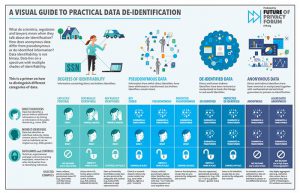
One key method for ensuring privacy while processing large amounts of data is de-identification. De-identified data refers to data through which a link to a particular individual cannot be established. This often involves “scrubbing” the identifiable elements of personal data, making it “safe” in privacy terms while attempting to retain its commercial and scientific value.
In the era of big data, the debate over the definition of personal information, de-identification and re-identification has never been more important. Privacy regimes often rely on data being considered Personal in order to require the application of privacy rights and protections. Data that is anonymous is considered free of privacy risk and available for public use.
Yet much data that is collected and used exists somewhere on a spectrum between these stages. FPF’s De-ID Project has examined practical frameworks for applying privacy restrictions to data based on the nature of data that is collected, the risks of de-identification, and the additional legal and administrative protections that may be applied.

Making Perfect De-Identification the Enemy of Good De-Identification
This week, Ann Cavoukian and Dan Castro waded into the de-identification debate with a new whitepaper, arguing that the risk of re-identification has been greatly exaggerated and that de-identification will play a central role in the age of big data. FPF has repeatedly called for the need for informed conversations about what practical de-identification requires, […]
Comments for the White House "Big Data Review"
This afternoon, FPF submitted comments to help inform the White House Office of Science and Technology Policy’s “Big Data Review.” Announced in January, the White House Big Data Review has been a helpful exercise in scoping out how big data is changing our society. Through public workshops at MIT, NYU, and Berkeley, the review has […]
MAC Addresses and De-Identification
Location analytics companies log the hashed MAC address of mobile devices in range of their sensors at airports, malls, retail locations, stadiums and other venues. They do so primarily in order to create statistical reports that provide useful aggregated information such as average wait times on line, store “hot spots,” and the percentage of devices […]
White House/MIT Big Data Privacy Workshop Recap
Speaking for everyone snowed-in in DC, White House Counselor John Podesta remarked that “big snow trumped big data,” while on the phone to open the first of the Obama Administration’s three big data and privacy workshops. This first workshop focused on advancing the “start of the art” in technology and practice. While these workshops are ultimately the […]
Essays on Big Data and Privacy
A collection of essays by leading scholars and privacy advocates on the legal, technological, social, and policy implications of Big Data, emerging out of our 2013 Big Data and Privacy…
Comments to the FCC About "Anonymized" and "Deidentification"
Yesterday, the Federal Communications Commission posted FPF’s comments about “anonymization” and “deidentification.” The comments come in response to a request from Public Knowledge that the FCC clarify whether “anonymized” or “deidentified” but non-aggregate call records constitute individually identifiable “customer proprietary network information” under Section 222 of the Communications Act. FPF submitted comments to address the argument that […]

GAO Looks at Privacy Practices for Connected Car Location Data
Yesterday, the Government Accountability Office released its study on in-car location-based services, and its survey generally concludes that players in the connected car space are thinking seriously about …
Testimony on Privacy Policies before the California State Assembly
This morning, Jules Polonetsky, FPF’s Executive Director, will be speaking before the California State Assembly Joint Committee Hearing on Digital Privacy on the question of whether privacy policies adequately protect consumer privacy. Jules’ testimony will note that “[p]rivacy policies are not useful for many consumers, but are essential accountability mechanisms. Consumers need to be able to […]
A New Privacy Paradigm for the “Internet of Things”
Today the FTC is hosting a workshop on the Internet of Things, which will feature many great panelists including FPF’s Co-Chairman Christopher Wolf. Chris and FPF Executive Director Jules Polonetsky have also today released a whitepaper arguing for a new privacy paradigm in the new highly connected world. The whitepaper argues that current implementations of […]
Latanya Sweeney and Andrea Matwyshyn to Join FTC
Today, the FTC announced that the appointment of Latanya Sweeney to serve as the agency’s Chief Technologist and Andrea Matwyshyn as a Senior Policy Advisor on privacy and data security issues. Dr. Sweeney is well-known for her hardline criticism of “anonymity” in publicly released datasets. In 1997, Sweeney used seemingly anonymous medical data to demonstrate […]