
Research often requires using sensitive data to answer important questions. The ethical collection and analysis of personal information can be challenging to do while still protecting the privacy of the implicated individuals, honoring informed consent, and complying with other legal obligations. The technology, policies, and ethical considerations for researchers are constantly shifting, sometimes making it difficult to keep up. That’s why FPF engages stakeholders across academia and industry to produce recommendations, best practices, and ethical review structures that promote responsible research. Our work is centered around streamlining, encouraging, and promoting responsible research that respects essential privacy and ethical considerations throughout the research lifecycle. FPF works with policymakers to develop legislative protections that support effective, responsible research with strong privacy safeguards, including hosting events that allow policymakers and regulators to engage directly with practitioners from academia, advocacy, and industry.




FPF Partner in algoaware Project Releases State of the Art Report
algoaware has released the first public version of the State of the Art Report, open for peer review. The report includes a comprehensive explanation of the key concepts of algorithmic decision-making, a summary of the academic debate and its most pressing issues, as well as an overview of the most recent and relevant initiatives and policy actions of the civil society as well as of national and international governing bodies.

Privacy Scholarship Research Reporter: Issue 4, December 2018 – GDPR in Focus
Notes from FPF The General Data Protection Regulation (Regulation (EU) 2016/679) (‘GDPR’) aims to guarantee strong protections for individuals regarding their personal data and apply to businesses that collect, use, or share consumer data, whether the information was obtained online or offline. The GDPR went into effect on May 25, 2018 and is one of […]
Nothing to Hide: Tools for Talking (and Listening) About Data Privacy for Integrated Data Systems
Data-driven and evidence-based social policy innovation can help governments serve communities better, smarter, and faster. Integrated Data Systems (IDS) use data that government agencies routinely collect in the normal course of delivering public services to shape local policy and practice. They can use data to evaluate the effectiveness of new initiatives or bridge gaps between public services and community providers.
Future of Privacy Forum and Actionable Intelligence for Social Policy Release ‘Nothing to Hide: Tools for Talking (and Listening) About Data Privacy for Integrated Data Systems’
Washington, DC – Today, Future of Privacy Forum and Actionable Intelligence for Social Policy released Nothing to Hide: Tools for Talking (and Listening) About Data Privacy for Integrated Data Systems. Nothing to Hide provides governments and their partners working to integrate data for policy and program improvement with the necessary tools to lead privacy-sensitive, inclusive engagement efforts. In addition to a narrative step-by-step guide to communication and engagement on data privacy, the toolkit is supplemented with action-oriented appendices, including worksheets, checklists, exercises, and additional resources.

The Privacy Expert's Guide to AI And Machine Learning
Today, FPF announces the release of The Privacy Expert’s Guide to AI and Machine Learning. This guide explains the technological basics of AI and ML systems at a level of understanding useful for non-programmers, and addresses certain privacy challenges associated with the implementation of new and existing ML-based products and services.

FPF Perspective: Limit Law Enforcement Access to Genetic Datasets
Today, researchers published a paper detailing how governments can use public genetic databases to identify criminal suspects. These activities raise real questions about when it’s appropriate for law enforcement to analyze genetic information, and how best to protect individuals whose genetic data has been analyzed as part of a commercial service, but who are not accused of a crime.

FPF Launches AI and Machine Learning Working Group and Releases New AI Resource Guides
FPF has convened a leading group of its members to consider priority areas for technologies and companies to address ML privacy and ethics concerns. Our AI and Machine Learning Working Group, composed of FPF member companies with an interest in AI and Machine Learning privacy and data management challenges, meets monthly to discuss various relevant issues regarding new updates, hear from experts regarding AI in the EU and under GDPR, the occurrence and defense against bias, and other timely topics.

FPF Welcomes Inaugural Elise Berkower Memorial Fellow
Earlier this year, FPF launched a new fellowship in memory of Elise Berkower. Elise was a senior privacy executive at global measurement and data analytics company Nielsen for nearly a decade and was a valued, longtime member of the FPF Advisory Board. FPF graciously acknowledges the Berkower Family and the Nielsen Foundation as founding sponsors of the Elise Berkower Memorial Fellowship
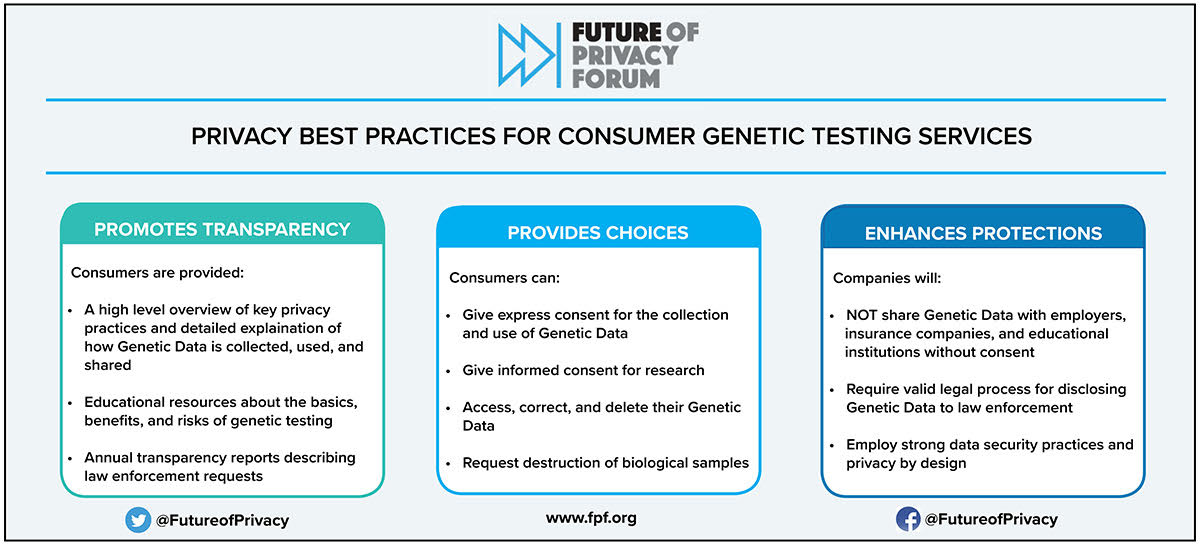
Privacy Best Practices for Consumer Genetic Testing Services
The Best Practices provide a policy framework for the collection, protection, sharing, and use of Genetic Data generated by consumer genetic testing services. These services are commonly offered to consumers for testing and interpretation related to ancestry, health, nutrition, wellness, genetic relatedness, lifestyle, and other purposes.
Future of Privacy Forum and Leading Genetic Testing Companies Announce Best Practices to Protect Privacy of Consumer Genetic Data
Washington, DC – Today, Future of Privacy Forum, along with leading consumer genetic and personal genomic testing companies 23andMe, Ancestry, Helix, MyHeritage, and Habit, released Privacy Best Practices for Consumer Genetic Testing Services. The Best Practices provide a policy framework for the collection, protection, sharing, and use of Genetic Data generated by consumer genetic testing services. These services are commonly offered to consumers for testing and interpretation related to ancestry, health, nutrition, wellness, genetic relatedness, lifestyle, and other purposes.