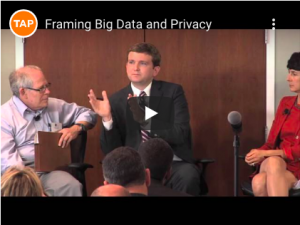
The first session from the Big Data & Privacy: Making Ends Meet conference held on September 10, 2013. Event was co-hosted by the Future of Privacy Forum and Stanford Law School’s The Center for Internet and Society. Panelists are Martin Abrams, Deirdre Mulligan, Neil Richards, Omer Tene, Erik Jones, and Jules Polonetsky moderated.
We wanted to draw your attention to several excellent pieces discussing and summarizing last Tuesday’s “Big Data and Privacy: Making Ends Meet” workshop:
Jedidiah Bracy covered the event for the IAPP’s Privacy Perspectives blog. He highlights a number of the day’s discussions, and concludes that “the ethics of Big Data and technology will be discussed a lot in the months and years ahead.
Howard Fienberg from the Marketing Research Association asks whether privacy and Big Data can coexist? He provides a full summary of the day’s panels, and notes that “Big Data’s growing use, and fervor inside and out of the survey, opinion and marketing research profession, mean that privacy concerns regarding Big Data need to be addressed sooner rather than later.”
Grant Gross writes for IDG News Service and discusses the event’s conversation on government use of Big Data. “The increasing uses of big data in all kinds of organizations, particularly surveillance agencies, should prompt a debate about legitimate data collection and practices, said several speakers at a Washington, D.C., big data and privacy forum,” he writes.
Jonathan King, who with Professor Neil Richards prepared a paper in advance of the event, shares his thoughts on the day in a piece entitled “The New Washington Data Grid.” He highlights the keynote address given by Rayid Ghani, and suggests that “the contrast between Ghani and the first two privacy panels highlighted the need for many more workshops between policy makers and technologists.”
The full report on the workshop is available here.
Apple Introduces New Privacy Features with iOS 7
With all the excitement around the launch of the new iPhone and iOS 7, we thought it would be interesting to highlight some new privacy-specific features. Some of these have been introduced as part of the iOS 7 software; others, like the Touch ID fingerprint scanner, are specific to the new iPhone. Here are some new privacy features worth noting:
Limitations on Tracking
No MAC address or UDID tracking
iOS 7 restricts developers’ ability to track users using MAC addresses and UDIDs. This is a technical change; developers trying to access a MAC address are shown an identical number for every device. While the App Store has not accepted new apps that access UDIDs since May, iOS 7 now provides a Vendor Identifier (a unique per-developer identifier) to existing applications accessing the UDID.
Safari privacy
In iOS 7, Safari’s “Private” mode can now be enabled from within the browser itself. Safari’s Do Not Track setting is in Settings > Safari. Enabling private browsing will also turn on Do Not Track for that session.
Limit Ad Tracking
When Apple advised developers not to use device IDs for tracking, it provided an alternative Advertising Identifier that users could clear. This option is now more visible; it resides under Settings > Privacy > Advertising, rather than under the About section. Users can also find the option to limit ad tracking in the Advertising section.
Other Privacy Features
Touch ID
The new iPhone allows users to unlock the phone using a biometric fingerprint scanner. The phone does not store an image of the fingerprint, but instead stores a mathematical representation of your fingerprint. This information is stored only on the device within an advanced security architecture called the Secure Enclave. Fingerprint data is never accessed by iOS or other third party apps, never stored on Apple servers, and never backed up to iCloud or anywhere else.
Find My iPhone Activation Lock
Find My iPhone now has an ‘Activation Lock,’ requiring a correct Apple ID and password to turn off Find My iPhone or erase the device. Even if the device is erased, reactivating it also requires a correct Apple ID and password.
Frequent Locations
Frequent Locations is a visualization of information that the iPhone collects regarding places you’ve been and how often. This information is kept solely on the device unless a user opts-in to improve Apple Maps, in which case some locations may be submitted in an anonymous form.
Security Features
iOS 7 also debuts data isolation for the microphone and motion detector worldwide. Additional security features are discussed in greater detail in this article.
We’re excited to see these features implemented and look forward to the launch.
Campaigns, the Internet, and Big Data
In this morning’s Politico, Emile Schultheis explores how German politicians are trying to emulate the Obama’s campaign data and digital operation in advance of the country’s September 22 federal election. “The Internet has come into the center of the campaign,” Robert Heinrich, Green Party campaign manager, is quoted as saying. He notes, however, that campaigns “will not win a campaign with the Internet, but without it, you will lose.”
This echoes comments provided by Rayid Ghani at the FPF and Stanford Center for Internet & Society “Big Data and Privacy” workshop on Tuesday. Ghani, the former Chief Scientist for the Obama 2012 campaign, has turned his attention to using data for good. Speaking about his time on the campaign, he suggested that the campaign’s data operation may have had nothing to with the President’s ultimate margin of victory. Instead, he emphasized that good data was all about improving the President’s probability of victory.
“People are assuming that you can predict everything about everyone 10 years in advance with big data, but algorithms are not as deterministic as some think. It is more about probability,” Ghani said. In his address about Big Data, he admitted that he wasn’t nearly as concerned about privacy threats as he was the public’s lack of education and knowledge about how data works.
Informing people about how data are used—and how inferences are drawn from it—was suggested over and over again as one way to address public concerns about Big Data. Perhaps education and digital literacy will be a primary tool to help make privacy concerns and Big Data benefits meet?
Future of Privacy Forum and Stanford’s Center for Internet and Society Team Up to Talk Big Data Risk and Rewards
Future of Privacy Forum and Stanford’s Center for Internet and Society Team Up to Talk Big Data Risk and Rewards
Washington, DC – The Future of Privacy Forum (FPF) and Stanford’s Center for Internet and Society (CIS) today hosted a forum addressing critical issues involved with the collection and use of Big Data.
The day-long forum was sold out and had to be moved twice to accommodate space demands.
On September 3, the Stanford Law Review Online published 11 new papers by privacy leaders in academia, government and business in a special symposium issue dedicated to the tension between big data innovation and privacy risks. Many of the papers are slated to be presented today at a forum titled Big Data and Privacy: Making Ends Meet, which is hosted by Microsoft in Washington, DC.
The forum makes up one of the largest gatherings of privacy experts to take place since the recent revelations about the massive scope of NSA data collection and analysis. While Snowden’s leaks focused on data-driven government surveillance, big data tools also are used to spark innovation and growth in the private sector in areas ranging from public health and scientific research to energy conservation and sustainable development.
The Stanford publication and today’s forum raises issue at the heart of the current privacy discussion such as balancing big data’s benefits against privacy costs. In their presentation, FPF Executive Director Jules Polonetsky and FPF Senior Fellow and CIS Affiliate Scholar Omer Tene proposed a first-of-its kind framework for assessing big data benefits against attendant privacy costs. The full paper – published last week — can be read here. The calculation takes into account factors such as who benefits from big data; who bears the costs; and what is the probability of risks and rewards.
“Finding the right balance between privacy risks and big data rewards is one of the biggest public policy challenges of our time,” Polonestky and Tene said. “Unfortunately, the discussion lurches from crisis to crisis, focusing on legalistic formalities while the bigger policy choices remain blurred. This is a debate that has to happen now, not later.”
Rayid Ghani, co-founder of Edgeflip, a startup building social media analytics products for non-profits and the former Chief Scientist for the Obama for America 2012 campaign, is scheduled to provide a keynote address. Jennifer Stoddart, the Privacy Commissioner of Canada, will deliver closing notes.
Today’s forum is scheduled from 9 a.m. ET to 5 p.m. ET in Washington, DC, at Microsoft’s Innovation and Policy Center, 901 K St., NW.
Media should contact Melissa Merz at 773.505.6037 or at [email protected]. Also, follow the conversation on Twitter at #BigPrivacy.
New Survey on App Stores and Account Info Sharing – What This Means for COPPA
FPF is committed to helping the app marketplace comply with the FTC’s revised Children’s Online Privacy Protection Act (COPPA) rule. As explained in our public commentsfiled with the FTC, we think that one way to help companies and parents alike is to encourage collaboration. For example, by leveraging a common platform, “operators” under the rule could provide streamlined notice and obtain verifiable consent from parents using an easy-to-understand and manageable approach. This way, parents aren’t overwhelmed by countless notices and consent processes, and “operators” under the rule can fulfill their COPPA obligations in a practical manner.
However, in its COPPA FAQs, the FTC said that a parent’s app store account number and password alone aren’t sufficient to establish consent under the rule: “The mere entry of an app store account number or password, without other indicia of reliability (e.g., knowledge-based authentication questions or verification of government identification), does not provide sufficient assurance that the person entering the account or password information is the parent, and not the child.” The assumption appears to be that parents share their account names and passwords with their children.
As part of our mission to give policy makers more data to inform their decision making, we recently commissioned Harris Interactive to conduct a survey online among U.S. adults to better understand whether parents share account information with their kids. We identified parents with children ages 3-12 who own smartphones, tablets, and/or e-readers and have an app store account, and asked whether those parents have ever shared their account name and password with their children so that their kids could download free apps or purchase apps. The results show that 72% have never shared this information with their kids. And, for the less than 100 parents surveyed who have, most require that their kids ask permission before using their account information to download free apps or purchase apps: only 4% of those parents surveyed said their kids did not have to first ask permission before downloading free apps or purchasing apps.
So what does this mean? This is a recent poll, and we certainly plan to study it in greater depth. But it suggests that most parents keep their app store account information private – they don’t just hand it over to their kids. And, for those that do share this information, there are rules in place so that kids have to get permission first.
This is encouraging for those of us that want to answer the FTC’s call for better notices and simpler yet effective choices. We want to avoid overly long, overly detailed privacy policies by giving parents a general up-front notice, and provide more specific notice at a time that is most relevant to the parent. We want parents to be able to easily provide verifiable consent in a way that complies with COPPA but doesn’t subject them to duplicative procedures.
As the app market continues to grow, the Commission is right to be concerned about apps targeting children and COPPA compliance. It just makes sense to leverage existing platforms and relationships to provide parents and operators with smart, innovative, and common sense notice and consent mechanisms. Hopefully, these findings will encourage policy makers to help do just that.
For complete survey methodology, including weighting variables, please contact [email protected] or call (202) 642-9142.
Is "Compromise" a Dirty Word?
Policy making used to be about consensus and compromise. Once upon a time, if you convened a diverse group of participants, each with different interests and sensitivities, and came to an agreed upon understanding, you could declare victory. Imagine the group that came to this agreement consisted of entities ranging from civil liberties groups to industry trade associations. In 2013, that’s practically a unicorn.
And yet, it happened. In 2012, for the first time ever, the U.S. National Telecommunications and Information Administration (NTIA) convened a multi-stakeholder process on mobile privacy. After more than a year of work, privacy groups like Consumer Action, World Privacy Forum, FPF and the ACLU, and industry including the App Developers Alliance, Intuit, AT&T, Verizon, CTIA, SIIA and the Internet Commerce Coalition, came together in July to support a code of conduct for mobile app developer transparency.
Now, the NTIA multi-stakeholder process is taking a lot of criticism in the press. It didn’t go far enough. Or it went too far. It wasn’t focused. It was messy.
To that, we say, “Of course it was – this is how consensus is built.” The NTIA group may not have fundamentally altered the state of privacy in America. It wasn’t supposed to. Instead, it is one part of a broader strategy for incremental progress to develop flexible but enforceable privacy codes of conduct in the U.S. And yes, it was messy. Debate and compromise among stakeholders with divergent viewpoints will always be. The NTIA success is all the greater when one considers it came to a modest consensus in the absence of any immediate legislative or technical threat. This stands in stark contrast to the ongoing Do Not Track debate in the W3C. In the face of technical browser implementations and proposed legislation, the W3C group has yet to agree to anything, leaving the call for Do Not Track unanswered.
The NTIA multi-stakeholder process should be applauded because it demonstrates that we can compromise – something that is becoming far less common in today’s polarized policy making environment. It should be supported because instead of a stalemate, we moved forward – standardized mobile privacy notices are now being deployed and tested in the field. It should be encouraged and yes, improved upon, because although it was not perfect, it was and is a step in the right direction for American consumers.
Stanford Law Review Online Unveils Compelling New Papers in Advance of September 10 “Big Data and Privacy: Making Ends Meet” Conference Hosted by Future of Privacy Forum (FPF) and Stanford’s Center for Internet and Society (CIS)
Stanford Law Review Online Unveils Compelling New Papers in Advance of September 10 “Big Data and Privacy: Making Ends Meet” Conference Hosted by Future of Privacy Forum (FPF) and Stanford’s Center for Internet and Society (CIS)
Ongoing NSA Revelations Bring Big Data and Privacy Issues to Forefront
The Stanford Law Review Online today published 11 new papers by privacy leaders in academia, government and business in a special symposium issue dedicated to the tension between big data innovation and privacy risks. Many of the papers will be presented in a forum titled Big Data and Privacy: Making Ends Meet, which will be hosted by Microsoft next Tuesday, September 10, in Washington, DC.
The forum constitutes one of the largest gatherings of privacy experts to take place since the recent revelations about the massive scope of NSA data collection and analysis. While Snowden’s leaks focused on data-driven government surveillance, big data tools are also used to propel innovation and growth in the private sector in areas ranging from public health and scientific research to energy conservation and sustainable development.
Although scheduled long in advance of the NSA story, the symposium raises issues at the heart of the current discussion such as balancing big data’s benefits against privacy costs. In their lead-off piece, FPF Executive Director Jules Polonetsky and FPF Senior Fellow and CIS Affiliate Scholar Omer Tene propose a first-of-its kind framework for assessing big data benefits against attendant privacy costs. The full paper – published today — can be read here. The calculation takes into account factors such as who benefits from big data; who bears the costs; and what is the probability of risks and rewards.
“Finding the right balance between privacy risks and big data rewards is one of the biggest public policy challenges of our time,” Polonestky and Tene said. “Unfortunately, the discussion progresses from crisis to crisis, focusing on legalistic formalities while the bigger policy choices remain blurred.”
Rayid Ghani, co-founder of Edgeflip, a startup building social media analytics products for non-profits and the former Chief Scientist for the Obama for America 2012 campaign, is scheduled to provide a keynote address. Jennifer Stoddart, the Privacy Commissioner of Canada, will deliver closing notes.
The September 10 forum is scheduled from 9 a.m. ET to 5 p.m. ET in Washington, DC, at Microsoft’s Innovation and Policy Center, 901 K St., NW.
While new registrants are waitlisted due to overwhelming demand, interested media should contact Melissa Merz at 773.505.6037 or at [email protected]. Also, follow the conversation on Twitter at #bigprivacy.
If you are not able to attend the September 10 event and want to receive the conference papers as they are released, join the LinkedIn discussion here and follow FPF on Facebook or Twitter. Additionally, CIS can be followed on Facebook and Twitter.
Future of Privacy Forum and Stanford Law School’s Center for Internet and Society Bring Big Data and Privacy Debate to Washington on September 10
“The Snowden/National Security Agency (NSA) events have focused public attention on how governments, businesses and other entities collect vast amounts of data about peoples’ lives and how that information, now called Big Data, is analyzed and used,” said Jules Polonetsky, FPF Executive Director.
While the event – Big Data and Privacy: Making Ends Meet – was scheduled long in advance of the latest news, it raises issues at the heart of the current debate such as balancing Big Data’s benefits against privacy costs. The forum agenda features a discussion of papers by leading data privacy experts in law, technology, social science and philosophy.
Rayid Ghani, co-founder of Edgeflip, a startup building social media analytics products for non-profits and the former Chief Scientist for the Obama for America 2012 campaign, is scheduled to provide a keynote address. Jennifer Stoddart, the Privacy Commissioner of Canada, will deliver closing notes.
The September 10 forum is scheduled from 9 a.m. ET to 5 p.m. ET in Washington, DC, at Microsoft’s Innovation and Policy Center, 901 K St., NW.
While new registrants are waitlisted due to overwhelming demand, interested media should contact Melissa Merz at 773.505.6037 or at [email protected]. Also, follow the conversation on Twitter at #bigprivacy.
Many of the conference papers, which will be presented by their authors in the event, will be published in September in a special issue of the Stanford Law Review Online.
If you are not able to attend the September 10 event and want to receive the conference papers as they are released, join the LinkedIn discussion here and follow FPF on Facebook or Twitter. Additionally, CIS can be followed on Facebook and Twitter.
Future of Privacy Forum Applauds Appointment of Senior Fellow Peter Swire to President Obama’s Review Group on Intelligence and Communications Technologies
Future of Privacy Forum Applauds Appointment of Senior Fellow Peter Swire to President Obama’s Review Group on Intelligence and Communications Technologies
Date: August 28, 2013
WASHINGTON, D.C. – The Future of Privacy Forum (FPF) today applauded FPF Senior Fellow, Professor Peter Swire, on his appointment as as a member of President Barack Obama’s Review Group on Intelligence and Communications Technologies.
“Peter brings to this task a deep passion for individual privacy rights” said Jules Polonetsky, Executive Director and Co-Chair of FPF. “The public will be well served by his commitment to ensure our intelligence activities are conducted in a manner that respects civil liberties.”
“Americans can sleep better knowing that Peter Swire will bring his great intellect and great common sense to the task of weighing privacy and national security needs,” commented Christopher Wolf, Founder and Co-Chair of the Future of Privacy Forum.
Swire brings unique government experience and substantive expertise to the newly created position. Under former President Bill Clinton, Swire served as Chief Counselor for Privacy, in the U.S. Office of Management and Budget (OMB) and was the sole principal to date to have government-wide responsibility for privacy policy, including chairing a White House Working Group on how to update wiretap laws for the Internet age. In 2009-2010, Swire served as Special Assistant to the President for Economic Policy, in the National Economic Council under Lawrence Summers.
Swire has written extensively on international intelligence and communications technology issues, including articles on “The System of Foreign Intelligence Surveillance Law” and “Privacy and Information Sharing in the War Against Terrorism.” He has testified before Congress on multiple occasions about these and related issues.
Swire also is recognized as an expert on encryption policy, which is a key issue for global Internet communications. He chaired the White House Working Group on encryption in 1999, when the U.S. government shifted policies in favor of greater exports of effective encryption. As part of a project on government access to information for FPF, he has written articles including “Encryption and Globalization” and “From Real-Time Intercepts to Stored Records: Why Encryption Drives the Government to Seek Access to the Cloud.” His essay on “Going Dark vs. a Golden Age of Surveillance” was recognized by FPF as one of its leading 2012 Privacy Papers for Policy Makers.
Professor Swire is the lead author of two 2012 books used by the International Association of Privacy Professionals (IAPP) as official texts for the Certified Information Privacy Professionals examinations.
In November, 2012, Professor Swire was named co-chair of the global “Do Not Track” process of the World Web Consortium. With his new responsibilities on the Review Group, Swire is stepping down from his role as co-chair.