
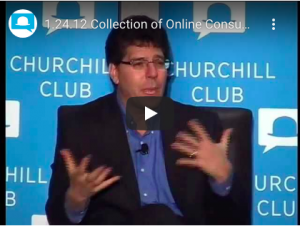
Jules Polonetsky moderated a panel called “The Collection of Online Consumer Data: The Good, The Bad, and The Unknown.” The panel discussed multiple privacy related issues including the manner in which companies use data and protecting consumer data through privacy measures.
FPF is pleased to announce that FPF Senior Fellow and visiting law professor at Berkeley, Omer Tene, and FPF Co-Chair and Director Jules Polonetsky’s article, “Privacy in the Age of Big Data: A Time for Big Decisions” has been published in the Stanford Law Review (SLR) Online. In the Internet age, big data mining use is a growing field that is proving to be a new source for massive economic and social value. Advances in data mining use are making it possible to discover relationships amidst large data sets, yielding patterns, trends, and accurate and timely predictions. This suggests that we are on the cusp of considerable innovation, productivity, efficiency, and growth. At the same time, there are privacy and security concerns associated with big data which could stir a regulatory backlash stifling economic growth and innovation in the process. In their paper, they call for the development of a model where the benefits of data for businesses and researchers are balanced against individual privacy rights.
FPF Senior Fellow Peter Swire’s paper, “A Reasonableness Approach to Searches After the Jones GPS Tracking Case” was also recently published on SLR Online.
FPF senior fellows Peter Swire and Omer Tene will be speaking at the annual 2012 Stanford Law Review Symposium titled “The Privacy Paradox: Privacy and its Conflicting Values.” The event will take place at Stanford Law School and will begin Thursday evening with an interactive talk on military technologies and its different civilian uses. On Friday, there will be panels on the different values of privacy. The symposium will close with a keynote on Friday evening. For more information on the event, please click here.
Today, Christopher Wolf testified before The Judiciary Subcommittee on Privacy, Technology and the Law, chaired by Senator Al Franken (D-Minn.). The hearing, titled “The Video Privacy Protection Act: Protecting Viewer Privacy in the 21st Century,” examined the Video Privacy Protection Act of 1988. The act protects people’s right to control personal information about the movies and videos they rent and watch. However, the applicability of the act is being questioned given the new popularity of and desire to share personal information online via social networks. Chris’ spoken testimony follows and his written testimony can be viewed here. To see video from the hearing, click here.
“Chairman Franken, Ranking Member Coburn, and distinguished members of the Subcommittee. Thank you for the opportunity to testify today.
My name is Christopher Wolf and I am a privacy lawyer at Hogan Lovells, where I lead that firm’s global privacy practice. I am also a privacy advocate. As part of my pro bono work, I won a leading case against the government for violating the Electronic Communications Privacy Act. I am part of a group advising the OECD on its privacy guidelines. I am on the EPIC Advisory Board. And I founded and co-chair the Future of Privacy Forum, a think tank with an Advisory Board from business, consumer advocacy, and academia, focused on practical ways to advance privacy.
Fundamentally, privacy is about control. Indeed, a principal goal of privacy law is to put choices and decisions in the hands of informed consumers.
With the advent of video streaming and social sharing, the Video Privacy Protection Act (VPPA) today stands in the way of consumers exercising control, and thus limits their choices and even limits their free expression. The VPPA, enacted nearly a quarter of a century ago during the Betamax era, was designed to prevent prying into people’s video rental history.
The purpose of the law was not to stop people from sharing information about the videos they watched or to dictate how they share. Indeed, the law’s laudable purpose was to give control and choice to consumers, to let the consumers decide whether and how to share their video-watching information.
In 1988, when the VPPA was enacted, no one dreamed of streaming video and social sharing. So, when that pre-Internet-era law is applied to the world of online video and social media, it can be read to frustrate the choices of consumers to authorize the disclosure, on an ongoing basis, of the streaming movies they have watched online.
For many people, automatic sharing on social media is how they shape their online identities and share ideas. Facebook users commonly utilize a one-time authorization to share a wide range of information – a durable sharing option — with their friends. But when it comes to sharing their online video experiences, the law gets in the way.
Take a person who is an avid online video watcher, watching 100 short videos per week. She wants to share every video that she watches with her friends, just as she shares every song she listens to on the streaming music service Spotify, and just as she shares every item she reads online on the Washington Post through a Facebook social sharing app. But current law suggests she is not fit to make the frictionless sharing decision with respect to the videos she watches.
Should this videophile have to opt in 100 times per week? Does making her do so serve any purpose other than to annoy her and to take needless time? The constant, legally-required interruption to her online experience harkens back to the day when pop-ups had to be clicked just to proceed online. Our frequent video viewer should be given the opt-in choice to share all of her viewing experience, if that is what she wants.
In contrast to the restrictions of the VPPA, there are no legal restrictions on her ability to socially share every e-book she reads. Through a durable sharing option, she easily can share the fact she read the e-book entitled The Girl With The Dragon Tattoo. But the law stands in the way of her similarly sharing the fact that she watched the movie entitled The Girl With The Dragon Tattoo. That makes no sense.
Of course, not everyone wants to share their viewing experiences with their friends online, and they don’t have to share. And if someone prefers to share their video watching experiences on a case-by-case basis, he or she can do so manually, just as people occasionally post news stories they read in the Washington Post on Facebook rather than choosing the automatic sharing option. Similarly, a person who chooses to share on a continuous basis can disable the share function before watching a streaming video that he or she wants to exclude from online posting.
In order to clarify the uncertainty of the language in the VPPA on disclosures, I support an amendment such as HR 2471 allowing a durable sharing choice for consumers, which in turn will permit frictionless social sharing. I agree that, as a privacy best practice, the durable choice option should be opt in, and presented prominently, separate and distinct from the general privacy policy and terms of use of an online service. I join the Center for Democracy and Technology in concluding that such an amendment will not undermine the fundamental purpose of the VPPA.
Even though some Senators personally may feel that sharing all the movies one watches is – to use a phrase not heard much anymore – TMI, or “too much information” – people should, as a matter of free expression, be able to share as they choose. And companies should not face legal penalties for providing them with that choice.
As governments around the world, including our own, consider ways to improve their privacy frameworks, there are big decisions to be made. Starting a legislative process in the name of privacy protection, through which lawmakers decide — case-by-case – what information and by what means consumers can share online, seems terribly ill-advised. In contrast, amendment of the VPPA to permit full user choice and control fits squarely within the preferred privacy framework, one that empowers consumers.
Thank you for the opportunity to appear before you today.”
To read Chris and Jules’ opinion piece on video sharing that ran in Roll Call, please click here.