I have been following the privacy concerns raised about Google Plus with interest and some skepticism. I can’t quite figure out where exactly data is being used in a way that would create an issue. I have two monitors on my desk, one on my left with my Google Plus circles displayed and one in front of me with the Google Search home page. On my left, I search for New Hampshire primary results on Google Plus and I see posts that are public and posts from folks who have me in their Circles. On my right, I search on Google for New Hampshire primary and see the usual Google Search results. The new Google Plus Social Search in effect combines these two screens. If I am logged in to Google Plus when I search on Google Search, my personal results will include links to posts available to me in my Google Plus network.
Nothing previously private becomes public and nothing previously public but obscure becomes more visible than before. Isn’t this precisely the way search should become more useful to me, leveraging data without exposing it in some unexpected way?
-Jules Polonetsky
12 pm Webinar: Recapping FPF's "Personal Information: The Benefits and Risks of De-Identification" Event
Please join Jules Polonetsky and Professor Khaled El Emam, Associate Professor, Faculty of Medicine and Canada Research Chair in Electronic Health Information, University of Ottawa, for a 12 pm Eastern webinar. Polonetsky and Professor El Emam will discuss highlights from FPF’s December 5, 2011 event on personal information and provide an analysis of the conference. Please click here to join the webinar.
To see complete panel videos from the day, please click here.
Jan. 12, 2012 – Seven tips for protecting personal data online, The Globe and Mail
Think protecting customer privacy is only an issue for business giants such as Facebook and Sony? Think again.
Many small companies have lost customer trust or even been sued over privacy mishaps in recent years. And they’re likely to face more problems as digital data files grow in size and importance.
Jan. 11, 2012 – The Circuit: FCC at CES, gadget privacy, Google’s social search, Washington Post
LEADING THE DAY: Today is a big policy day at CES, with panels addressing a range of technology policy issues. Federal Communications Chairman Julius Genachowski is also speaking today with the Consumer Electronics Association president, Gary Shapiro
Jan. 5, 2012 – Even Without Legislation, Privacy Will Be a Hot Issue in 2012, National Journal
While few expect Congress to pass broad privacy legislation, privacy will still get a lot of attention in 2012, starting with the release in the coming weeks of two highly anticipated federal reports providing guidance on protecting consumer privacy online.
FPF Comments on Proposed COPPA Rule
FPF submitted comments to the FTC on proposed amendments to the Children’s Online Privacy Protection Act. FPF commends the FTC’s commitment to protect the privacy of children in a rapidly developing online marketplace. FPF’s comments focus on amendments affecting those areas that correspond with the organization’s specific expertise and experience, namely: (I) The proposal to modify the definition of “personal information”; (II) the proposed revisions directed to protecting the security, confidentiality and integrity of information collected from children; (III) geolocation issues; (IV) apps and platform issues; and (V) new parental consent mechanisms.
Dec. 21, 2011 – Facebook To Notify Europeans On Facial Recognition, Investors.com
Amid concerns about user privacy in Europe and beyond, Facebook on Wednesday announced sweeping changes to its European data collection, including notifications on a controversial facial recognition feature. Along with having to notify European users three times about its opt-out facial recognition feature, Facebook will disclose “all personal data held (about users) on request,” says Ireland’s
Privacy Ins and Outs
De-identification Workshop Videos
Opening Presentation:
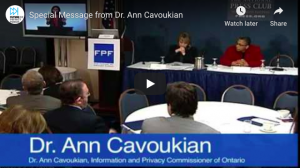
Special Message from Dr. Ann Cavoukian
Panel 1:
Panel 2:
Panel 3:
Keynote Luncheon:
Panel 4:
Panel 5:
FPF & CDT Release Best Practices for Mobile App Developers
Today, the Future of Privacy Forum and the Center for Democracy & Technology publicly released a beta version of their “Best Practices for Mobile Applications Developers.” We have been working on this guidance over the past year in consultation with stakeholders from industry and civil society, both in the United States and abroad. We hope that this document can serve as a primer for developers who are interested in preserving their customers’ privacy but who aren’t necessarily privacy experts themselves.
We started on this project because of heightened privacy issues in the mobile environment. Application developers can access a considerably broader range of information about users than traditional web developers. Last year, the Wall Street Journal reported that of the top 101 apps, most were transmitting personal information about users, such as unique device identifiers, age, gender, and precise geo-location information to third parties. Research from the Future of Privacy Forum has shown that even in the most popular applications, less than half have privacy policies detailing what they do with customer data.
The best practices are based on long-established privacy principles that we believe should apply to everyone who collects and processes individual information, not just mobile developers. Among the recommendations that we make to developers are:
Be completely transparent about how you are using or transmitting customer data
Don’t access more data than you need, and get rid of old data
Give your customers control over uses that users might not expect
Use reasonable and up-to-date security protocols to safeguard data
As the app developer, you need to be responsible for thinking about privacy, and taking privacy into consideration during the various stages of your app life cycle
This is not a final pronouncement on our view as to what app developer best practices are. We’re soliciting public comment on this draft — if you have feedback, please send your thoughts to [email protected]
Also, check out the survey we released yesterday finding that Free Mobile Apps are Better than Paid on Privacy Policies.