Manipulative UX Design & the Role of Regulation: Event Highlights
On March 24, the FPF hosted “Dark Patterns:” Manipulative UX Design and the Role of Regulation. So-called “dark patterns” are user interface design choices that benefit an online service by coercing, manipulative, or deceiving users into making unintended or potentially harmful decisions. The event provided a critical examination of the ways in which manipulative interfaces can limit consumer choice and explored how regulation of manipulative designs continues to expand – from California’s recent Attorney General regulations, to the California Privacy Rights Act, to other state and federal privacy bills. Participants also discussed whether truly neutral design is ever possible, and the differences between acceptable persuasion (such as in advertising) and manipulation, coercion, and deception.
The event, moderated by FPF Senior Counsel Stacey Gray, began with a survey of legislative proposals that would regulate manipulative user interface design choices. Stacey highlighted several prominent state privacy laws, including the California Consumer Privacy Act (CCPA) and California Privacy Rights Act (CPRA), which define and address dark patterns in certain contexts, such as in the California Attorney General’s regulations for the design of “opt-out of sale” mechanisms for personal data collection and use. Gray also addressed relevant legislative proposals at the state and federal level – the Washington Privacy Act (SB 5062), CA SB 980, and the SAFE DATA Act (S. 4626) – that explicitly define or create regulations around manipulative design choices. Finally, Gray explained that manipulative design is an “ongoing focus” of the Federal Trade Commission, citing past enforcement actions related to manipulative user interface design choices and referencing the FTC’s upcoming April 29 workshop, “Bringing Dark Patterns to Light.”
Dr. Jennifer King, Privacy and Data Policy Fellow at the Stanford Institute for Human-Centered Artificial Intelligence, provided the keynote presentation, which defined dark patterns, the contexts they target, how they work, types of dark patterns, examples, and key thoughts for policymakers and regulators. Specifically, Dr. King recommended that lawmakers consider the following questions:
Is current FTC section 5 authority enough to address dark patterns generally? Or is expanded authority necessary?
How do we evaluate and measure dark patterns, and who should do this type of work?
Identifying the “dark” vs. the “gray”: what defines the line between permissible persuasion and manipulation or coercion?
Are neutral designs a realistic and enforceable option, particularly at decision points, such as opt-in or opt-outs?
What are the implications for Privacy by Design? How is success in privacy measured?
How does the CPRA’s “effect” standard differ from a potential “intent” standard? Which standard is more measurable and enforceable?
Following Dr. King’s address, the event moved to a panel discussion with Mihir Kshirsagar, Clinic Lead for Princeton’s Center for Information Technology Policy, Tanya Forsheit, Chair of the Privacy & Data Security Group at Frankfurt Kurnit Klein + Selz, as well as Gray and Dr. King. Together, the panel considered manipulative design from legal, policy, and technology perspectives, providing insightful answers to questions from the audience.
Gray closed the event by noting that manipulative design will continue to be a focus for FPF, previewing future convenings on manipulative design under EU and global law and in specific contexts, such as in online products and services for children and teens.
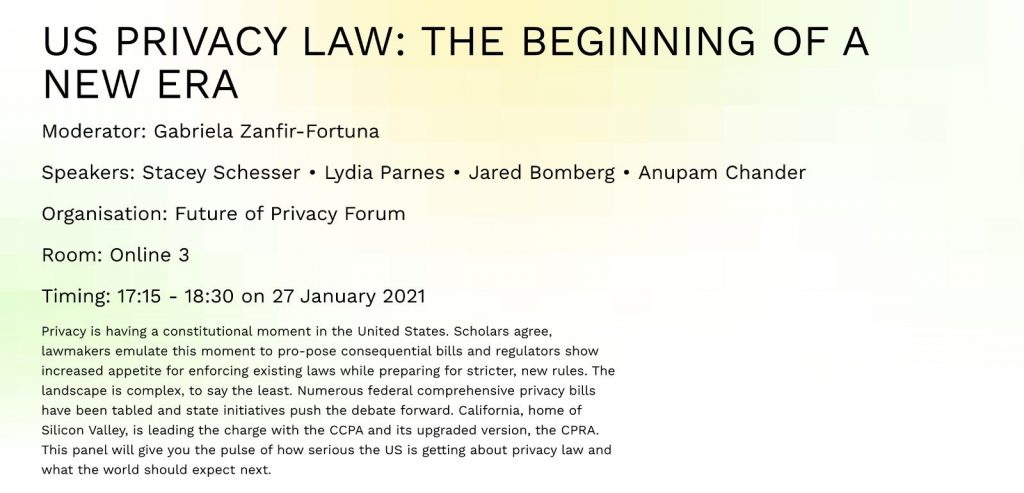
FPF Hosted a CPDP 2021 Panel on US Privacy Law: The Beginning of a New Era
By Srivats Shankar, FPF Legal Intern
For the 14th annual Computers, Privacy and Data Protection conference, which took place between 27 and 29 January, 2021, FPF hosted a panel of experts to discuss “US Privacy Law: The Beginning of a New Era”, whose recording has just been published. The panel was moderated by Dr. Gabriela Zanfir-Fortuna, who was joined by Anupam Chander, Professor of Law at Georgetown University; Jared Bomberg, Senior Counsel for the Senate Committee on Commerce, Science and Transportation; Stacey Schesser, Office of California Attorney General; and Lydia Parnes, Partner at Wilson Sonsini’s Privacy and Cybersecurity Practice.
Broadly, the panel discussed the events that have prompted the shift towards privacy protection in the US in recent years, including the latest privacy law initiatives at the state and federal level. The discussion addressed how regulators are enforcing current laws and preparing for what’s to come, and how these developments may strengthen the Trans-Atlantic relationship in the digital age.
Professor Anupam Chander discussed the most consequential developments in US privacy law in recent years, which he identified as the passage of the California Consumer Privacy Act (CCPA) in 2018, the Supreme Court decision ofCarpenter v. US, and the passage of theConsumer Privacy Rights Act (CPRA) in 2020. According to Professor Chander, these developments will define the law of privacy over the next decade.
Jared Bomberg discussed developments at the federal level in the United States, including the increasing focus by Congress on a comprehensive consumer privacy legislation. In the Senate, the two leading proposals are the Consumer Online Privacy Rights Act (COPRA), led by Senator Cantwell (D-WA) and the SAFE DATA Act, led by Senator Wicker (R-MS). Both bills have many cosponsors. Among these and other privacy bills, there is commonality regarding the right of access, correction, deletion, and portability. Meanwhile, key differences include the existence of a private right of action, the extent to which a federal law would preempt state laws, and the incorporation of fiduciary responsibilities.
Stacey Schesser discussed the privacy law in California, including the enactment of the CCPA and the response of companies to the law. Following the passage of the GDPR, many companies have come to support compliance with the CCPA. California, by virtue of its large population and major economy, has required many businesses across the United States to come into compliance with the CCPA. Schesser notes that they have seen consumer frustration with opt-out mechanisms and deletion of personal information, alongside challenges with companies interpreting the law in different ways. However, she noted that many companies have complied with the CCPA within the 30 day notice and cure period after being notified of a violation. The initial rollout of Attorney General regulations have attempted to identify the scope of enforcement especially with reference to unique problems such as dark patterns.
Lydia Parnes discussed the enforcement of privacy law in the US. She observed that the Federal Trade Commission (FTC) has been fairly aggressive in exercising its enforcement powers. Commissioner Slaughter who became Acting Chairwoman has promoted the usage of civil penalties in privacy rights cases. These enforcement actions have become “baseline norms” for companies to follow. They don’t just affect the individual company but the industry at large. Parnes noted that the FTC has limited resources and enforcement by state agencies would be an effective way to facilitate change.
In the Q&A session, attendees raised issues of global interoperability, agency enforcement, and competition. Professor Anupam Chander emphasized the importance of the Schrems II decision, and the need for the US and Europe to come to another “modus vivendi.” This could be established without a “national” policy on privacy, to protect the information of foreign individuals whose data may be stored in the United States.
In response to a question about enforcement, Jared Bomberg emphasized that agencies like the FTC need more resources and that there is some acceptance that the FTC should continue enforcement in its existing fashion. He further noted that the Attorney General could also supplement and collaborate on enforcement. Bomberg also stressed the need for a private right of action. Market constraints also play a role in limiting the ability of the customer to protect their rights, and the current lack of transparency with the power dynamic has created a situation where customers do not understand what they have signed up for.
In closing, the panelists received a question on the likelihood of seeing a federal privacy law in the next two years. The consensus as Jared put it was that it could be “100% and 0%.”
Watch the full recording of the panel by following this link.
The right to be forgotten is not compatible with the Brazilian Constitution. Or is it?
The Brazilian Supreme Federal Court, or “STF” in its Brazilian acronym, recently took a landmark decision concerning the right to be forgotten (RTBF), finding that it is incompatible with the Brazilian Constitution. This attracted international attention to Brazil for a topic quite distant than the sadly frequent environmental, health, and political crises.
Readers should be warned that while reading this piece they might experience disappointment, perhaps even frustration, then renewed interest and curiosity and finally – and hopefully – an increased open-mindedness, understanding a new facet of the RTBF debate, and how this is playing out at constitutional level in Brazil.
This might happen because although the STF relies on the “RTBF” label, the content behind such label is quite different from what one might expect after following the same debate in Europe. From a comparative law perspective, this landmark judgment tellingly shows how similar constitutional rights play out in different legal cultures and may lead to heterogeneous outcomes based on the constitutional frameworks of reference.
How it started: insolvency seasoned with personal data
As it is well-known, the first global debate on what it means to be “forgotten” in the digital environment arose in Europe, thanks to Mario Costeja Gonzalez, a Spaniard who, paradoxically, will never be forgotten by anyone due to his key role in the construction of the RTBF.
Costeja famously requested to deindex from Google Search information about himself that he considered to be no longer relevant. Indeed, when anyone “googled” his name, the search engine provided as the top results some link to articles reporting Costeja’s past insolvency as a debtor. Costeja argued that, despite having been convicted for insolvency, he had already paid his debt with Justice and society many years before and it was therefore unfair that his name would continue to be associated ad aeternum with a mistake he made in the past.
The follow up is well known in data protection circles. The case reached the Court of Justice of the European Union (CJEU), which, in its landmark Google Spain Judgment (C-131/12), established that search engines shall be considered as data controllers and, therefore, they have an obligation to de-index information that is inappropriate, excessive, not relevant, or no longer relevant, when a data subject to whom such data refer requests it. Such an obligation was a consequence of Article 12.b of Directive 95/46 on the protection of personal data, a pre-GDPR provision that set the basis for the European conception of the RTBF, providing for the “rectification, erasure or blocking of data the processing of which does not comply with the provisions of [the] Directive, in particular because of the incomplete or inaccurate nature of the data.”
The indirect consequence of this historic decision, and the debate it generated, is that we have all come to consider the RTBF in the terms set by the CJEU. However, what is essential to emphasize is that the CJEU approach is only one possible conception and, importantly, it was possible because of the specific characteristics of the EU legal and institutional framework. We have come to think that RTBF means the establishment of a mechanism like the one resulting from the Google Spain case, but this is the result of a particular conception of the RTBF and of how this particular conception should – or could – be implemented.
The fact that the RTBF has been predominantly analyzed and discussed through the European lenses does not mean that this is the only possible perspective, nor that this approach is necessary the best. In fact, the Brazilian conception of the RTBF is remarkably different from a conceptual, constitutional, and institutional standpoint. The main concern of the Brazilian RTBF is not how a data controller might process personal data (this is the part where frustration and disappointment might likely arise in the reader) but the STF itself leaves the door open to such possibility (this is the point where renewed interest and curiosity may arise).
The Brazilian conception of the right to be forgotten
Although the RTBF has acquired a fundamental relevance in digital policy circles, it is important to emphasize that, until recently, Brazilian jurisprudence had mainly focused on the juridical need for “forgetting” only in the analogue sphere. Indeed, before the CJEU Google Spain decision, the Brazilian Supreme Court of Justice or “STJ” – the other Brazilian Supreme Court that deals with the interpretation of the Law, differently from the previously mentioned STF, which deals with the interpretation of constitutional matters – had already considered the RTBF as a right not to be remembered, affirmed by the individual vis-à-vis traditional media outlets.
This interpretation first emerged in the “Candelaria massacre” case, a gloomy page of Brazilian history, featuring a multiple homicide perpetrated in 1993 in front of the Candelaria Church, a beautiful colonial Baroque building in Rio de Janeiro’s downtown. The gravity and the particularly picturesque stage of the massacre led Globo TV, a leading Brazilian broadcaster, to feature the massacre in a TV show called Linha Direta. Importantly, the show included in the narration some details about a man suspected of being one of the perpetrators of the massacre but later discharged.
Understandably, the man filed a complaint arguing that the inclusion of his personal information in the TV show was causing him severe emotional distress, while also reviving suspects against him, for a crime he had already been discharged of many years before. In September 2013, further to Special Appeal No. 1,334,097, the STJ agreed with the plaintiff establishing the man’s “right not to be remembered against his will, specifically with regard to discrediting facts.” This is how the RTBF was born in Brazil.
Importantly for our present discussion, this interpretation is not born out of digital technology and does not impinge upon the delisting of specific type of information as results of search engine queries. In Brazilian jurisprudence the RTBF has been conceived as a general right to effectively limit the publication of certain information. The man included in the Globo reportage had been discharged many years before, hence he had a right to be “let alone,” as Warren and Brandeis would argue, and not to be remembered for something he had not even committed. The STJ, therefore, constructed its vision of the RTBF, based on article 5.X of the Brazilian Constitution, enshrining the fundamental right to intimacy and preservation of image, two fundamental features of privacy.
Hence, although they utilize the same label, the STJ and CJEU conceptualize two remarkably different rights, when they refer to the RTBF. While both conceptions aim at limiting access to specific types of personal information, the Brazilian conception differs from the EU one on at least three different levels.
First, their constitutional foundations. While both conceptions are intimately intertwined with individuals’ informational self-determination, the STJ built the RTBF based on the protection of privacy, honour and image, whereas the CJEU built it upon the fundamental right to data protection, which in the EU framework is a standalone fundamental right. Conspicuously, in the Brazilian constitutional framework an explicit right to data protection did not exist at the time of the Candelaria case and only since 2020 it has been in the process of being recognized.
Secondly, and consequently, the original goal of the Brazilian conception of the RTBF was not to regulate how a controller should process personal data but rather to protect the private sphere of the individual. In this perspective, the goal of STJ was not – and could not have been – to regulate the deindexation of specific incorrect or outdated information, but rather to regulate the deletion of “discrediting facts” so that the private life, honour and image of any individual might be illegitimately violated.
Finally, yet extremely importantly, the fact that, at the time of the decision, an institutional framework dedicated to data protection was simply absent in Brazil did not allow the STJ to have the same leeway of the CJEU. The EU Justices enjoyed the privilege of delegating to search engine the implementation of the RTBF because, such implementation would have received guidance and would have been subject to the review of a well-consolidated system of European Data Protection Authorities. At the EU level, DPAs are expected to guarantee a harmonious and consistent interpretation and application of data protection law. At the Brazilian level, a DPA has just been established in late 2020 and announced its first regulatory agenda only in late January 2021.
This latter point is far from trivial and, in the opinion of this author, an essential preoccupation that might have driven the subsequent RTBF conceptualization of the STJ.
The stress-test
The soundness of the Brazilian definition of the RTBF, however, was going to be tested again by the STJ, in the context of another grim and unfortunate page of Brazilian story, the Aida Curi case. This case originated with the sexual assault and subsequent homicide of the young Aida Curi, in Copacabana, Rio de Janeiro, on the evening of 14 July 1958. At the time the case crystallized considerable media attention, not only because of its mysterious circumstances and the young age of the victim, but also because the sexual assault perpetrators tried to dissimulate it by throwing the body of the victim from the rooftop of a very high building on the Avenida Atlantica, the fancy avenue right in front of the Copacabana beach.
Needless to say, Globo TV considered the case as a perfect story for yet another Linha Direta episode. Aida Curi’s relatives, far from enjoying the TV show, sued the broadcaster for moral damages and demanded the full enjoyment of their RTBF – in the Brazilian conception, of course. According to the plaintiffs, it was indeed not conceivable that, almost 50 years after the murder, Globo TV could publicly broadcast personal information about the victim – and her family – including the victim’s name and address, in addition to unauthorized images, thus bringing back a long-closed and extremely traumatic set of events.
The brothers of Aida Curi claimed reparation against Rede Globo, but the STJ, decided that the time passed was enough to mitigate the effects of anguish and pain on the dignity of Aida Curi’s relatives, while arguing that it was impossible to report the events without mentioning the victim. This decision was appealed by Ms Curi’s family members, who demanded by means of Extraordinary Appeal No. 1,010,606, that STF recognized “their right to forget the tragedy.” It is interesting to note that the way the demand is constructed in this Appeal exemplifies tellingly the Brazilian conception of “forgetting” as erasure and prohibition from divulgation.
At this point, the STF identified in the Appeal the interest of debating the issue “with general repercussion” which is a peculiar judicial process that the Court can utilize when recognizes that a given case has particular relevance and transcendence for the Brazilian legal and judicial system. Indeed, the decision of a case with general repercussion does not only bind the parties but rather establishes a jurisprudence that must be replicated by all lower-level courts.
In February 2021, the STF finally deliberated on the Aida Curi case, establishing that “the idea of a right to be forgotten is incompatible with the Constitution, thus understood as the power to prevent, due to the passage of time, the disclosure of facts or data that are true and lawfully obtained and published in analogue or digital media” and that “any excesses or abuses in the exercise of freedom of expression and information must be analyzed on a case-by-case basis, based on constitutional parameters – especially those relating to the protection of honor, image, privacy and personality in general – and the explicit and specific legal provisions existing in the criminal and civil spheres.”
In other words, what the STF has deemed as incompatible with the Federal Constitution is a specific interpretation of the Brazilian version of the RTBF. What is not compatible with the Constitution is to argue that the RTBF allows to prohibit publishing true facts, lawfully obtained. At the same time, however, the STF clearly states that it remains possible for any Court of law to evaluate, on a case-by-case basis and according to constitutional parameters and existing legal provisions, if a specific episode can allow the use of the RTBF to prohibit the divulgation of information that undermine the dignity, honour, privacy, or other fundamental interests of the individual.
Hence, while explicitly prohibiting the use of the RTBF as a general right to censorship, the STF leaves room for the use of the RTBF for delisting specific personal data in an EU-like fashion, while specifying that this must be done finding guidance in the Constitution and the Law.
What next?
Given the core differences between the Brazilian and EU conception of the RTBF, as highlighted above, it is understandable in the opinion of this author that the STF adopted a less proactive and more conservative approach. This must be especially considered in light of the very recent establishment of a data protection institutional system in Brazil.
It is understandable that the STF might have preferred to de facto delegate the interpretation of when and how the RTBF could be rightfully invoked before Courts, according to constitutional and legal parameters. First, in the Brazilian interpretation of the RTBF, this right fundamentally insist on the protection of privacy – i.e. the private sphere of an individual – and, while admitting the existence of data protection concerns, these are not the main ground on which the Brazilian RTBF conception relays.
It is understandable that in a country and a region where the social need to remember and shed light on what happened in a recent history, marked by dictatorships, well-hidden atrocities, and opacity, outweighs the legitimate individual interest to prohibit the circulation of truthful and legally obtained information. In the digital sphere, however, the RTBF quintessentially translates into an extension of informational self-determination, which the Brazilian General Data Protection Law, better known as “LGPD” (Law No. 13.709 / 2018), enshrines in its article 2 as one of the “foundations” of data protection in the country and that whose fundamental character was recently recognized by the STF itself.
In this perspective, it is useful to remind the dissenting opinion of Justice Luiz Edson Fachin, in the Aida Curi case, stressing that “although it does not expressly name it, the Constitution of the Republic, in its text, contains the pillars of the right to be forgotten, as it celebrates the dignity of the human person (article 1, III), the right to privacy (article 5, X) and the right to informational self-determination – which was recognized, for example, in the disposal of the precautionary measures of the Direct Unconstitutionality Actions No. 6,387, 6,388, 6,389, 6,390 and 6,393, under the rapporteurship of Justice Rosa Weber (article 5, XII).”
It is the opinion of this author that the Brazilian debate on the RTBF in the digital sphere would be clearer if it its dimension as a right to deindexation of search engines results were to be clearly regulated. It is understandable that the STF did not dare regulating this, given its interpretation of the RTBF and the very embryonic data protection institutional framework in Brazil. However, given the increasing datafication we are currently witnessing, it would be naïve not to expect that further RTBF claims concerning the digital environment and, specifically, the way search engines process personal data will keep emerging.
The fact that the STF has left the door open to apply the RTBF in the case-by-case analysis of individual claims may reassure the reader regarding the primacy of constitutional and legal arguments in such case-by-case analysis. It may also lead the reader to – very legitimately – wonder whether such a choice is the facto the most efficient to deal with the potentially enormous number of claims and in the most coherent way, given the margin of appreciation and interpretation that each different Court may have.
An informed debate able to clearly highlight what are the existing options and what might be the most efficient and just ways to implement them, considering the Brazilian context, would be beneficial. This will likely be one of the goals of the upcoming Latin American edition of the Computers, Privacy and Data Protection conference (CPDP LatAm) that will take place in July, entirely online, and will aim at exploring the most pressing issues for Latin American countries regarding privacy and data protection.
If you have any questions about engaging with The Future of Privacy Forum on Global Privacy and Digital Policymaking contact Dr. Gabriela Zanfir-Fortuna, Senior Counsel, at [email protected].
FPF announces appointment of Malavika Raghavan as Senior Fellow for India
The Future of Privacy Forum announces the appointment of Malavika Raghavan as Senior Fellow for India, expanding our Global Privacy team to one of the key jurisdictions for the future of privacy and data protection law.
Malavika is a thought leader and a lawyer working on interdisciplinary research, focusing on the impacts of digitisation on the lives of lower-income individuals. Her work since 2016 has focused on the regulation and use of personal data in service delivery by the Indian State and private sector actors. She has founded and led the Future of Finance Initiative for Dvara Research (an Indian think tank) in partnership with the Gates Foundation from 2016 until 2020, anchoring its research agenda and policy advocacy on emerging issues at the intersection of technology, finance and inclusion. Research that she led at Dvara Research was cited by the India’s Data Protection Committee in its White Paper as well as its final report with proposals for India’s draft Personal Data Protection Bill, with specific reliance placed on such research on aspects of regulatory design and enforcement. See Malavika’s full bio here.
“We are delighted to welcome Malavika to our Global Privacy team. For the following year, she will be our adviser to understand the most significant developments in privacy and data protection in India, from following the debate and legislative process of the Data Protection Bill and the processing of non-personal data initiatives, to understanding the consequences of the publication of the new IT Guidelines. India is one of the most interesting jurisdictions to follow in the world, for many reasons: the innovative thinking on data protection regulation, the potentially groundbreaking regulation of non-personal data and the outstanding number of individuals whose privacy and data protection rights will be envisaged by these developments, which will test the power structures of digital regulation and safeguarding fundamental rights in this new era”, said Dr. Gabriela Zanfir-Fortuna, Global Privacy lead at FPF.
We have asked Malavika to share her thoughts for FPF’s blog on what are the most significant developments in privacy and digital regulation in India and about India’s role in the global privacy and digital regulation debate.
FPF: What are some of the most significant developments in the past couple of years in India in terms of data protection, privacy, digital regulation?
Malavika Raghavan: “Undoubtedly, the turning point for the privacy debate India was the 2017 judgement of the Indian Supreme Court in Justice KS Puttaswamy v Union of India. The judgment affirmed the right to privacy as a constitutional guarantee, protected by Part III (Fundamental Rights) of the Indian Constitution. It was also regenerative, bringing our constitutional jurisprudence into the 21st century by re-interpreting timeless principles for the digital age, and casting privacy as a prerequisite for accessing other rights—including the right to life and liberty, to freedom of expression and to equality—given the ubiquitous digitisation of human experience we are witnessing today.
Overnight, Puttaswamy also re-balanced conversations in favour of privacy safeguards to make these equal priorities for builders of digital systems, rather than framing these issues as obstacles to innovation and efficiency. In addition, it challenged the narrative that privacy is an elite construct that only wealthy or privileged people deserve— since many litigants in the original case that had created the Puttaswamy reference were from marginalised groups. Since then, a string of interesting developments have arisen as new cases are reassessing the impact of digital technology on individuals in India, for e.g. the boundaries case of private sector data sharing (such as between Whatsapp and Facebook), or the State’s use of personal data (as in the case concerning Aadhaar, our national identification system) among others.
Puttaswamy also provided fillip for a big legislative development, which is the creation of an omnibus data protection law in India. A bill to create this framework was proposed by a Committee of Experts under the chairmanship of Justice Srikrishna (an ex-Supreme Court judge), which has been making its way through ministerial and Parliamentary processes. There’s a large possibility that this law will be passed by the Indian parliament in 2021! Definitely a big development to watch.
FPF: How do you see India’s role in the global privacy and digital regulation debate?
Malavika Raghavan: “India’s strategy on privacy and digital regulation will undoubtedly have global impact, given that India is home to 1/7th of the world’s population! The mobile internet revolution has created a huge impact on our society with millions getting access to digital services in the last couple of decades. This has created nuanced mental models and social norms around digital technologies that are slowly being documented through research and analysis.
The challenge for policy makers is to create regulations that match these expectations and the realities of Indian users to achieve reasonable, fair regulations. As we have already seen from sectoral regulations (such as those from our Central Bank around cross border payments data flows) such regulations also have huge consequences for global firms interacting with Indian users and their personal data.
In this context, I think India can have the late-mover advantage in some ways when it comes to digital regulation. If we play our cards right, we can take the best lessons from the experience of other countries in the last few decades and eschew the missteps. More pragmatically, it seems inevitable that India’s approach to privacy and digital regulation will also be strongly influenced by the Government’s economic, geopolitical and national security agenda (both internationally and domestically).
One thing is for certain: there is no path-dependence. Our legislators and courts are thinking in unique and unexpected ways that are indeed likely to result in a fourth way (as described by the Srikrishna Data Protection Committee’s final report), compared to the approach in the US, EU and China.”
If you have any questions about engaging with The Future of Privacy Forum on Global Privacy and Digital Policymaking contact Dr. Gabriela Zanfir-Fortuna, Senior Counsel, at [email protected].
India: Massive overhaul of digital regulation, with strict rules for take-down of illegal content and Automated scanning of online content
On February 25, the Indian Government notified and published Information Technology (Guidelines for Intermediaries and Digital media Ethics Code) Rules 2021. These rules mirror the Digital Services Act (DSA) proposal of the EU to some extent, since they propose a tiered approach based on the scale of the platform, they touch on intermediary liability, content moderation, take-down of illegal content from online platforms, as well as internal accountability and oversight mechanisms, but they go beyond such rules by adding a Code of Ethics for digital media, similar to the Code of Ethics classic journalistic outlets must follow, and by proposing an “online content” labelling scheme for content that is safe for children.
The Code of Ethics applies to online news publishers, as well as intermediaries that “enable the transmission of news and current affairs”. This part of the Guidelines (the Code of Ethics) has already been challenged in the Delhi High Court by news publishers this week.
The Guidelines have raised several types of concerns in India, from their impact on freedom of expression, impact on the right to privacy through the automated scanning of content and the imposed traceability of even end-to-end encrypted messages so that the originator can be identified, to the choice of the Government to use executive action for such profound changes. The Government, through the two Ministries involved in the process, is scheduled to testify in the Standing Committee of Information Technology of the Parliament on March 15.
New obligations for intermediaries
“Intermediaries” include “websites, apps and portals of social media networks, media sharing websites, blogs, online discussion forums, and other such functionally similar intermediaries” (as defined in rule 2(1)(m)).
Here are some of the most important rules laid out in Part II of the Guidelines, dedicated to Due Diligence by Intermediaries:
All intermediaries, regardless of size or nature, will be under an obligation to “remove or disable access” as early as possible and no later than 36 hours of content subject to a Court order or an order of a Government agency (see rule 4(1)(d)).
All intermediaries will be under an obligation to inform users at least once per year about their content policies, which must at a minimum include rules such as not uploading, storing or sharing information that “belongs to another person and to which the user does not have any right”, “deceives or misleads the addressee about the origin of the message”, “is patently false and untrue” or “is harmful to minors” (see rules 4(1)(b) and (f)).
All intermediaries will have to provide information to authorities for the purpose of identity verification and for investigating and prosecuting offenses, within 72 hours of receiving an order from an authorised government agency (see rule 4(1)(j)).
All intermediaries will have to take all measures to remove or limit accesswithin 24 hours of receiving a complaint from a user, to any content that reveals nudity, amounts to sexual harassment, or represents a deep fake, and the content is transmitted with the intent to harass, intimidate, threaten or abuse an individual (see rule 4(1)(p)).
“Significant social media intermediaries” have enhanced obligations
“Significant social media intermediaries” are social media services with a number of users above a threshold which will be defined and notified by the Central Government. This concept is similar to the the DSA’s “Very Large Online Platform”, however the DSA includes clear criteria in the proposed act itself on how to identify a VLOP.
As for Significant Social Media Intermediaries” in India, they will have additional obligations (similar to how the DSA proposal in the EU scales obligations):
“Significant social media intermediaries” that provide messaging services will be under an obligation to identify the “first originator” of a message following a Court order or an order from a Competent Authority (see rule 5(2)). This provision raises significant concerns over end-to-end encryption and encryption backdoors.
They will have to appoint a Chief Compliance Officer for the purposes of complying with these rules and who will be liable for failing to ensure that the intermediary observes due diligence obligations; the CCO will have to hold an Indian passport and will have to be based in India;
They will have to appoint a Chief Grievance Officer, who also must be based in India.
Publish compliance reports every 6 months.
Deploy automated scanning to proactively identify all identical information to content removed following an order (under the 36 hours rule), as well as child sexual abuse and related content (see rule 5(4)).
Set up an internal mechanism for receiving complaints.
These “Guidelines” seem to have the legal effect of a statute, and they are being adopted through executive action to replace Guidelines adopted in 2011 by the Government, under powers conferred to it in the Information Technology Act 2000. The new Guidelines would enter into force immediately after publication in the Official Gazette (no information as to when publication is scheduled). The Code of Ethics would enter into force three months after the publication in the Official Gazette. As mentioned above, there are already some challenges in Court against part of these rules.
This analysis by Rahul Matthan, who raises questions with regard to “identifying the first originator” rule, arguing that it is likely the Indian Supreme Court would declare such a measure unconstitutional: “Traceability is Antithetical to Liberty”.
Another jurisdiction to keep your eyes on: Australia
Also note that, while the European Union is starting its heavy and slow legislative machine, by appointing Rapporteurs in the European Parliament and having first discussions on the DSA proposal in the relevant working group of the Council, another country is set to soon adopt digital content rules: Australia. The Government is currently considering an Online Safety Bill, which was open to public consultation until mid February and which would also include a “modernised online content scheme”, creating new classes of harmful online content, as well as take-down requirements for image-based abuse, cyber abuse and harmful content online, requiring removal within 24 hours of receiving a notice from the eSafety Commissioner.
If you have any questions about engaging with The Future of Privacy Forum on Global Privacy and Digital Policymaking contact Dr. Gabriela Zanfir-Fortuna, Senior Counsel, at [email protected].
FPF Testifies on Maryland Student Data Privacy Bill
Amelia Vance, Director of Youth and Education Privacy for FPF, recently testified before the Maryland House Ways and Means Committee on HB 1062. The legislation proposes several updates to the state’s Student Data Privacy Act, and an extension of the Maryland Student Data Privacy Council, which Vance was asked to serve on when it was created in 2019.
While Vance applauded many of the proposed updates in HB 1062, her testimony focused on two recommended amendments: clarifying how the bill defines Operator, and the scope of the Council’s recommendations.
Vance urged the Legislature to consider aligning the definition of Operator in the bill with the full definition as proposed by the Council, noting:
The Council’s definition was carefully crafted to ensure that companies have adequate notice that their products are subject to this law. Some companies are not aware that their tools are used in an educational context, such as general audience services used to assist special education students. HB 1062’s current definition could compel companies to either ban the use of their products by schools, or push companies to collect and link more identifiable user data to determine whether their product is used in Maryland schools.
Clarifying the definition of Operator would also ensure that it does not unintentionally apply to other entities such as education researchers, whose work is as crucial as ever as educators look to measure learning loss and other student challenges during the pandemic.
Finally, Vance noted that the original intent and scope of the Council is to provide expert recommendations on student privacy laws as they relate to edtech products and companies – not to schools. While the reporting requirements for County Boards outlined in HB 1062 could be useful, Vance cautioned that overly burdensome transparency requirements often end up making well-intended student privacy legislation ineffective or even counterproductive by overwhelming parents with information that doesn’t help them make educated decisions about their children’s privacy. She recommended specifically tasking the Council, whose mandate would be expanded by this legislation, to “provide expert recommendations on this topic [to] help ensure the right balance.”
Read Vance’s written testimony on HB1062here and watch the testimony here (add YouTube link teed up to the right time code). For more background on Maryland’s Student Data Privacy Council, statutorily created in 2019, click here.
Statement on Passage of the Virginia Consumer Data Protection Act
Statement by Future of Privacy Forum CEO Jules Polonetsky regarding the approval of the Virginia Consumer Data Protection Act:
“Today, Governor Ralph Northam signed the Virginia Consumer Data Protection Act (CDPA), making Virginia the second state, following California, to establish baseline legal protections for consumer privacy – a significant milestone in the United States.
The law will be the first in the country to require companies to obtain affirmative opt-in consent for processing sensitive data, such as health information, race, ethnicity, precise geolocation, and other sensitive categories, and the first to mandate formal Data Protection Assessments. It also provides for consumer rights of access, deletion, correction, portability, and opt-outs for profiling, targeted advertising, and sale. In the absence of a comprehensive federal privacy law, we are encouraged to see Virginia lawmakers and other states continue to establish and improve legal protections for personal information.”
FPF’s analysis of the Virginia law and comparison to other jurisdictions is available here.
Event Report: Brussels Privacy Symposium 2020 – Research and the Protection of Personal Data Under the GDPR
On December 2, 2020, the Future of Privacy Forum (FPF) and the Brussels Privacy Hub of Vrije Universiteit Brussel (VUB) hosted the Brussels Privacy Symposium 2020: Research and the protection of Personal Data Under the GDPR. The event, convened by FPF CEO Jules Polonetsky and Dr. Christopher Kuner, Co-Chair of the Brussels Privacy Hub, brought together industry privacy leaders, academic researchers, and regulators to discuss data protection in the context of scientific research under the European Union’s General Data Protection Regulation (GDPR) from various policy and technical perspectives. A new report from FPF’s Caroline Hopland, Hunter Dorwart, Dr. Gabriela Zanfir-Fortuna, and Dr. Rob van Eijk, as well as Associate Professor at the EDHEC Augmented Law Institute Dr. Gianclaudio Malgieri, summarizes and offers context to the discussions at the event.
The 2020 Brussels Privacy Symposium was the fourth-annual academic program jointly presented by VUB and FPF. Notably, the panelists emphasized risks and vulnerabilities with respect to data protection in the scientific research context, highlighting issues with consent structures, artificial intelligence (AI) and machine learning systems during the Covid-19 pandemic, as well as difficulties to define sensitive data, what privacy enhancing technologies are applied to research datasets and how they may affect efforts to identify bias, or the role of international frameworks and of cross-border data flows in facilitating or hindering research outcomes.
The Symposium also brought into focus recent developments in EU policymaking that may have significant effects on processing personal data for research purposes. One of the relevant legislative proposals recently introduced by the European Commission is the Data Governance Act (DGA), which “aims to foster the availability of data for use by increasing trust in data intermediaries and by strengthening data-sharing mechanisms across the EU.” It also proposes to promote “data altruism,” allowing researchers access to larger datasets for their research. Overall, the Symposium focused on striking a balance between utility of research and privacy and data protection.
The keynote speakers included:
Dr. Malte Beyer-Katzenberger, DG CONNECT, European Commission
Cornelia Kutterer Senior Director, EU Government Affairs, AI, Privacy and Digital Policies at Microsoft Corporation
Dr. Wojciech Wiewiórowski, European Data Protection Supervisor (EDPS)
The first panel explored Complex Interactions: the GDPR, Data Protection and Research, and was moderated by Dr. Gianclaudio Malgieri, Associate Professor EDHEC Augmented Law Institute (Lille) and Affiliated Researcher LSTS VUB. Speakers on the panel included:
Claire Gayrel, Deputy Head of Unit Supervision and Enforcement, EDPS
Dr. Dara Hallinan, Legal Academic, FIZ Karlsruhe – Leibniz Institute for Information Infrastructure
Dr. Ciara Staunton, Senior Lecturer in Law, School of Law, Middlesex University, London and Centre for Biomedicine, EURAC, Bolzano, Italy
Dr. Henrik Junklewitz, Scientific Project Officer, Joint Research Center, European Commission
The second panel discussed Using Sensitive Data in Research to Counter (Hidden) Bias and Discrimination, and was moderated by Dr. Gabriela Zanfir-Fortuna, Senior Counsel FPF and Affiliated Researcher LSTS VUB. Speakers included:
Dr. Elettra Ronchi, Senior Policy Analyst, Organisation for Economic Co-operation and Development
Dr. Paul Quinn, Professor, VUB
Dr. Heng Xu, Professor of Information Technology and Analytics, American University
If you have any questions about the Report, contact Dr. Gabriela Zanfir-Fortuna at [email protected] or Dr. Rob van Eijk at [email protected].
Russia: New Law Requires Express Consent for Making Personal Data Available to the Public and for Any Subsequent Dissemination
Authors: Gabriela Zanfir-Fortuna and Regina Iminova
Source: Pixabay.Com, by Opsa
Amendments to the Russian general data protection law (Federal Law No. 152-FZ on Personal Data) adopted at the end of 2020 enter into force today (Monday, March 1st), with some of them having the effective date postponed until July 1st. The changes are part of a legislative package that is also seeing the Criminal Code being amended to criminalize disclosure of personal data about “protected persons” (several categories of government officials). The amendments to the data protection law envision the introduction of consent based restrictions for any organization or individual that publishes personal data initially, as well as for those that collect and further disseminate personal data that has been distributed on the basis of consent in the public sphere, such as on social media, blogs or any other sources.
The amendments:
introduce a new category of personal data, defined as “personal data allowed by the data subject to be disseminated” (hereinafter PDD – personal data allowed for dissemination);
include strict rules for initially making personal data available to an unlimited number of persons, but also for further processing PDD by other organizations or individuals, including for further disseminating this type of data – all of this must be done on the basis of specific, affirmative and separately collected consent from the data subject, the existence of which must be proved at any point of the use and further use;
introduce the possibility of the Russian regulator enforcing this law (“Roskomnadzor”) to record in a centralized information system the consent obtained for dissemination of personal data to an unlimited number of persons;
introduce an absolute right to opt out of the dissemination of personal data, “at any time”.
The potential impact of the amendments is broad. The new law prima facie affects social media services, online publishers, streaming services, bloggers, or any other entity who might be considered as making personal data available to “an indefinite number of persons.” They now have to collect and prove they have separate consent for making personal data publicly available, as well as for further publishing or disseminating PDD which has been lawfully published by other parties originally.
Importantly, the new provisions in the Personal Data Law dedicated to PDD do not include any specific exception for processing PDD for journalistic purposes. The only exception recognized is processing PDD “in the state and public interests defined by the legislation of the Russian Federation”. The Explanatory Note accompanying the amendments confirms that consent is the exclusive lawful ground that can justify dissemination and further processing of PDD and that the only exception to this rule is the one mentioned above, for state or public interests as defined by law. It is thus expected that the amendments might create a chilling effect on freedom of expression, especially when also taking into account the corresponding changes to the Criminal Code.
The new rules seem to be part of a broader effort in Russia to regulate information shared online and available to the public. In this context, it is noteworthy that other amendments to Law 149-FZ on Information, IT and Protection of Information solely impacting social media services were also passed into law in December 2020, and already entered into force on February 1st, 2021. Social networks are now required to monitor content and “restrict access immediately” of users that post information about state secrets, justification of terrorism or calls to terrorism, pornography, promoting violence and cruelty, or obscene language, manufacturing of drugs, information on methods to commit suicide, as well as calls for mass riots.
Below we provide a closer look at the amendments to the Personal Data Law that entered into force on March 1st, 2021.
A new category of personal data is defined
The new law defines a category of “personal data allowed by the data subject to be disseminated” (PDD), the definition being added as paragraph 1.1 to Article 3 of the Law. This new category of personal data is defined as “personal data to which an unlimited number of persons have access to, and which is provided by the data subject by giving specific consent for the dissemination of such data, in accordance with the conditions in the Personal Data Law” (unofficial translation).
The old law had a dedicated provision that referred to how this type of personal data could be lawfully processed, but it was vague and offered almost no details. In particular, Article 6(10) of the Personal Data Law (the provision corresponding to Article 6 GDPR on lawful grounds for processing) provided that processing of personal data is lawful when the data subject gives access to their personal data to an unlimited number of persons. The amendments abrogate this paragraph, before introducing an entirely new article containing a detailed list of conditions for processing PDD only on the basis of consent (the new Article 10.1).
Perhaps in order to avoid misunderstanding on how the new rules for processing PDD fit with the general conditions on lawful grounds for processing personal data, a new paragraph 2 is introduced in Article 10 of the law, which details conditions for processing special categories of personal data, to clarify that processing of PDD “shall be carried out in compliance with the prohibitions and conditions provided for in Article 10.1 of this Federal Law”.
Specific, express, unambiguous and separate consent is required
Under the new law, “data operators” that process PDD must obtain specific and express consent from data subjects to process personal data, which includes any use, dissemination of the data. Notably, under the Russian law, “data operators” designate both controllers and processors in the sense of the General Data Protection Regulation (GDPR), or businesses and service providers in the sense of the California Consumer Privacy Act (CCPA).
Specifically, under Article 10.1(1), the data operator must ensure that it obtains a separate consent dedicated to dissemination, other than the general consent for processing personal data or other type of consent. Importantly, “under no circumstances” may individuals’ silence or inaction be taken to indicate their consent to the processing of their personal data for dissemination, under Article 10.1(8).
In addition, the data subject must be provided with the possibility to select the categories of personal data which they permit for dissemination. Moreover, the data subject also must be provided with the possibility to establish “prohibitions on the transfer (except for granting access) of [PDD] by the operator to an unlimited number of persons, as well as prohibitions on processing or conditions of processing (except for access) of these personal data by an unlimited number of persons”, per Article 10.1(9). It seems that these prohibitions refer to specific categories of personal data provided by the data subject to the operator (out of a set of personal data, some categories may be authorized for dissemination, while others may be prohibited from dissemination).
If the data subject discloses personal data to an unlimited number of persons without providing to the operator the specific consent required by the new law, not only the original operator, but all subsequent persons or operators that processed or further disseminated the PDD have the burden of proof to “provide evidence of the legality of subsequent dissemination or other processing”, under Article 10.1(2), which seems to imply that they must prove consent was obtained for dissemination (probatio diabolica in this case). According to the Explanatory Note to the amendments, it seems that the intention was indeed to turn the burden of proof of legality of processing PDD from data subjects to the data operators, since the Note makes a specific reference to the fact that before the amendments the burden of proof rested with data subjects.
If the separate consent for dissemination of personal data is not obtained by the operator, but other conditions for lawfulness of processing are met, the personal data can be processed by the operator, but without the right to distribute or disseminate them – Article 10.1.(4).
A Consent Management Platform for PDD, managed by the Roskomnadzor
The express consent to process PDD can be given directly to the operator or through a special “information system” (which seems to be a consent management platform) of the Roskomnadzor, according to Article 10.1(6). The provisions related to setting up this consent platform for PDD will enter into force on July 1st, 2021. The Roskomnadzor is expected to provide technical details about the functioning of this consent management platform and guidelines on how it is supposed to be used in the following months.
Absolute right to opt-out of dissemination of PDD
Notably, the dissemination of PDD can be halted at any time, on request of the individual, regardless of whether the dissemination is lawful or not, according to Article 12.1(12). This type of request is akin to a withdrawal of consent. The provision includes some requirements for the content of such a request. For instance, it requires writing contact information and listing the personal data that should be terminated. Consent to the processing of the provided personal data is terminated once the operator receives the opt-out request – Article 10.1(13).
A request to opt-out of having personal data disseminated to the public when this is done unlawfully (without the data subject’s specific, affirmative consent) can also be made through a Court, as an alternative to submitting it directly to the data operator. In this case, the operator must terminate the transmission of or access to personal data within three business days from when such demand was received or within the timeframe set in the decision of the court which has come into effect – Article 10.1(14).
A new criminal offense: The prohibition on disclosure of personal data about protected persons
Sharing personal data or information about intelligence officers and their personal property is now a criminal offense under the new rules, which amended the Criminal Code. The law obliges any operators of personal data, including government departments and mobile operators, to ensure the confidentiality of personal information concerning protected persons, their relatives, and their property. Under the new law, “protected persons” include employees of the Investigative Committee, FSB, Federal Protective Service, National Guard, Ministry of Internal Affairs, and Ministry of Defense judges, prosecutors, investigators, law enforcement officers and their relatives. Moreover, the list of protected persons can be further detailed by the head of the relevant state body in which the specified persons work.
Previously, the law allowed for the temporary prohibition of the dissemination of personal data of protected persons only in the event of imminent danger in connection with official duties and activities. The new amendments make it possible to take protective measures in the absence of a threat of encroachment on their life, health and property.
What to watch next: New amendments to the general Personal Data Law are on their way in 2021
There are several developments to follow in this fast changing environment. First, at the end of January, the Russian President gave the government until August 1 to create a set of rules for foreign tech companies operating in Russia, including a requirement to open branch offices in the country.
Second, a bill (No. 992331-7) proposing new amendments to the overall framework of the Personal Data Law (No. 152-FZ) was introduced in July 2020 and was the subject of a Resolution that passed in the State Duma on February 16, allowing for a period for amendments to be submitted, until March 16. The bill is on the agenda for a potential vote in May. The changes would entail expanding the possibility to obtain valid consent through other unique identifiers which are currently not accepted by the law, such as unique online IDs, changes to purpose limitation, a possible certification scheme for effective methods to erase personal data and new competences for the Roskomnadzor to establish requirements for deidentification of personal data and specific methods for effective deidentification.
If you have any questions on Global Privacy and Data Protection developments, contact Gabriela Zanfir-Fortuna at [email protected]
Understanding Interconnected Local and Global Data Flows
International data flows have been top of mind in the past year for digital rights advocates, companies and regulators, particularly international transfers following the Schrems II judgment of the Court of Justice of the EU from last July. As data protection authorities assess how to use technical safeguards and contractual measures to support data flows while ensuring the protection of rights and freedoms of individuals, it’s essential to understand the interconnectedness that exists today in a highly digitized environment and globalized relationships, so that guidance can be most effective.
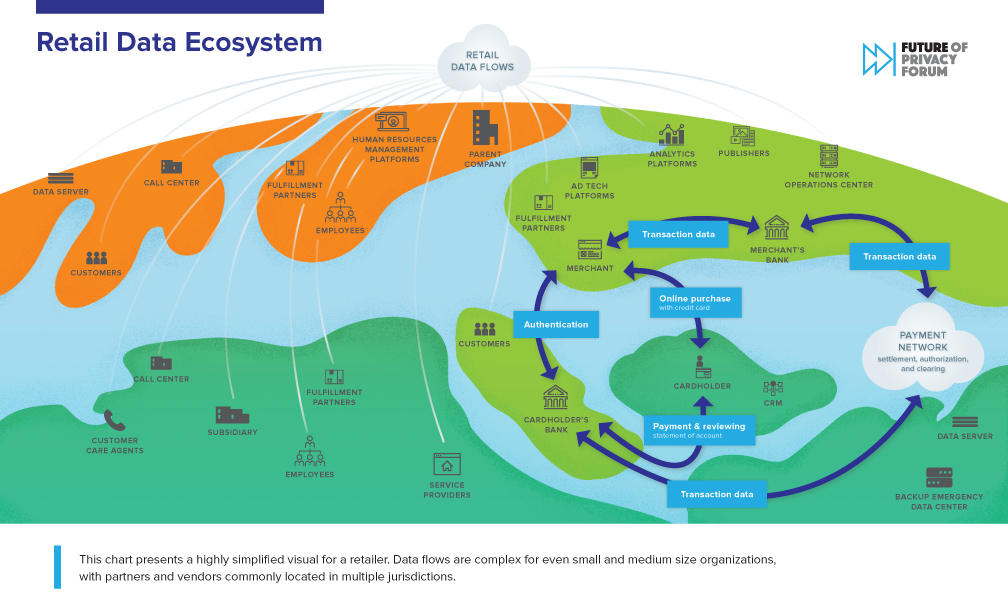
Here, we explore the issue of the complexity of international data flows in two distinct contexts that affect daily lives of people regardless of where they live, especially during a pandemic that has moved most of daily lives remote: (I) how they shop (retail) and (II) how they engage with education services (education technology, or EdTech). We provide an infographic for each with notes to better understand the actors and the complexities of data flows between them, while having an understanding that the systems being used and the actors involved are very often established within different jurisdictions.
Click here to download the 4-page (PDF) Infographic.
I. Understanding Retail Data Flows
The first infographic presents a highly simplified visual for a retailer. Data flows are complex for even small and medium size organizations, with partners and vendors commonly located in multiple jurisdictions. A retailer is likely to use a number of different cloud-based service providers to support consumer transactions. Many of these service providers may only be located in a single jurisdiction and be geographically dispersed. These service providers often use other service providers, and are themselves geographically distributed and interconnected.
One of the essential services provided to a retailer is payment processing which will involve:
An individual makes an online purchase with a credit card at a merchant via its online shop.
Authentication checking before a payment is authorized.
Authorization is the process shown with the transaction data that ultimately is presented to the cardholder bank and they either approve or decline (authorize) the transaction initiated by the cardholder.
Authentication is the process whereby the issuer requests certain information from the cardholder to have a higher assurance that they are in fact who they say they are.
Payment of the bill by the cardholder’s bank.
Facilitating the routing of the payment authorizations and the transaction, clearing, and settlement of funds between banks.
Settlement of a transaction through a network that includes the merchant’s bank, the cardholder’s bank, and the payment network, i.e., credit card companies.
Monitoring network, database, application, and other critical services from a Network Operations Center (NOC) in a centralized location.
Global fraud detection and cybersecurity monitoring which consolidate both domestic and cross-border fraud data to identify patterns of fraud and to create and improve global fraud models.
Click here to download the 4-page (PDF) Infographic.
II. Understanding EdTech Data Flows
The second infographic presents a highly simplified visual of the data flows for education technology for schools and universities. Cloud based services support a wide range of programs used by teachers, students and administrators in this sector.
Schools and universities increasingly rely on EdTech applications to help educate their students. This includes online classroom/video call collaboration tools, applications to inform parents and students about important developments, learning management systems and learning content providers. Most of these providers rely on a global network of subsidiaries to support, maintain and secure their product 24/7 as well as on other service providers that deliver hosting and other specialist services. While applications and personal data of students are often hosted regionally, these subsidiaries and vendors will require access to the data for the delivery of the service.
Universities and schools will also often rely on (cloud-based) vendors to fulfill their tasks. For example:
Messaging and communications tools to stay in contact with their students, parents and the wider community as well as promoting their activities.
Specialist applications for conducting and facilitating research with international collaborators.
Online collaboration tools, e.g., video conferencing, to collaborate with other schools and universities.
For further information or to provide comments or suggestions, please contact Dr. Rob van Eijk ([email protected]) or Dr. Gabriela Zanfir-Fortuna ([email protected]).