
Showing results for toptout xped xped api documentation

More Parties, More Risks, More Opportunity? Evolving Governance to Support Cyber Resilience Amidst Evolving Policy and Technological Change
[…] but includes the downstream effects of autonomous decision-making and execution across interconnected systems. These risks are amplified in environments where agents operate with persistent credentials or broad API access. In such contexts, a single compromised interaction can propagate across systems, particularly when agents are designed to optimize for task completion without sufficiently robust constraints […]
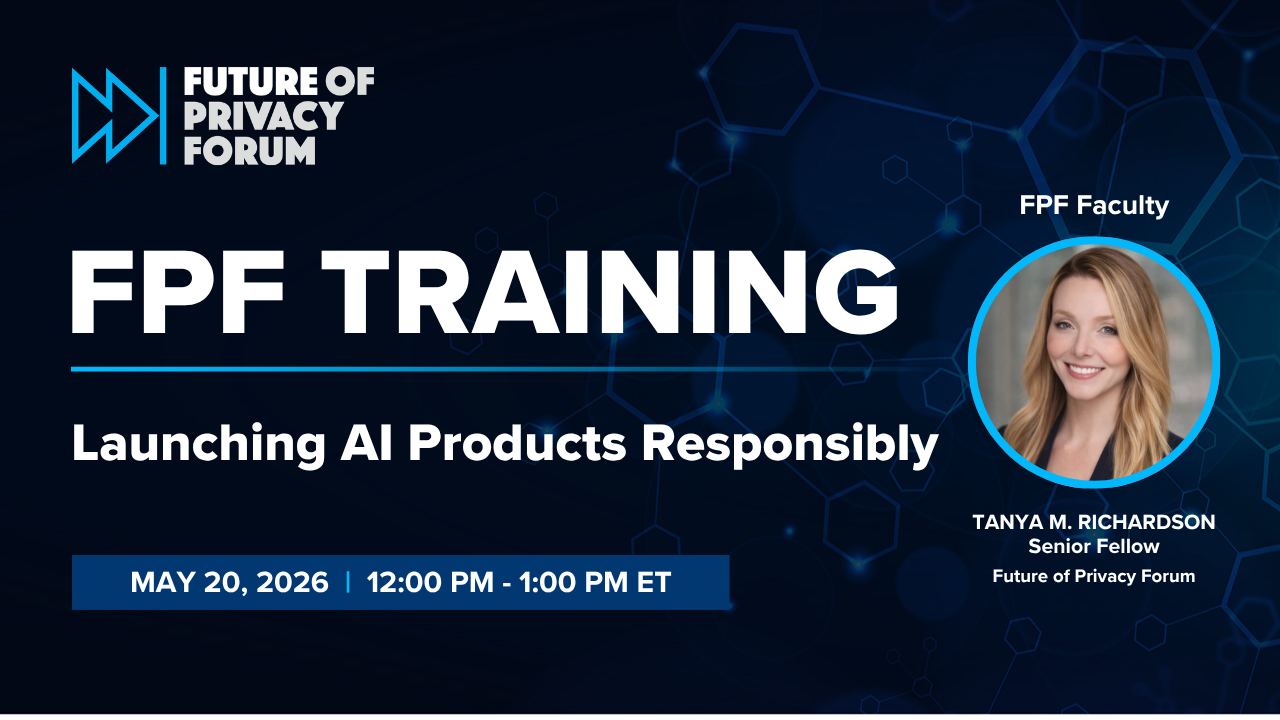
FPF Member Training: Launching AI Products Responsibly
[…] most before launch: examine how product function, data use, outputs, claims, and context shape legal, privacy, and compliance review; and Recognize when a product may require closer scrutiny: explore when additional testing, documentation, controls, or escalation should be considered before launch. Register here to attend this live training webinar for FPF members. For questions, email [email protected].

FPF Data-Driven Pricing – The Price is Right Report
[…] how price discrimination works, as well as its legal implications in the U.S., see Hal R. Varian, Price Discrimination, CREST Working Paper No. 87-26 (Jan. 1987), https://backend.production.deepblue-documents.lib.umich.edu/server/ api/core/ bitstreams/b6daf384-21a8-4fbc-ad9f-43821f2ada95/content. 9 “The Pennsylvania Quakers’ “honest price” was institutionalized in 1874 by John Wanamaker, when he opened his eponymous department store in Philadelphia. A renowned innovator […]

Red Lines under the EU AI Act: Restricting Real-time Remote Biometric Identification Systems for Law Enforcement Purposes
Blog 8 | Red Lines under the EU AI Act Series This blog is the eighth of a series that explores prohibited AI practices under the EU AI Act and their interplay with existing EU law. You can find the whole series here. The eighth blog in the “Red lines under the EU AI Act” series […]

Privacy Protections Coming Sooner Rather Than Later to the Sooner State
Oklahoma has become the latest U.S. state to enact a comprehensive consumer privacy law after Governor Stitt signed SB 546 into law on March 20. This ends two long legislative droughts: First, this is the long-awaited 20th state comprehensive privacy law and the first since the Rhode Island Data Transparency and Privacy Protection Act was […]

Incentives or Obligations? The U.S. Regulatory Approach to Voluntary AI Governance Standards
By FPF Legal Intern Rafal Fryc As artificial intelligence gets increasingly deployed across every sector of the economy, regulators find themselves grappling with a fundamental challenge: how to govern a technology that defies traditional regulatory frameworks and changes faster than legislation can keep pace. One increasingly common approach can be found outside the text of […]
Senior Analyst/Counsel – AI Governance
[…] Cybersecurity knowledge or experience is strongly preferred An ideal candidate has a solid understanding of the data flows underpinning modern mobile and web ecosystems (e.g. HTML, mobile/web, cookies, APIs, web scraping, etc.). Any technical savvy, or demonstrated experience working with technologists or engineers, is a plus. Location and Work Expectations: The position is located in […]
Common Chatbot Provisions — Future of Privacy Forum (5)
Common Chatbot Provisions Febru ary 2 026 Chatbot legislation includes one or mor e core requirements: transparency, age verification & access controls, content safety & harm prevention, professional licensure & regulated services, data protection, and liability & enforcement. Ju stin e G lu ck & Raf al Fr yc This document groups substantive chatbot provisions […]
Chatbot Definitional Approaches — Future of Privacy Forum (2)
Chatb ot D efin it io nal A ppro ach es Fe bru ary 2 026 W hy t his m atte rs : H ow a b ill d efin es ” c h atb ot ” d ete rm in es w ho m ust c om ply a n d w hic […]

Red Lines under the EU AI Act: Unpacking the Prohibition of Individual Risk Assessment for the Prediction of Criminal Offences
Blog 4 | Red Lines under the EU AI Act Series This blog is the fourth of a series that explores prohibited AI practices under the EU AI Act and their interplay with existing EU law. You can find the whole series here. The fourth blog in the “Red lines under the EU AI Act” series […]