

Encryption_Safe_Harbours
ENCRYPTION SAFE H ARBOURS AND D ATA BREACH N OTIFICATION LAWS Mark Burdon a, Jason Reid a and Rouhshi Low a ABSTRACT Data breach notification laws require organizations to notify affected persons or regulatory authorities when an unauthorized acquisition of personal data occurs. Most laws provide a safe harbour to this obligation if acquired data […]
E-Commerce_and_Information_Privacy_ Privacy_Policies_as_Personal
Corey A. Ciocchetti n r r 55 American Business Law Journal n Id. F F See, e.g Personal Information in Government Records: Protecting the Public Interest In Privacy 63, 118 & n.332 (2006) (defining personally identifying information with reference to the Privacy Act of 1974, 5 U.S.C.552a(a)(4) (2000)); TRUSTe,Guidance on Model Web Site Disclosures, http://www.truste.org/docs/Model_Privacy_ […]
Dispelling the Myths Surrounding De-identification Anonymization Remains a Strong Tool for Protecting Privacy
Dispelling the Myths Surrounding De-identification: Anonymization Remains a Strong Tool for Protecting Privacy Ann Cavoukian, Ph.D. Information & Privacy Commissioner, Ontario, Canada June 2011 Khaled El Emam, Ph.D. Canada Research Chair in Electronic Health Information, CHEO Research Institute and University of Ottawa Table of Contents Introduction ……………………………………………………………… ………. 1 Questioning the Value of De-identification ………………………………. […]
Chinas_Pragmatic_Privacy_Law_beyond_APEC
China’s Pragmatic Privacy Law beyond APEC: Does Generational Culture Matter? By Cheryl L. Brown Associate Professor Department of Political Science University of North Carolina at Charlotte [email protected] Paper Draft 1 Please do not quote without permission Abstract Culture and tradition remain significant influences in China’s conception of privacy and implementation of data protection laws. At the sam e time, the National People’s Congress’ initiation of privacy protection consider ation reveals the prospect of evolving laws emphasizing protection of data privacy based o n domestic and international developments. Although a growing literature focuse s on Internet filtering and social networking mining, this paper will examine five fac tors influencing national and international perspectives of China’s approach to p rivacy and data protection: (1) privacy concerns of RFID technology of China’s second-gener ation national identification card (2) personal data leaks of consumer information by banks, insurance companies, and real estate companies as China seeks to build consumer t rust in the modern banking and financial system; (3) data protection for citizens of countries engaged with China across borders in electronic commerce and outsourcing; (4) privacy compatibility with multinational and regional organizations in a soft power era; and (5) the changing leadership generations with backgrounds in the “sof t sciences” of history, economics, management, business, journalism, and law. These f actors may offer useful comparisons for addressing the convergence of an international framework for privacy laws and data protection. 1 This paper draft was originally submitted to the I nformation Privacy Law Scholars Conference, June 2010. The author is currently revising the paper. 2 […]
China’s_Pragmatic_Privacy_Law_beyond_APEC_
China’s Pragmatic Privacy Law beyond APEC: Does Generational Culture Matter? By Cheryl L. Brown Associate Professor Department of Political Science University of North Carolina at Charlotte [email protected] Paper Draft 1 Please do not quote without permission Abstract Culture and tradition remain significant influences in China’s conception of privacy and implementation of data protection laws. At the sam e time, the National People’s Congress’ initiation of privacy protection consider ation reveals the prospect of evolving laws emphasizing protection of data privacy based o n domestic and international developments. Although a growing literature focuse s on Internet filtering and social networking mining, this paper will examine five fac tors influencing national and international perspectives of China’s approach to p rivacy and data protection: (1) privacy concerns of RFID technology of China’s second-gener ation national identification card (2) personal data leaks of consumer information by banks, insurance companies, and real estate companies as China seeks to build consumer t rust in the modern banking and financial system; (3) data protection for citizens of countries engaged with China across borders in electronic commerce and outsourcing; (4) privacy compatibility with multinational and regional organizations in a soft power era; and (5) the changing leadership generations with backgrounds in the “sof t sciences” of history, economics, management, business, journalism, and law. These f actors may offer useful comparisons for addressing the convergence of an international framework for privacy laws and data protection. 1 This paper draft was originally submitted to the I nformation Privacy Law Scholars Conference, June 2010. The author is currently revising the paper. 2 […]
Calo_Boundaries_of_Privacy_Harm
THE BOUNDARIES OF PRIVACY HARM M. Ryan Calo * A BSTRACT This Essay describes the outer boundaries and core properties of privacy harm, an important, unique, but chronically under-t heorized injury. I argue that the vast majority of privacy harms fall into j ust two categories. The subjective category of privacy harm is the unwanted perception of observation. This category describes unwelcome men […]
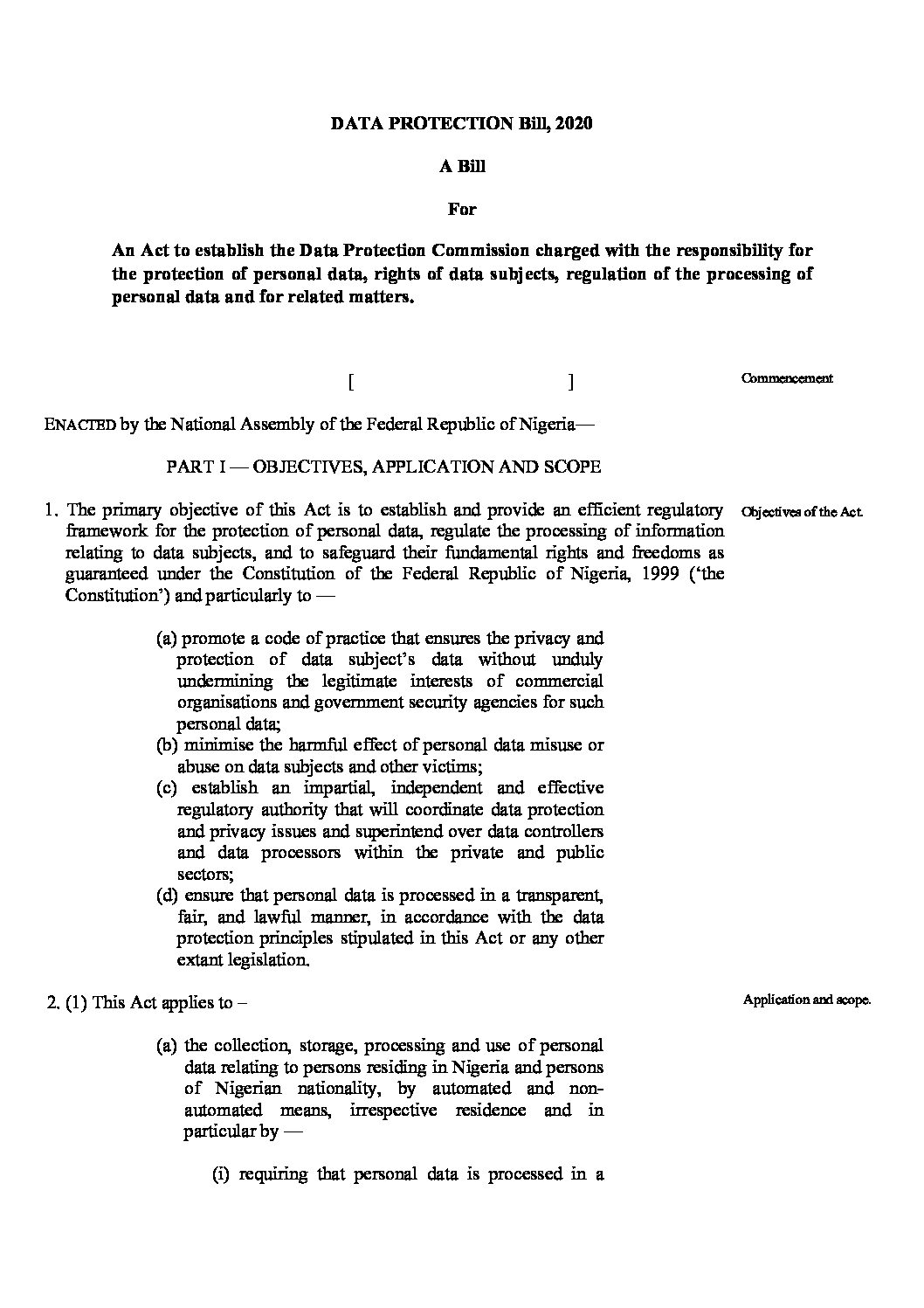
Africa_Nigeria_Draft-Data-Protection-Bill-2020-pdf
africa nigeria draft data protection bill 2020 pdf
Preserving_Identities_ Protecting_Personal_Identifying_Information
1 PRESERVING IDENTITIES: PROTECTING PERSONAL IDENTIFYING INFORMATION THROUGH ENHANCED PRIVACY POLICIES AND LAWS by Robert Sprague* and Corey Ciocchetti** “The common law has always recognized a man’s house as his castle . . . . Shall the courts thus close the front entrance to constituted authority, and open wide the back door to idle or […]
Harbour_&_ Koslov_ALJ 76-3_ANT314
SECTION 2 IN A WEB 2.0 WORLD: AN EXPANDED VISION OF RELEVANT PRODUCT MARKETS PAMELA JONES H ARBOUR TARA ISA K OSLOV * Section 2 enforcement by the U.S. antitrust authorities is back—at least, that is what the antitrust enforcers themselves have been saying. 1 An examination of Section 2 enforcement principles could not be […]

NASA__The_Andromeda_Galaxy_M31_Spyral_Galaxy_2647_1024_768-800×280
nasa the andromeda galaxy m31 spyral galaxy 2647 1024 768 800×280