
When handling personal data, organizations must utilize both best practices for privacy and cybersecurity to ensure that it is protected, sound, and treated in line with individual and societal expectations.
FPF’s work on privacy and cybersecurity focuses on the overlap between the two areas, including how different global laws and policy regimes tackle that overlap. Through FPF’s Privacy and Cybersecurity Expert Group, FPF facilitates the coordination and collaboration of privacy and cybersecurity experts to promote common goals, strategies, and understanding.
FPF’s Cybersecurity Advisory Committee comprises top cyber and privacy executives at industry-leading companies and civil society and academia representatives.
Advisory committee members include:
- Emily Hancock, Cloudflare
- Stephenie Handler, Gibson Dunn (Chair)
- David Hoffman, Duke University, Sanford School of Public Policy
- Anitha Ibrahim, Amazon Web Services
- Andy Serwin, DLA Piper
- Chad Sniffen, National Network to End Domestic Violence
- Melanie Tiano, T-Mobile
- Heng Xu, American University





Understanding Data Embassies and Corridors
The following is a guest post to the FPF blog authored by Yeong Zee Kin, Chief Executive of the Singapore Academy of Law and FPF Senior Fellow. The guest post reflects the opinion of the author only and does not necessarily reflect the position or views of FPF and our stakeholder communities. FPF provides this […]

FPF Year in Review 2025
Co-authored by FPF Communications Intern Celeste Valentino with contributions from FPF Global Communications Manager Joana Bala This year, FPF continued to broaden its footprint across priority areas of data governance, further expanding activities across a range of cross-sector topics, including AI, Youth, Conflict of Laws, AgeTech (seniors), and Cyber-Security. We have engaged extensively at the local […]

“Personality vs. Personalization” in AI Systems: Intersection with Evolving U.S. Law (Part 3)
This post is the third in a series on personality versus personality in AI systems. Read Part 1 (exploring concepts) and Part 2 (concrete uses and risks). Conversational AI technologies are hyper-personalizing. Across sectors, companies are focused on offering personalized experiences that are tailored to users’ preferences, behaviors, and virtual and physical environments. These […]
FPF in 2023: A Year in Review
As 2023 comes to an end, we want to reflect on a year that saw the Future of Privacy Forum (FPF) continue to expand its presence globally and domestically while organizing engaging events, publishing thought-provoking analysis, providing the latest expert updates, and more. FPF continues to convene industry experts, academics, consumer advocates, and other experts […]
FPF Releases Infographic to Explore Implications of Open Banking Data Flows and Security for Individuals
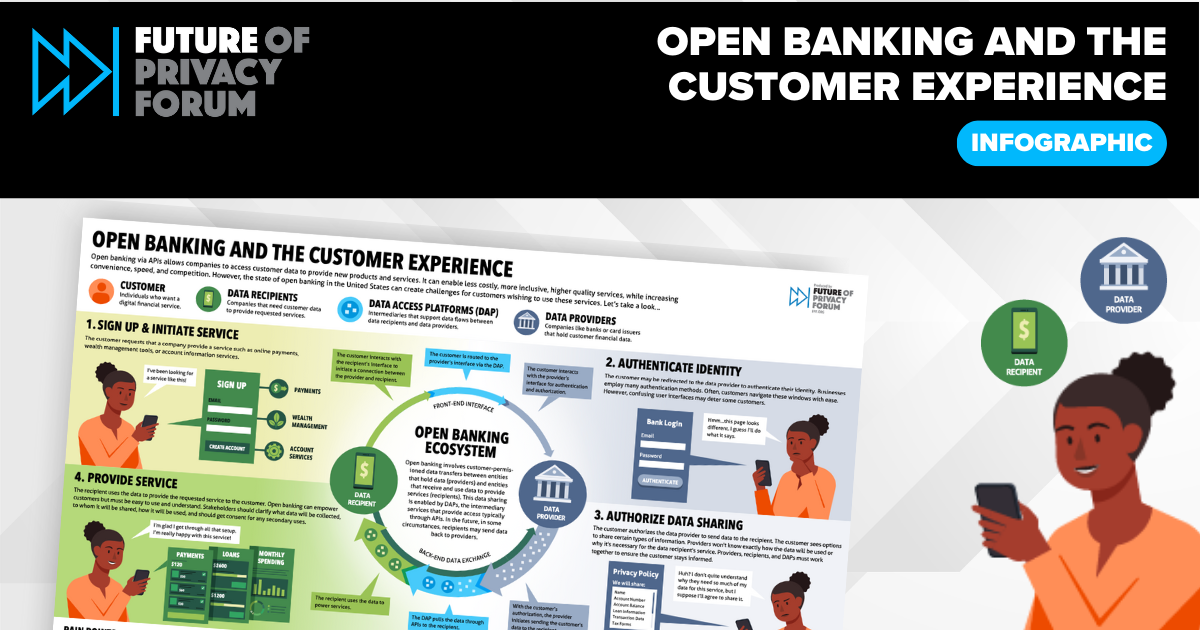
Today, the Future of Privacy Forum (FPF), a global non-profit focused on privacy and data protection, is pleased to release an infographic, “Open Banking And The Customer Experience,” visualizing the US open banking ecosystem. FPF’s open banking infographic is supported by over a year of meetings and outreach with leaders in banking, credit management, financial […]

FPF Response to CFPB Data Portability Proposal
In response to the Consumer Financial Protection Bureau’s (CFPB) request for comment regarding data portability for financial products and services, the Future of Privacy Forum filed comprehensive comments and recommendations, urging the Bureau to craft balanced, informed privacy rules that protect individuals’ personal information while enhancing trust in the privacy and security of emerging data […]

Report Outlines Key Privacy Considerations for Video-Based Safety Systems in Vehicles
Despite fewer vehicle miles traveled as a result of the COVID-19 pandemic, an estimated 38,680 individuals died in motor vehicle accidents in 2020 — the largest projected number of fatalities in such accidents in over a decade. Washington, D.C.-based non-profit Future of Privacy Forum (FPF) released a report detailing the data usage and privacy implications […]

FPF Health and AI & Ethics Policy Counsels Present a Scientific Position at ICML 2020 and at 2020 CCSQ World Usability Day
On November 12, 2020, FPF Policy Counsels Drs. Rachele Hendricks-Sturrup and Sara Jordan presented privacy-by-design alongside human-centered design concepts during the 2020 CCSQ World Usability Day virtual conference. This presentation followed Drs. Hendricks-Sturrup’s and Jordan’s July 2020 scientific position paper presented at the International Conference on Machine Learning (ICML) 2020, entitled “Patient- Reported Outcomes: A Privacy-Centric and Federated Approach […]

Five Top of Mind Data Protection Recommendations for Brain-Computer Interfaces
By Jeremy Greenberg, [email protected] and Katelyn Ringrose [email protected]. Key FPF-curated background resources – policy & regulatory documents, academic papers, and technical analyses regarding brain-computer interfaces are available here. Recently, Elon Musk livestreamed an update for Neuralink—his startup centered around creating brain-computer interfaces (BCIs). BCIs are an umbrella term for devices that detect, amplify, and translate […]

New White Paper Explores Privacy and Security Risk to Machine Learning Systems
FPF and Immuta Examine Approaches That Can Limit Informational or Behavioral Harms WASHINGTON, D.C. – September 20, 2019 – The Future of Privacy Forum (FPF) released a white paper, WARNING SIGNS: The Future of Privacy and Security in an Age of Machine Learning, exploring how machine learning systems can be exposed to new privacy and […]