
When handling personal data, organizations must utilize both best practices for privacy and cybersecurity to ensure that it is protected, sound, and treated in line with individual and societal expectations.
FPF’s work on privacy and cybersecurity focuses on the overlap between the two areas, including how different global laws and policy regimes tackle that overlap. Through FPF’s Privacy and Cybersecurity Expert Group, FPF facilitates the coordination and collaboration of privacy and cybersecurity experts to promote common goals, strategies, and understanding.
FPF’s Cybersecurity Advisory Committee comprises top cyber and privacy executives at industry-leading companies and civil society and academia representatives.
Advisory committee members include:
- Emily Hancock, Cloudflare
- Stephenie Handler, Gibson Dunn (Chair)
- David Hoffman, Duke University, Sanford School of Public Policy
- Anitha Ibrahim, Amazon Web Services
- Andy Serwin, DLA Piper
- Chad Sniffen, National Network to End Domestic Violence
- Melanie Tiano, T-Mobile
- Heng Xu, American University




Event Recap: Panel at the Annual Privacy Forum 2020
Authors: Hunter Dorwart and Rob van Eijk To track and to get tracked: new innovative methods and advancements On September 30, 2020, the Future of Privacy Forum participated in a panel at the Annual Privacy Forum 2020 (APF-2020). The event is organized annually by the European Union Agency for Cybersecurity (ENISA), the Directorate-General for Communications […]

FPF Testifies at FTC Data Portability Workshop
Yesterday, on September 22, 2020, the Federal Trade Commission held a public workshop, “Data To Go,” examining the benefits and challenges of data portability frameworks for consumers and competition. As a panelist during the first discussion, FPF’s Gabriela Zanfir-Fortuna discussed: how data portability operates in different commercial sectors; lessons learned from the GDPR and other […]

The First National Model Student Data Privacy Agreement Launches
Protections for student data privacy took an important step forward this summer when the Student Data Privacy Consortium (SDPC) released the first model National Data Privacy Agreement (NDPA) for school districts to use with their technology service providers. Ever since education technology (edtech) emerged as a key tool in classrooms, both schools and edtech companies […]

Five Top of Mind Data Protection Recommendations for Brain-Computer Interfaces
By Jeremy Greenberg, [email protected] and Katelyn Ringrose [email protected]. Key FPF-curated background resources – policy & regulatory documents, academic papers, and technical analyses regarding brain-computer interfaces are available here. Recently, Elon Musk livestreamed an update for Neuralink—his startup centered around creating brain-computer interfaces (BCIs). BCIs are an umbrella term for devices that detect, amplify, and translate […]
Call for Position Statements on Responsible Uses of Technology and Health Data During Times of Crisis
Event Overview The Future of Privacy Forum, in collaboration with the National Science Foundation, Duke Sanford School of Public Policy, SFI ADAPT Research Centre, Dublin City University, and Intel Corporation presents Privacy & Pandemics: Responsible Uses of Technology and Health Data During Times of Crisis — An International Tech and Data Conference, including a two day […]
Christy Harris Discusses Trends in Ad Tech
We’re talking to FPF senior policy experts about their work on important privacy issues. Today, Christy Harris, CIPP/US, Director of Technology and Privacy Research, is sharing her perspective on ad tech and privacy. Prior to joining the FPF team, Christy spent almost 20 years at AOL, where she helped navigate novel consumer privacy issues in […]
FPF & VUB Roundtable – Banking on Personal Data
Authors: Caroline Hopland, Ine van Zeeland, and Rob van Eijk FPF & Vrije Universiteit Brussel: Banking on Personal Data Last week, Future of Privacy Forum (FPF) and Vrije Universiteit Brussel (VUB) hosted a roundtable on open banking. Twenty subject-matter experts discussed some of the main challenges in banking and data protection law: consent and its […]

The European Commission Considers Amending the General Data Protection Regulation to Make Digital Age of Consent Consistent
The European Commission published a Communication on its mandated two-year evaluation of the General Data Protection Regulation (GDPR) on June 24, 2020 in which it discusses as a future policy development “the possible harmonisation of the age of children consent in relation to information society services.” Notably, harmonizing the age of consent for children across […]
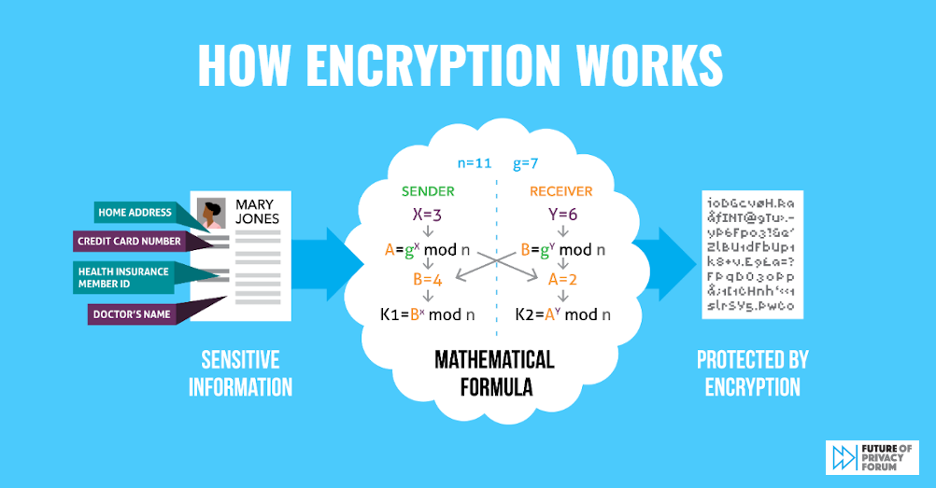
Strong Data Encryption Protects Everyone: FPF Infographic Details Encryption Benefits for Individuals, Enterprises, and Government Officials
Today, the Future of Privacy Forum released a new tool: the interactive visual guide “Strong Data Encryption Protects Everyone.” The infographic illustrates how strong encryption protects individuals, enterprises, and the government. FPF’s guide also highlights key risks that arise when encryption safeguards are undermined – risks that can expose sensitive health and financial records, undermine the […]

FPF Webinar Explores the Future of Privacy-Preserving Machine Learning
On June 8, FPF hosted a webinar, Privacy Preserving Machine Learning: New Research on Data and Model Privacy. Co-hosted by the FPF Artificial Intelligence Working Group and the Applied Privacy Research Coordination Network, an NSF project run by FPF, the webinar explored how machine learning models as well as data fed into machine learning models […]