
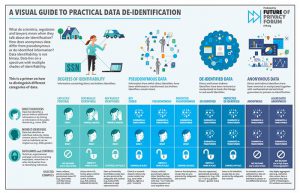
One key method for ensuring privacy while processing large amounts of data is de-identification. De-identified data refers to data through which a link to a particular individual cannot be established. This often involves “scrubbing” the identifiable elements of personal data, making it “safe” in privacy terms while attempting to retain its commercial and scientific value.
In the era of big data, the debate over the definition of personal information, de-identification and re-identification has never been more important. Privacy regimes often rely on data being considered Personal in order to require the application of privacy rights and protections. Data that is anonymous is considered free of privacy risk and available for public use.
Yet much data that is collected and used exists somewhere on a spectrum between these stages. FPF’s De-ID Project has examined practical frameworks for applying privacy restrictions to data based on the nature of data that is collected, the risks of de-identification, and the additional legal and administrative protections that may be applied.


Microsoft to delete full Search IP addresses after 6 months
The news is just in that Microsoft is announcing that it will delete full IP addresses from their Bing search engine log files after 6 months. In July 2009, when Microsoft and YAHOO announced their search partnership, we predicted that real competition in the search arena between Google and Microsoft could lead to privacy benefits […]
Ensuring that We Leave Children Behind
This guest post from FPF Advisory Board member Professor Danielle Citron is cross-posted with Concurringopinions.com, one of the top legal blogs. Check out Concurringopinions.com for regular legal and policy from top privacy scholars, including among others FPF Advisory Board members Daniel Solove, Frank Pasquale and Danielle Citron. Ensuring that We Leave Children Behind October 29, […]
Search Privacy and the Microsoft-Yahoo! Agreement
As we have followed the rumors of a Microsoft-Yahoo deal over the last few months, the area we were most concerned about was the future of Yahoo’s leading search data retention policy. We have repeatedly praised Yahoo for implementing a data retention policy that seeks to anonymize search queries after 3 months and we have […]
MediaPost Publications Court: IP Addresses Are Not 'Personally Identifiable' Information
MediaPost Publications Court: IP Addresses Are Not ‘Personally Identifiable’ Information 07/07/2009. Snip…..”Jules Polonetsky, co-chair and director of the think tank Future of Privacy Forum, adds that many sites with older privacy policies maintain they don’t collect personally identifiable information, but log IP addresses. “For many years, people just threw around the term personal information,” he […]
De-identified data
Some thoughtful points today on de-identified health data from the team at CDT . See CDT | Policy Post 15.11, June 26, 2009.
IAPP Audio Conference – Identity, Identifiers and Personal Data
IAPP Audio Conference – Identity, Identifiers and Personal Data
Date: May 7, 2009
Time: 1 – 2:30 p.m. EDT
After search, ad-serving logfiles.
Last week the major search engines presented before the Article 29 Working Party of European data regulators. Brendon Lynch of Microsoft had this handy chart which gave an overview of how the companies handle search data. One thing I haven’t seen discussed is how companies are – or are not – handling the very tricky […]
New from TRUSTe on Behavioral Advertising
It is particularly pleasing that this checklist lays out some of the leading practices of the future for behavioral advertising – ways to give users more transparency and control, and minimizing the retention of data that is not needed. From the document: Self-regulation is a process often preceded by leading companies beginning to strengthen practices […]
Search Log Files – Ad Server Log Files
Microsoft has agreed with the Article 29 Working Party of EU data regulators that they will remove cookies and IP addresses from search data after 6 months, but only if Google and Yahoo also go along. We will comment further about this, but are already thinking about the next issue – ad server log file […]
The Future of Privacy Forum Agenda for Consumers and Businesses
FPF will seek to bring transparency to online data practices. Our plan is to document practices, produce multi-media educational materials, and commission reports and studies that provide consumers and policy makers the real story about how their data is used. FPF will seek to bring true transparency and user control to behavioral targeting and will […]