
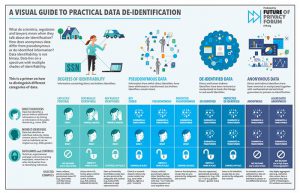
One key method for ensuring privacy while processing large amounts of data is de-identification. De-identified data refers to data through which a link to a particular individual cannot be established. This often involves “scrubbing” the identifiable elements of personal data, making it “safe” in privacy terms while attempting to retain its commercial and scientific value.
In the era of big data, the debate over the definition of personal information, de-identification and re-identification has never been more important. Privacy regimes often rely on data being considered Personal in order to require the application of privacy rights and protections. Data that is anonymous is considered free of privacy risk and available for public use.
Yet much data that is collected and used exists somewhere on a spectrum between these stages. FPF’s De-ID Project has examined practical frameworks for applying privacy restrictions to data based on the nature of data that is collected, the risks of de-identification, and the additional legal and administrative protections that may be applied.

Emerging Patchwork or Laboratories of Democracy? Privacy Legislation in Virginia and Other States
Stacey Gray, Pollyanna Sanderson & Samuel Adams In the absence of federal privacy legislation, U.S. states are weighing in. In Virginia, the “Consumer Data Protection Act” (“CDPA”) (HB 2307 / SB 1392) could be signed into law within weeks, and if passed, would take effect on Jan. 1, 2023. If the law passes, it would […]
Workshop Report: Privacy & Pandemics – Responsible Use of Data During Times of Crisis
In October 2020, the Future of Privacy Forum (FPF) convened a virtual workshop entitled “Privacy and Pandemics: Responsible Uses of Technology and Health Data During Times of Crisis” with invited computer science, privacy law, public policy, social science, and health information experts from around the world to examine benefits, risks, and strategies for the collection […]
South Korean Personal Information Protection Commission Announces Three-Year Data Protection Policy Plan
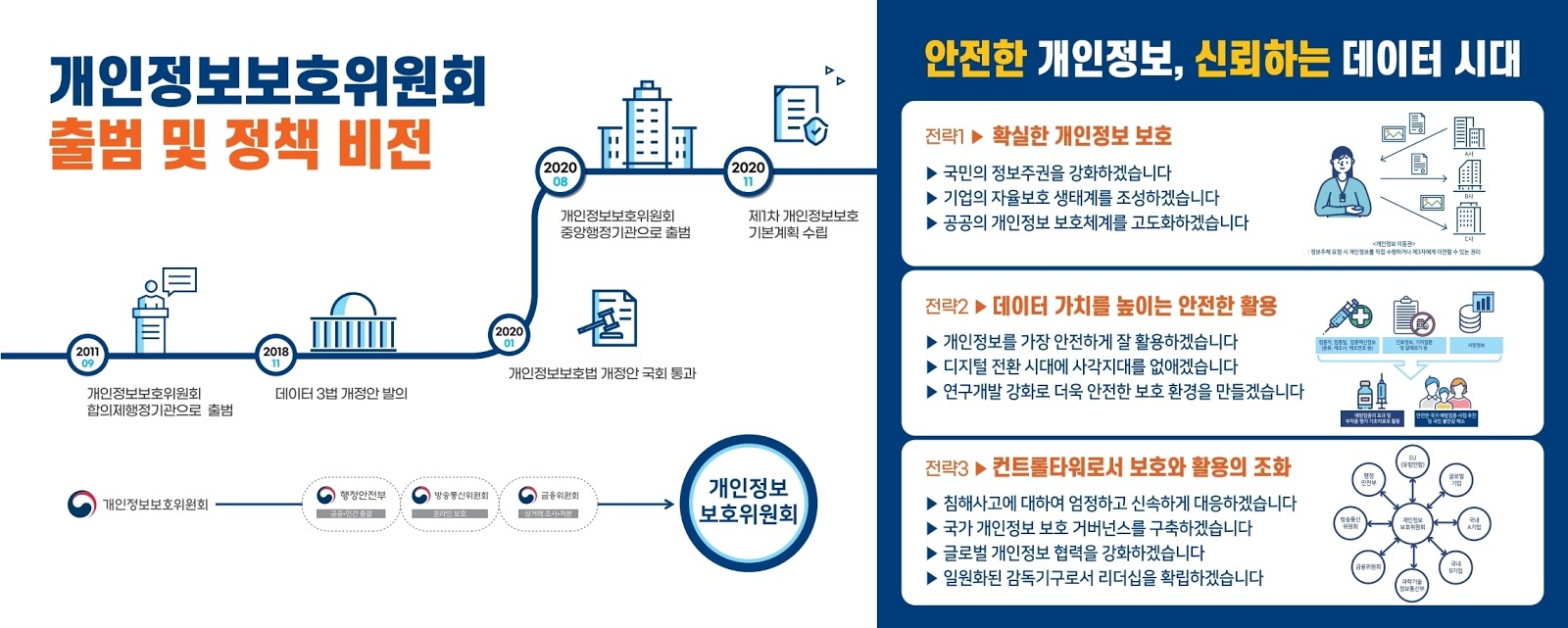
by Jasmine Park On November 24, 2020, the South Korean Personal Information Protection Commission (PIPC), the nation’s central administrative agency tasked with protecting the privacy rights of individuals by enforcing the country’s privacy laws, released its revised three-year “Personal Information Protection Master Plan” (‘21-‘23). A wide range of policies that balance both the protection and […]

Seven Questions to Ask if You Have XR on Your Holiday Wish List
The holidays are right around the corner, and with so many of us sheltering in place in response to COVID-19, some are looking for an escape from the same four walls. Enter XR to help virtually transport us to new worlds, immersive games, and social interactions. XR, or extended reality, is an umbrella term for […]
2020 Brussels Privacy Symposium
The 2020 Brussels Privacy Symposium is the fourth-annual academic program jointly presented by the Brussels Privacy Hub of Vrije Universiteit Brussel (VUB) and the Future of Privacy Forum (FPF) and is a global convening of practical, applicable, substantive privacy research and scholarship. On December 2, 2020, the fourth iteration of the Brussels Privacy Symposium, “Research and the Protection of […]
California’s Prop 24, the “California Privacy Rights Act,” Passed. What’s Next?
Authors: Stacey Gray, Senior Counsel, Katelyn Ringrose, Christopher Wolf Diversity Law Fellow at FPF, Polly Sanderson, Policy Counsel, and Veronica Alix, FPF Legal Intern Despite a day of election uncertainty, November 3, 2020 produced an important moment for privacy legislation: California voters approved Proposition 24 (the California Privacy Rights Act) (CPRA) (full text here). Garnering 56.1% of the vote so far, […]

FPF Best Practices and Contract Guidelines Help Companies Share Data with Academic Researchers
Does your company have data that could help academic researchers unravel the mysteries of human health, behavior, education, or other areas of study? Data held by private organizations has the potential to lead to scientific insights that can benefit society and improve lives – if it can be accessed in a responsible manner that respects […]

The First National Model Student Data Privacy Agreement Launches
Protections for student data privacy took an important step forward this summer when the Student Data Privacy Consortium (SDPC) released the first model National Data Privacy Agreement (NDPA) for school districts to use with their technology service providers. Ever since education technology (edtech) emerged as a key tool in classrooms, both schools and edtech companies […]
Call for Position Statements on Responsible Uses of Technology and Health Data During Times of Crisis
Event Overview The Future of Privacy Forum, in collaboration with the National Science Foundation, Duke Sanford School of Public Policy, SFI ADAPT Research Centre, Dublin City University, and Intel Corporation presents Privacy & Pandemics: Responsible Uses of Technology and Health Data During Times of Crisis — An International Tech and Data Conference, including a two day […]
California’s SB 980 Would Codify Strong Protections for Genetic Data
Author: John Verdi (Vice President of Policy) This week, SB 980 (the “Genetic Information Privacy Act”) passed the California State Assembly and State Senate, with near unanimous support (54-10 and 39-0). If signed by the Governor before the Sept. 30 deadline, the law would become the first comprehensive genetic privacy law in the United States, […]