Across the United States, evolving data collection and processing practices and advances in artificial intelligence are driving new digital services, technologies, and socially beneficial research – while also raising new opportunities, risks, and questions for individuals and communities. In response, state and federal policymakers are considering new legislative and regulatory frameworks on three interconnected fronts: comprehensive consumer privacy laws that establish baseline rights and protections for personal data across the economy; frameworks that target specific sectors and practices such as automated decisionmaking, biometric identification, companion chatbots, data-driven pricing, data brokerage, frontier AI model safety, genetic data, and health data; and youth-specific privacy and online safety laws that set distinct rules for minors. These three tracks rarely stay in their lanes: a comprehensive privacy law may include AI provisions, an AI safety bill may carve out rules for minors, a youth online safety law may hinge on biometric age verification. Understanding the landscape requires understanding both the individual pieces and how they fit together.
FPF’s U.S. Legislation team provides expert, independent, pragmatic analysis of state and federal legislative and regulatory approaches to privacy, AI, and youth online safety – three distinct but increasingly intertwined issue areas. The team tracks emerging proposals, compares new laws against existing frameworks, analyzes implementation and compliance implications, and helps policymakers and stakeholders understand how legal requirements interact with current technologies, business practices, and data uses.
Through reports, blog posts, legislative and policy analyses, webinars, in-person and virtual peer-to-peer gatherings, and educational programs, FPF helps the broader technology policy and governance community understand the mechanisms and strategies available to protect privacy, promote responsible AI development and deployment, and advance youth online safety. FPF does not typically support or oppose particular bills. Instead, the U.S. Legislation team focuses on explaining the practical and legal implications of proposals – individually and as they interact with one another. This work helps ensure that privacy, AI, and youth safety compliance and policy strategies remain future-looking, adaptable, and workable for the continued, beneficial use of data and AI.
FPF’s U.S. Legislation team is led by Tatiana Rice, Senior Director.




New Infographic: Understanding Uses of Microphones in Internet of Things (IoT) Devices
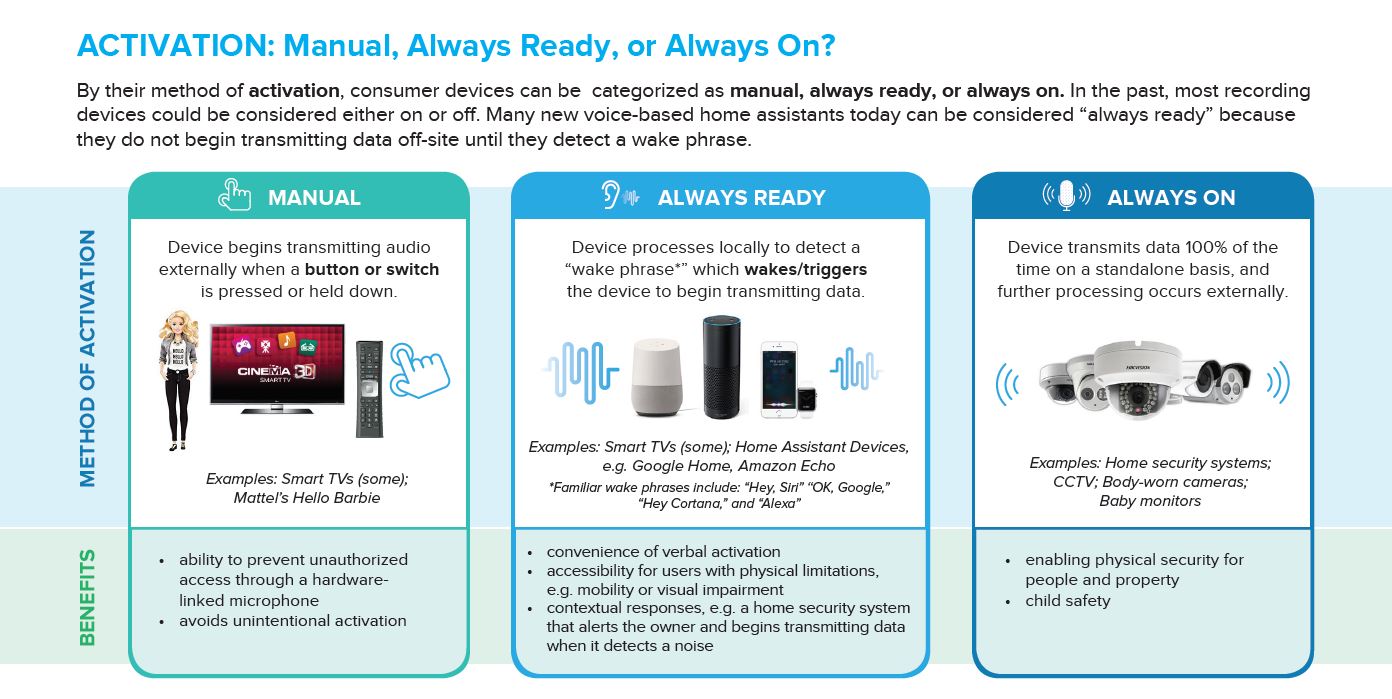
Washington, DC – Today, the Future of Privacy Forum released an infographic, “Microphones & the Internet of Things: Understanding Uses of Audio Sensors in Connected Devices.” In order to enable the benefits of new voice-based services while protecting data privacy, this infographic attempts to explain the range of possible uses of microphones in connected devices.
The House’s SELF DRIVE Act Races Ahead on Privacy
In a rare moment of bipartisanship, the House Energy and Commerce Committee yesterday unanimously approved the SELF DRIVE Act H.R. 3388, sending it to the full House of Representatives for consideration. The bill facilitates introduction and testing of autonomous cars by clarifying federal and state roles, and by granting exemptions from motor vehicle standards that have impeded introduction of new automated vehicle technologies. This vote was an important step forward in enabling introduction of new technologies that have the potential to transform the future of mobility and maximize consumer safety.

Federal Trade Commission: COPPA Applies to Connected Toys
This week, the Federal Trade Commission (FTC) updated its guidance on COPPA, the Children’s Online Privacy Protection Act, to clarify that the 1998 statute applies not just to websites and online service providers that collect data from children, but also to Internet of Things devices, including children’s toys.

The Top 10: Student Privacy News (April – May 2017)
The Future of Privacy Forum tracks student privacy news very closely, and shares relevant news stories with our newsletter subscribers.* Approximately every month, we post “The Top 10,” a blog with our top student privacy stories.

The Top 10: Student Privacy News (March-April 2017)
The Future of Privacy Forum tracks student privacy news very closely, and shares relevant news stories with our newsletter subscribers. Approximately every month, we post “The Top 10,” a blog with our top student privacy stories.

FPF Comments on NHTSA’s V2V Rulemaking
Yesterday, the Future of Privacy Forum submitted written comments to the Department of Transportation and National Highway Traffic Safety Administration in response to their Notice of Proposed Rulemaking on Vehicle to Vehicle Communications.

The Top 10: Student Privacy News (Feb-March 2017)
The Future of Privacy Forum tracks student privacy news very closely, and shares relevant news stories with our newsletter subscribers.* Approximately every month, we post “The Top 10,” a blog with our top student privacy stories. New America has released an ethical framework to help colleges use predictive analytics to benefit students (this report follows their previous report […]

Regulating the Online Advertising Market: Yesterday, Today, and Tomorrow
Today, the Senate Committee on Commerce, Science, and Transportation held a hearing to examine the broad policy issues facing the Federal Communications Commission (FCC). Commissioners Pai, Clyburn, and O’Rielly outlined their priorities for the FCC, and answered questions about their proposed plans—including for the future of net neutrality and privacy of data collected online.
House Passes Email Privacy Act (H.R. 387)
Yesterday, the U.S. House of Representatives passed the Email Privacy Act (H.R. 387). The bill updates the Electronic Communications Privacy Act (ECPA), the law that sets standards for government access to private internet communications. Although ECPA was forward-thinking for its time, the developments of technology and communications in the 30 years since its passage have greatly surpassed its scope and the effectiveness of its policy direction.

The Top 10: Student Privacy News (Dec 2016-Jan 2017)
The Future of Privacy Forum tracks student privacy news very closely, and shares relevant news stories with our newsletter subscribers.* Today, we are launching “The Top 10,” a monthly blog with our top student privacy stories from the past month (or month-and-a-half, in today’s case).