Commissioners Discussed Global Privacy Regulations at the Second Japan Privacy Symposium
November 26, 2024 — This week, the Future of Privacy Forum (FPF), a global non-profit focused on data protection, privacy, and emerging technologies, hosted the second annual Japan Privacy Symposium with support from S&K Brussels LPC and in cooperation with the Personal Information Protection Commission of Japan (PPC) and the Japan DPO Association.
This event, on the sidelines of the 62nd Asia-Pacific Privacy Authorities (APPA) Forum, brought together leaders in the Japanese privacy community and data protection and privacy regulators from across the globe at the Ritz-Carlton in Tokyo, Japan.
Commissioner OHSHIMA Shuhei opened the event with a keynote speech outlining some of PPC’s key regulatory priorities going forward. Subsequently, Philippe Dufresne, Commissioner, Office of the Privacy Commissioner, Canada; Ashkan Soltani, Executive Director, California Privacy Protection Agency; Nazri Kama, Commissioner, Personal Data Protection Department of Malaysia; Thienchai Na Nakorn, Chairman, Personal Data Protection Committee, Thailand; and Josh Lee Kok Thong, Managing Director for APAC, Future of Privacy Forum, also discussed upcoming regulatory priorities for data protection authorities, and key trends around regulatory priorities in the APAC region.
“We are excited to have had a successful second edition of this valuable event that brings together data protection and privacy regulators from around the world alongside the Japanese privacy community,” Gabriela Zanfir-Fortuna, FPF’s Vice President for Global Privacy, said. “Tokyo is a perfect location to host these important global conversations and it provides a valuable forum for commissioners from around the globe to share their perspectives with privacy leaders and community members. We are grateful to our partners, the Personal Information Protection Commission of Japan, the Japan DPO Association, S&K Brussels LPC and our Senior Fellow Kaori Inui, for their steadfast partnership and support.”
Pictured: Gabriela Zanfir-Fortuna addressing attendees at the second annual Japan Privacy Symposium November 25, in Tokyo, Japan.
###
About Future of Privacy Forum (FPF)
The Future of Privacy Forum (FPF) is a global non-profit organization that brings together academics, civil society, government officials, and industry to evaluate the societal, policy, and legal implications of data use, identify the risks and develop appropriate protections.FPF believes technology and data can benefit society and improve lives if the right laws, policies, and rules are in place. FPF has offices in Washington D.C., Brussels, Singapore, and Tel Aviv. Follow FPF on X and LinkedIn.
FPF Launches New Privacy-Enhancing Technologies Repository
For some time now, stakeholders at the intersection of data, privacy, and new technologies have increasingly recognized the potential of a range of technical and computational approaches and techniques to mitigate privacy risks. This set of tools and methods are otherwise known as privacy-enhancing technologies (PETs) and are understood as a group of techniques that can help enhance and preserve data privacy while maintaining its utility. As novel technological challenges continue to evolve, the conversation around PETs as possible enablers of secure, trusted, and fair data sharing and use has similarly intensified.
Recognizing the need for a deeper understanding of the potential and limitations of these technologies, FPF has actively contributed to shaping policymaking around PETs through discussion papers, reports, and stakeholder engagement. In 2023, FPF began facilitating the convenings of the Global PETs Network, an informal forum for global Data Protection Authorities (DPAs) and regulators interested in the development and policy implications of the adoption and implementation of PETs. In July 2024, FPF also launched the Research Coordination Network for Privacy-Preserving Data Sharing and Analytics, bringing together a group of cross-sector and multidisciplinary experts dedicated to exploring the potential of PETs in the context of AI and emerging technologies, and steward their adoption and scalability.
Through these initiatives and other efforts, FPF has identified a growing demand among stakeholders to promote and enhance a better understanding and awareness of the potential and limitations of PETs. Many regulators and organizations have made significant contributions to advancing PETs development and deployment through research, guidance, and testing, many of which have been publicly available for social use and benefit. Building on these efforts and its own initiatives, FPF recently launched the PETs Repository, a webpage that consolidates available resources and developments around the development and deployment of PETs.
FPF’s PETs Repository is a centralized, trusted, and up-to-date resource where individuals and organizations interested in these technologies can find practical and useful information in the field. The Repository is currently organized into three segments:
Regulatory Activity: Including official guidance, statements, blogs, tools, and reports on PETs from DPAs and regulators around the world.
External Reports: Relevant and contemporary publications from global organizations offering insights into PETs.
Sandboxes: Links to official resources detailing use cases, applications, and results from testing environments such as sandboxes and other initiatives led by governments and organizations.
While FPF acknowledges the extensive field of academic research around PETs, the Repository intends to primarily consolidate developments and official resources reflecting the existing regulatory thinking and policymaking around these technologies. Through the Repository, FPF contributes to facilitating a better understanding of PETs and increasing the visibility of global initiatives in the field from governments and organizations to a broader audience.
FPF Unveils Report on the Anatomy of State Comprehensive Privacy Law
Today, the Future of Privacy Forum (FPF) launched a new report—Anatomy of State Comprehensive Privacy Law: Surveying the State Privacy Law Landscape and Recent Legislative Trends. By distilling this broad landscape to identify the “anatomy” of state comprehensive privacy law, this report highlights the strong commonalities and the nuanced differences between the various laws, showing how they can exist within a common, partially-interoperable framework while also creating challenging compliance difficulties for companies within their overlapping ambits. Until a federal privacy law materializes, this ever changing state landscape will continue to evolve as lawmakers iterate upon the existing frameworks and add novel obligations, rights, and exceptions to respond to changing societal, technological, and economic trends.
Between 2018 and 2024, nineteen U.S. states enacted comprehensive consumer privacy laws. This rapid adoption of privacy legislation has caused the legal landscape to explode in depth and complexity as each new law iterates upon those that came before it. This report summarizes the legislative landscape and identifies the “anatomy” of state comprehensive privacy law by comparing and contrasting the two prevailing models for state laws and identifying commonalities and differences in the laws’ core components. These core components of a comprehensive privacy law include:
Definitions of covered entities (controllers and processors) and covered data (personal data and sensitive data);
Individual rights of access, correction, portability, deletion, and both opt-in and opt-out requirements for certain uses of personal data;
Business obligations such as transparency, data minimization, and data security; and
Enforcement by the attorney general.
The report concludes with an overview of five emerging legislative trends:
Changes to applicability thresholds;
Expanding scope of sensitive data;
Emergence of substantive data minimization requirements;
Heightened protections for consumer health data, adolescents’ personal data, and biometrics; and
New individual rights, like contesting adverse profiling decisions.
The African Union’s Continental AI Strategy: Data Protection and Governance Laws Set to Play a Key Role in AI Regulation
By Chuma Akana, Former FPF Global Privacy Summer Fellow and Mercy King’ori, FPF Policy Analyst, Global Privacy
The African Union (AU) Executive Council, composed of representatives of the 55 African Member States, approved the highly anticipated AU AI Continental Strategy (the Strategy) in July 2024. The adoption of the Strategy follows a period of stakeholder consultations that sought to broaden the understanding of African AI needs and create awareness of the risks of AI use and development in Africa. The adoption of the Strategy marks a significant step in global AI policy and will serve as a guiding light for African countries developing and adopting national AI rules.
The Strategy takes a development-focused and inclusive approach to AI, and places emphasis on five focus areas: harnessing AI’s benefits, building AI capabilities, minimizing risks, stimulating investment, and fostering cooperation. These focus areas give rise to fifteen action points that will help to achieve the strategic objectives of the AU with regard to AI use in Africa, while addressing the societal, ethical, security, and legal challengesassociated with AI-driven systems. One of the Strategy’s first action points focuses on establishing appropriate AI governance systems and regulations at regional and national levels. Another focuses on encouraging cross-border data sharing among AU Member States to support the development of AI.
This blog post offers a comprehensive analysis of the Strategy, with a focus on its approach to AI governance as a fundamental building block of AI adoption in the continent. We explore the role of AI governance within the Strategy before delving into its specific components, such as strengthening data governance frameworks, balancing innovation and responsibility, harmonizing data protection laws, establishing AI regulatory bodies, and developing ethical principles to address AI risks. This post also covers some developments in AI policy across the continent and analyzes the tension in African policymaking between pursuing the transformative capabilities of AI and mandating strong safeguards to manage its risks.
AI Governance as an Essential Building Block of the Strategy
The Strategy centers AI governance as a foundational aspect for the successful development and deployment of AI in the continent. In fact, the Strategy considers AI governance as an essential element for addressing all of the focus areas, including minimizing risks associated with the increasing use of AI and as a catalyst for the realization of all other action areas. To achieve this goal, the Strategy calls on Member States to develop national strategies that would, in addition to providing a roadmap for implementing the priority areas, facilitate the creation of normative governance frameworks that are adapted to local contexts and are transparent and collaborative.
The Strategy emphasizes the importance of adequate governance to ensure that AI development and use is inclusive, aligned with African priorities, and does not harm African people, societies, or the environment. It calls for robust AI governance based on ethical principles, democratic values, human rights, and the rule of law, consistent with the AU’s Agenda 2063.
As countries and regions around the world have been developing their own AI frameworks, an emerging task for AI policymakers has been to identify context-specific and inclusive components of a governance system. The AU’s AI Strategy attempts to solve this by proposing a multi-tiered governance approach that will ensure responsible AI ecosystems. The multi-tiered governance approach for Africa consists of five core activities:
1. Amendment and application of existing laws and frameworks: According to the Strategy, legal frameworks relating to data protection, cybersecurity, consumer protection, and inclusion are essential for responsible AI development in Africa. Enacting and fully implementing these laws will be crucial, and Member States may need to amend existing laws to address AI-related risks effectively. Most African countries have enacted at least some of these laws. Also, some African data protection laws specifically impose restrictions on the automated processing of personal data that produces legal effects or has similar significant effects. The Strategy considers data protection laws crucial to addressing data-related concerns of AI. On the enforcement level, there are few AI-specific actions to examine, though data protection agencies in Senegal and Morocco have previously issued administrative actions against the use of facial recognition technologies. It is likely that as existing data protection laws mature, a more comprehensive picture of how they are applied across the AU will emerge. Other data-related legal frameworks to be considered include open data policies, necessary for availing data for AI.
2. Identification of regulatory gaps: Governments, with the support of the AU and Regional Economic Communities, will need to consider what regulatory gaps exist to safeguard the development and use of AI and ensure the rule of law in its adoption across the continent. The Strategy recommends reviewing labor protections, AI procurement standards, and healthcare approvals, while aligning social media regulations with international standards. Other regulatory gaps to be filled relate to protection against algorithmic bias and discrimination.
3. Establishment of enabling policy frameworks: The Strategy stresses the importance of national AI strategies that align with development priorities, focusing on areas like job creation, health, and education. These strategies should be developed through open consultations with a broad range of stakeholders, including the public and private sectors, academia, and civil society.
4. Development and roll-out of AI assessment and evaluation tools and institutional mechanisms: The Strategy underscores the importance of independent review mechanisms, including impact assessments like UNESCO’s Ethical Impact Assessment, in mitigating AI-related harms. These tools will help evaluate and measure AI’s impact on individuals and societies, offering a way to understand and address potential risks by drawing on various methodologies, including consultations with affected communities.
5. Continuous research and evaluation: Ongoing African-led research is needed to assess new risks arising from AI development and use in Africa; evaluate the efficacy of governance tools to promote the development and use of AI systems that are inclusive, fair, sustainable, and just; review best practices in AI governance coming out of similar country contexts worldwide; develop policy innovations with policy-makers and stress-test them in a safe environment; and support regulatory sandboxing initiatives.
To support these governance measures, the Strategy suggests that Member States should consider global best practices such as the recent EU AI Act while aligning with existing national and continental frameworks to address regulatory gaps and policy needs.
Comparing the AI Strategy with Existing National AI Frameworks on the Continent
Discussions about AI governance in Africa predate the Strategy and have continued following its adoption. Notable efforts include the release of national AI strategies by multiple AU Member States including Algeria, Benin, Egypt, Mauritius, Nigeria, and Senegal. Rwanda is the only country with a national policy while other countries like Ethiopia, Morocco, Ghana, Kenya, South Africa, Mauritania, Tanzania, and Tunisia are making significant steps to define their AI strategies. As a result, the Strategy is designed to inform an environment of ongoing efforts aimed at ensuring robust AI governance in the continent.
Many countries with existing strategies appear to have considered some of the foundational principles in the AU’s Strategy even if their efforts predate its adoption, demonstrating some convergence in AI governance across Africa. The key similarities between the Strategy and various national AI strategies and policies include an emphasis on:
Acquiring high-quality and diverse data sets for AI development, as seen in Rwanda, Benin, and Nigeria;
Stimulating adoption of AI in similar industries, as in Mauritius;
Adopting AI in public and private sectors; and
Adopting and implementing ethical principles for AI that respect human rights.
On the other hand, some notable differences relate to the flagship sectors under consideration in the various national AI strategies. While the AU’s regional AI Strategy marks the agricultural, healthcare, public service delivery, climate change, peace, and security sectors as those that stand to benefit from AI solutions, Rwanda includes these and others such as construction, banking, digital payments, and e-commerce. On AI governance, while the AU proposes a multi-tiered approach as explained above, countries such as Benin view their path to AI governance as mostly consisting of updating existing institutional and regulatory frameworks for AI.
From Theory to Implementation of Practical AI Governance Frameworks in Africa: Balancing Innovation with Responsibility
The Strategy’s timeline for implementation extends from 2025 to 2030, with a preparatory phase in 2024. The process is set to unfold in two phases:
Phase 1 (2025-2026) will focus on establishing governance structures, creating national AI strategies, and mobilizing resources. This phase will include developing strategic documents, organizing forums and workshops, and setting up AI advisory boards and centers of excellence;
Phase 2 (starting in 2028) will concentrate on executing the core projects and actions of the Strategy, informed by a review in 2027 to ensure effective implementation.
The Strategy appreciates that the road to establishing normative AI governance frameworks is multi-pronged and will require bringing together a variety of different stakeholders, with the AU playing a pivotal role. For example, private sector actors are expected to play an important role and contribute to responsible AI initiatives by funding such initiatives and developing AI solutions that meet the objectives laid out by the Strategy. Public actors, such as Member State governments, are encouraged to develop policies that provide a conducive environment for AI development and promote the rule of law. As with the AU’s Continental Data Policy Framework (2022), which sets out a common vision for the use of data in Africa, a key tenet of the AI Strategy is to reach a unified level of AI governance despite differing levels of development among countries.
In exploring how harmonized AI rules can be developed across the continent, the Strategy highlights the steps taken by other regions in advancing AI governance, such as the EU’s AI Act, which is part of a broader policy package promoting trustworthy AI; the Association of Southeast Asian Nations’ (ASEAN) Guide on AI Governance and Ethics to establish common principles; and the 2024 Santiago Declaration for Latin America and the Caribbean which aims to strengthen regional cooperation in AI governance. As Africa’s regional body, the AU identifies several considerations for ensuring a harmonized, regional AI governance landscape for Africa, including:
1. Strengthening Data Governance as a Prerequisite for Responsible AI
The AU has consistently sought to develop consultative frameworks, particularly on data governance, for Member States to adopt when shaping their domestic policies. In 2014, the AU adopted the Malabo Convention to establish general rules and principles in three key areas: personal data protection, electronic commerce, and cybersecurity across the continent. The Malabo Convention was designed to provide a holistic, continent-wide framework to harmonize African data protection policies and promote digital rights, including privacy and internet freedom. Although adopted in 2014, the Malabo Convention did not come into force until receiving its 15th national ratification in 2023. With only 15 ratifying nations of 55 AU Member States, the Convention’s impact and influence have been limited. Aside from the Convention, in 2022 the AU released its Data Policy Framework to provide guidance on data governance for Africa’s growing data market.
The AI Strategy emphasizes the critical role of data in AI innovation and development, noting that AI systems rely on identifying patterns in existing data and applying this knowledge to new datasets. To effectively identify these patterns, a large volume of data is required. This data must be high-quality, diverse, inclusive, and locally sourced to effectively address local challenges. While protecting personal data is essential, it is equally important to ensure open and secure access to data to support the development of AI algorithms. This makes the AU Data Policy Framework vital, as it offers the necessary guidance to strike a balance between these priorities.
In line with this, the AI Strategy encourages:
Alignment of AI governance with existing national laws in order to complement these laws and address regulatory gaps and policy areas;
Adoption of governance frameworks that outline the principles and practices for ensuring high levels of data quality and security. The Strategy emphasizes the need for African countries to establish National Data Strategies focused on data protection, privacy, and quality data for AI, including data sharing and reuse. African countries collect data from a variety of sources, including government agencies, businesses, and individuals. Countries can store data in secure and accessible locations, create comprehensive datasets through data sharing, and undertake data analysis to identify patterns and trends that can be used to improve AI systems.
Development of agile, forward-looking, and risk-based regulations at both national and regional levels. These regulations should foster accountability and transparency in the design and deployment of AI systems.
Cooperation and the sharing of experiences on AI regulations, including the development and implementation of regulatory frameworks at the national level.
Development of national and regional data pools and data markets, with a focus on facilitating cross-border data transfers within Africa.
2. Establishment of Regulatory Bodies to Oversee the Implementation of the AI Strategy
Regulatory bodies are crucial to the implementation of the AI Strategy. In this regard, the Strategy:
Advocates that Member States establish independent institutions responsible for overseeing AI use, enforcing compliance with emerging standards, and providing access to redress and remedies when violations occur;
Argues for a regional independent AI Ethics Board, which would review applications from AI research groups seeking to develop novel, large-scale AI systems with the potential to impact African societies significantly; and
Proposes an Advisory Board on AI to support the African Union and Member States, including research on AI governance approaches, technical assistance, and capacity strengthening for policy-makers.
3. Encouraging Data Sharing Among Stakeholders
The AI Strategy notes a significant gap in the quality, inclusiveness, and availability of data for AI models across Africa. Much of the data from the public and private sectors remains inaccessible because many organizations lack the necessary infrastructure, resources, and data-management protocols to collect and make this data available, which is crucial for accelerating AI adoption. To address these challenges, the Strategy proposes:
Promoting African cross-border data transfers and open data initiatives among member countries, as well as mechanisms for sharing AI expertise and best practices between member countries;
Encouraging countries to establish standards to ensure that data is shared in a consistent and interoperable format that enables responsible data management, and in compliance with the AU Data Policy Framework;
Member countries create policies and strategies that enable access to and sharing of non-personal data for AI, aligned with the AU Data Policy Framework. These strategies should focus on promoting the collection, management, and use of national datasets, addressing data localization and classification, and developing mechanisms for building data skills;
Public, private, and research access to open data, as well as support for research and innovation in data management;
Member countries establish and implement data governance frameworks and legal structures for personal data protection, along with protocols that establish standards for sharing data ethically, responsibly, and securely, as recommended by the AU Data Policy Framework; and
Increasing awareness of AI data needs and encouraging the development of national and regional data pools and data markets, with a focus on facilitating cross-border data transfers within Africa. This approach will enhance data exchange across the continent, fostering collaboration and enabling the development of more robust AI models that benefit from diverse and comprehensive datasets. This also aligns with the goals of the AU Data Policy Framework to create an interconnected data ecosystem that supports AI innovation across African nations.
Establishing a regional instrument to guide data sharing and cross-border transfers for AI that aligns with national laws, the AU Data Policy Framework, and the Malabo Convention.
4. Harmonizing Data Protection Laws
The Strategy recognizes that enhancing data privacy and security is a key component of safeguarding human rights in the context of AI. It highlights the significant challenges that arise from AI systems collecting and processing vast amounts of personal data, particularly concerning privacy breaches and the unauthorized use of sensitive information. The Strategy further notes that while privacy concerns have a direct impact on individuals’ rights and freedoms, they disproportionately affect vulnerable groups such as children, women, and girls.
The Strategy notes that a key privacy concern in Africa is the low awareness of privacy rights, and emphasizes the importance of promoting media and information literacy to help people understand how their data is processed as well as the potential consequences of processing. Additionally, it calls for strengthening and re-aligning the continental, regional, and national legal and regulatory regimes related to child online safety to integrate risks posed by AI and build AI skills of law enforcement agencies and regulatory bodies dealing with child protection.
The Strategy acknowledges the progress made in addressing data protection issues across Africa, as seen with the growing number of data protection laws and authorities. Furthermore, the Strategy notes that 25 African countries have launched national open data portals, and nearly all of these countries have adopted open data policies, strategies, and plans. Certain African countries, such as Ghana, Nigeria, Rwanda, Sierra Leone, Senegal, and South Africa, have recognized the importance of data in the development of AI and have drafted comprehensive data strategies.
These strategies emphasize data literacy, data infrastructure, open government data, data sovereignty, and the responsible use of data.
Beyond data governance and personal data protection, the Strategy also underscores the need for legal protection against algorithmic bias and discrimination. It recognizes that existing legal frameworks may need to be updated to address the new challenges posed by AI, including compensating for bias and discrimination based on race, gender, or other factors, as well as addressing the potential loss of personal privacy through predictive analytics and other AI-driven processes. The Strategy advocates for a comprehensive approach to AI governance that integrates data protection principles with broader ethical considerations to ensure the responsible development and deployment of AI technologies across the continent.
5. Creating Ethical AI Systems to Address AI Risks
Crucially, the AU’s Strategy recognizes bias, widening inequalities, marginalization of groups who are not ready to embrace AI, loss of culture and identity, and the widening of social and technological gaps as risks to be avoided.
It therefore emphasizes that AI ethics should be a foundational element in the development and use of AI, ensuring that these systems are deployed in ways that benefit society and avoid harm to individuals or groups. The Strategy urges African countries to prioritize ethical AI practices by establishing unified legal frameworks that define AI ethics and support the ratification and implementation of relevant regional and international conventions and recommendations. It calls for the development and adoption of codes of ethics for AI developers and users, while noting that systems such as Generative AI pose particularly timely ethical concerns.
Closing Reflections
The Strategy offers African countries a structured approach to AI governance. Presently, many African nations lack comprehensive AI policy frameworks that could support responsible AI implementation, regulate AI-enabled business models, and promote AI-driven socioeconomic growth. The Strategy encourages African nations to develop governance frameworks, including legislation, that facilitate AI adoption, particularly in countries without existing AI strategies or regulatory frameworks. As the phases of implementation of the AI Strategy begin, the AU and its Member States will have to address potential regulatory fragmentation across the region and the presence of varying AI governance structures that continue to persist, including differing privacy protection processes, security safeguards, and transparency measures. As African countries explore AI governance frameworks, it is important that these frameworks integrate and harmonize data protection principles and other ethical considerations, to ensure responsible AI development optimizes socioeconomic benefits.
U.S. Legislative Trends in AI-Generated Content: 2024 and Beyond
Standing in front of the U.S. flag and dressed as Uncle Sam, Taylor Swift proudly proclaims that you should vote for Joe Biden for President. She then wants you to vote for Donald Trump in a nearly identical image circulated by former President Trump himself. Both the images, and the purported sentiments, are fabricated, the output of a generative AI tool used for creating and manipulating images. In fact, shortly after Donald Trump circulated his version of the image, and in response to the fear of spreading misinformation, the real Taylor Swift posted a real endorsement to her Instagram account, for Vice President Kamala Harris.
Generative AI is a powerful tool, both in elections and more generally in people’s personal, professional, and social lives. In response, policymakers across the U.S. are exploring ways to mitigate risks associated with AI-generated content, also known as “synthetic” content. As generative AI makes it easier to create and distribute synthetic content that is indistinguishable from authentic or human-generated content, many are concerned about its potential growing use in political disinformation, scams, and abuse. Legislative proposals to address these risks often focus on disclosing the use of AI, increasing transparency around generative AI systems and content, and placing limitations on certain synthetic content. While these approaches may address some challenges with synthetic content, they also face a number of limitations and tradeoffs that policymakers should address going forward.
1. Legislative proposals to regulate synthetic content have primarily focused on authentication, transparency, and restrictions.
Generally speaking, policymakers have sought to address the potential risks of synthetic content by promoting techniques for authenticating content, establishing requirements for disclosing the use of AI, and/or setting limitations on the creation and distribution of deepfakes. Authentication techniques, which involve verifying the source, history, and/or modifications to a piece of content, are intended to help people determine whether they’re interacting with an AI agent or AI-generated content, and to provide greater insight into how content was created. Authentication often includes requiring the option to embed, attach, or track certain information in relation to content to provide others with more information about where the content came from, such as:
Watermarking: embedding information into content for the purpose of verifying the authenticity of the output, determining the identity or characteristics of the content, or establishing provenance (see below). Also referred to as “digital watermarking” in this context, to distinguish from traditional physical watermarks.
Provenance tracking: recording and tracking the origins and history of content or data (also known as “provenance”) in order to determine its authenticity or quality.
Metadata recording: tracking information about data or content itself, rather than its substance (also known as “metadata”) for the purpose of authenticating the origins and history of content.
A number of bills require or encourage the use of techniques like watermarking, provenance tracking, and metadata recording. Most notably, California AB 3211 regarding “Digital Content Provenance Standards,” which was proposed in 2024 but did not pass, sought to require generative AI providers to embed provenance information in synthetic content and provide a tool to users for detecting synthetic content, as well as for recording device manufacturers to offer users the ability to place authenticity and provenance information in content. At the federal level, a bipartisan bill, the Content Origin Protection and Integrity from Edited and Deepfaked Media (COPIED) Act, has been introduced that would direct the National Institute of Standards and Technology (NIST) to develop standards for watermarking, provenance, and synthetic content detection, and to require generative AI providers allow content owners to attach provenance information into content. If passed, the COPIED Act would build on NIST’s existing efforts to provide guidelines on synthetic content transparency techniques, as required by the White House Executive Order (EO) on the Safe, Secure, and Trustworthy Development and Use of Artificial Intelligence.
Relatedly, policymakers are also exploring ways to improve transparency regarding synthetic content through labeling, disclosures, and detection. Some legislation, such as the recently-enacted Colorado AI Act and the pending federal AI Labeling Act of 2023, requires individuals or entities to label AI-generated content (labeling) or disclose the use of AI in certain circumstances (disclosure). Other legislation focuses on synthetic content detection tools, which analyze content to determine whether it’s synthetic, and to provide further insight into the content. Detection tools can include those that evaluate the likelihood a given piece of content is AI-generated, as well as tools that can read watermarks, metadata, or provenance data to inform people about their background. For example, the recently-enacted California AI Transparency Act requires, among other things, generative AI system providers to make an AI detection tool available to its users. Separately, the Federal Communications Commission (FCC) is exploring creating rules around the use of technologies that analyze the content of private phone conversations to alert users that the voice on the other end of the line may be AI-generated.
Another common approach to addressing synthetic content risks has been to place legal restrictions on the production or distribution of certain AI-generated content, particularly “deepfakes” that use AI to appropriate a person’s likeness or voice. In contrast to more technical and organizational approaches, legal restrictions typically involve prohibiting certain uses of deepfakes, providing mechanisms for those affected to seek relief, and potentially placing liability on platforms that distribute or fail to remove prohibited content. Over the past few years, many states have passed laws focused on deepfakes in political and election-related communications, non-consensual intimate imagery (NCII), and child sexual abuse material (CSAM), with some applying to deepfakes more generally. This year at the federal level, a number of similar bills have been introduced, such as the Candidate Voice Fraud Prohibition Act, DEEPFAKES Accountability Act, and Protect Victims of Digital Exploitation and Manipulation Act. The Federal Trade Commission (FTC) has also taken this approach, recently finalizing a rule banning fake reviews and testimonials (including synthetic ones), and exploring rulemaking on AI-driven impersonation of individuals. The FCC has also considered engaging in rulemaking on disclosures for synthetic content in political ads on TV and radio.
2. Legislative approaches to synthetic content need to be carefully considered to assess feasibility and impact.
While legally-mandated safeguards may help address some of the risks of synthetic content, they also currently involve a number of limitations, and may conflict with other legal and policy requirements or best practices. First, many of the technical approaches to improving transparency are relatively new, and often not yet capable of achieving the goals with which they may be tasked. For example, synthetic content detection tools—which have already been used controversially in schools—are, generally speaking, not currently able to reliably flag when content is meaningfully altered by generative AI. This is particularly true when a given tool is used across different media and content types (e.g., images, audio, text), and across languages and cultures, where they can vary significantly in accuracy. And because they often make mistakes, detection tools may be unable to slow the distribution of misinformation while simultaneously exacerbating skepticism around their own reliability.
Even more established techniques may still have technical limitations. Watermarks, for instance, can still be removed, altered, or forged relatively easily, creating a false history for a piece of content. Techniques that are easy to manipulate could end up creating mistrust in the information ecosystem, as synthetic content may appear as non-synthetic, and non-synthetic content may be flagged as synthetic. Additionally, because watermarking only works when the watermark and detection tool are interoperable—and many are not—rolling this technique out at scale without coordination may prove unhelpful and exacerbate confusion. Finally, given that there is no agreement or standard regarding when content has been altered enough to be considered “synthetic,” techniques for distinguishing between synthetic and non-synthetic content are likely to face challenges in drawing a clear line.
Certain techniques that are intended to provide authentication through tracking, like metadata recording and provenance tracking, may also conflict with privacy and data protection principles. Provenance and metadata tracking, for example, may reveal individuals’ personal data, and digital watermarks can be individualized, which could then be used to monitor people’s personal habits or online behavior. These techniques require collecting more data about a piece of content, and keeping records of it for longer periods of time, which may be in tension with mandates to minimize data collection and limit retention. As previously mentioned, the FCC is investigating third-party AI call detection, alerting, and blocking technologies, which require real-time collection and analysis of private phone conversations, often without the other party’s knowledge. Notably, FCC Commissioner Simington has said the notion of the Commission putting its “imprimatur” on “ubiquitous third-party monitoring” tools is “beyond the pale.”
Beyond issues with technical feasibility and privacy, some approaches to addressing synthetic content risks are likely to face legal challenges under the First Amendment. According to some interpretations of the First Amendment, laws prohibiting the creation of deepfakes in certain circumstances—such as in the case of election-related content and digital replicas of deceased people—are a violation of constitutionally-protected free expression. For example, in early October a federal judge enjoined a recently-enacted California law that would prohibit knowingly and maliciously distributing communications with “materially deceptive” content that could harm a political candidate, and which portrays them doing something they did not—such as a deepfake—without a disclosure that the media is manipulated. According to the judge, the law may violate the First Amendment because its disclosure requirement is “overly burdensome and not narrowly tailored,” and given that the law’s over-broad conception of “harm” may stifle free expression.
Finally, some have raised challenges on the intersection between regulation of synthetic content and other regulatory areas, including platform liability and intellectual property. Critics argue that laws holding republishers and online platforms liable for prohibited content run afoul not only of the First Amendment but also Section 230 of the Communications Decency Act, which largely shields interactive computer service providers from liability for third-party content. In the latter argument, exposing platforms to liability for failing to remove or block violative synthetic content that users have not reported to it contradicts Section 230, and would also be an unreasonable logistical expectation to place on platforms. There is also concern that holding platforms responsible for removing “materially deceptive” content—such as in the context of elections and political communications—would put them in a position of determining what information is “accurate,” for which they are not equipped. In recognition of these technical and organizational limitations, some have pushed for legislation to include “reasonable knowledge” and/or “technical feasibility” standards.
3. More work lies ahead for policymakers intent on regulating synthetic content.
2024 has been called an election “super year,” and by the end of the year up to 3.7 billion people in 72 countries will have voted. This convergence has likely motivated lawmakers to focus on the issues surrounding deepfakes in political and election-related communications. By contrast, there will be significantly fewer elections in the coming years. At the same time, emerging research is challenging the notion that deepfakes have a noticeable impact on either the outcome or integrity of elections. Additionally, the U.S. Federal Election Commission (FEC) recently declined to make rules regarding the use of AI in election ads, stating it doesn’t have the authority to do so, and has clashed with the FCC in its own attempt to regulate AI in election ads.
While political and election deepfakes may get less policymaker attention in the U.S. in 2025, deepfakes are only becoming harder to distinguish from authentic content. At the federal level, U.S. regulators and lawmakers have signaled strong interest in continuing to push for the development and implementation of content authentication techniques to allow people to distinguish between AI and humans, or between AI-generated content and human-generated content. NIST, for example, is currently responding to the White House EO on AI and finalizing guidance for synthetic content authentication, to be published by late December 2024. In May 2024 the Bipartisan Senate AI Working Group, led by Sen. Chuck Schumer, published its Roadmap for AI policy, recommending that congressional committees consider the need for legislation regarding deepfakes, NCII, fraud, and abuse. The FTC is also currently considering an expansion of existing rules prohibiting impersonation of businesses and government officials to cover individuals as well, including AI-enabled impersonation. Given generative AI’s increasing sophistication, and integration into more aspects of people’s daily lives, interest in content authentication will likely continue to grow in 2025.
In the same way that age verification and age estimation tools got a boost in response to children’s privacy and safety regulations requiring differential treatment of minors online, there may be a similar effect on authentication tools. The FCC is already interested in exploring real-time call detection, alerting, and blocking technologies to distinguish human callers from AI callers. Other similar solutions, such as “personhood credentials,” are also building on existing techniques like credentialing programs and zero-knowledge proofs to provide assurance that a particular individual online is in fact a human, or that a given online account is the official one and not an imposter.
As generative AI becomes more powerful, and synthetic content more convincing, malicious impersonation, disinformation, and NCII and CSAM may pose even greater risks to safety and privacy. In response, policymakers are likely to ramp up efforts to manage these risks, through a combination of technical, organizational, and legal approaches. In particular, lawmakers may focus on especially harmful uses of deepfakes, such as synthetic NCII and CSAM, as well as encouraging or mandating the use of transparency tools like watermarking, content labeling and disclosure, and provenance tracking.
Processing of Personal Data for AI Training in Brazil: Takeaways from ANPD’s Preliminary Decisions in the Meta Case
Data Protection Authorities (DPAs) across the globe are currently wrestling with fundamental questions raised by the emergence of generative AI and its compatibility with data protection laws. A key issue is under which legal basis companies might be able to process personal data for training AI models. Another one is how the rights of individuals with regard to their personal data can be safeguarded, as well as how to mitigate potential risks arising from the complex and novel processing of personal data entailed particularly by generative AI.
Brazil’s Autoridade Nacional de Proteçao de Dados Pessoais (ANPD) reviewed these issues recently in a set of Preliminary Decisions following an inspection into the lawfulness of processing of personal data by Meta for the training of AI models. Particularly, the DPA initially ordered Meta under an emergency procedure to suspend this processing citing potential harm and irreparable damage to users. The emergency order was later maintained following a first challenge, but it was subsequently reversed after the DPA was satisfied with the level of cooperation by the company and the measures it proposed. However, the main inspection process continues.
Although preliminary, the Brazil ANPD’s decisions contain insights into the assessment criteria that DPAs are starting to deploy when looking at the impact generative AI has on the rights and freedoms of individuals1 in the context of the compatibility of this new technology with data protection law. In particular, the salient issues that surface are related to:
Relying on “legitimate interests” as a lawful ground for processing publicly available personal data for AI training, paired with providing individuals an accessible right to opt out from such processing;
Meaningful transparency;
The scope of what constitutes “sensitive data” and the lawfulness of processing it in this context;
Protections for children’s personal data.
In this blog, we summarize the procedural steps that have occurred, from initial suspension (Round 1), the upholding of that decision (Round 2), and the current proposed action plan (Round 3), including the ANPD’s reasoning at each stage, and offer our initial reflections and key takeaways, including what it means for ANPD’s enforcement priorities and the future of “legitimate interests.”
Round 1: ANPD Suspends Meta’s Processing for AI Training Purposes
The ANPD issued a preventive Measure on July 2, 2024, requiring the immediate suspension of the processing of personal data by Meta for the purpose of training its generative AI model. The decision came after Meta announced a change in its privacy policy indicating that it could use “publicly available” information collected from users to train and enhance its AI system starting June 26, 2024. The ANPD initiated an ex-officio inspection (Proceeding No. 00261.004529/2024-36) and preliminarily ordered a suspension of that processing activity.
In this initial order, the ANPD determined that preventive measures were necessary to avoid irreparable damage or serious risk to individuals, and in turn, ordered a temporary suspension of the processing activity by Meta. The decision adopted the legal reasoning of Vote 11/2024/DIR-MW/CD, presented by Director Miriam Wimmer, which was supported by the ANPD’s General Coordination of Inspection (CGF) technical report proposing the preventive measure2. In its deliberative vote, the Board determined Meta had potentially violated several provisions of the country’s general data protection law (LGPD) due to:
the ineffective use of “legitimate interest” as a legal basis for processing personal data for AI training purposes;
a lack of transparency and disclosure to users about its processing operations involving user data;
limiting the exercise of data subjects’ rights; and
processing of personal data of children and adolescents without proper safeguards.
Hurdles for relying on “legitimate interests”: processing sensitive data and the legitimate expectations of users
In its July 2 Order, the ANPD determined “legitimate interests” were not an adequate basis for processing personal data for Meta’s AI training activity, because the processing may have included users’ sensitive data. Of note, the LGPD requires that all processing of personal data is based on a lawful ground (Article 7), similar to the EU’s General Data Protection Regulation but with some variations. Meta’s privacy policy originally stated it relied on the “company, users, and third parties’ legitimate interest” to process any personal data from publicly available sources, including images, audio, texts, and videos. The ANPD found that such information might reveal sensitive information about an individual’s political, religious, and sexual preferences, among other aspects of their personality, and thus qualify as “sensitive data” under Article 5 of the LGPD. Article 5, section II, defines “sensitive personal data” as “personal data on racial or ethnic origin, religious conviction, political opinion, union affiliation or religious, philosophical or political organization, health or sexual life data, genetic or biometric data, when linked to a natural person.”
Under Article 11 LGPD, the processing of “sensitive data” can only be carried out with the data subject’s consent, or if the processing is “indispensable” for a set of specific scenarios, such as:
Compliance with a legal or regulatory obligation;
Processing data necessary for the execution of public policies provided by law or regulation;
Conducting studies by a research body, ensuring that data is anonymized where possible;
Processing that is part of the regular exercise of rights, including by contract or in judicial, administrative, or arbitral proceedings under the Arbitration Law;
Protecting the life or physical safety of the data subject or third parties;
Health protection, exclusive to a procedure performed by health professionals, health services, or the health authority;
Guaranteeing fraud prevention and security for the data subject, in processes of identification and authentication of registration in electronic systems, or safeguarding [the rights to access data given in Article 9] and except in the case where fundamental rights and freedoms of the data subject prevail, which require the protection of personal data.
Even if Meta’s processing activities did not include providing its model with sensitive data, the ANPD determined the company’s reliance on “legitimate interests” as lawful ground would not be sufficient unless it met the legitimate expectations of the data subjects.
Under Article 10, Section II of the LGPD, a controller must be able to demonstrate the processing of personal data for the intended purpose “respects the legitimate expectations and fundamental rights and freedoms” of the data subjects. In this case, the ANPD argued data subjects could not reasonably expect their personal information would be used to train Meta’s AI model – given that the data was primarily shared for networking with family and friends and included information posted long before the policy change. One point that was not addressed in the decision was whether the source of the publicly available personal data used for AI training, on-platform or off-platform, would make a difference in such an assessment.
To adequately meet required expectations, the ANPD determined a controller must give clear and precise information to data subjects concerning how it intended to use their data and provide effective mechanisms for the exercise of consumer rights. As explained below, the ANPD determined Meta’s new policy was insufficiently transparent and potentially obstructed data subjects’ rights – two potential violations of the LGPD.
Transparency must extend also over how changes in the Privacy Policy are communicated
The ANPD noted that even if Meta’s legitimate interest was adequate, the June change to its privacy policy would nonetheless violate the principle of transparency. Article 10(2) of the LGPD requires data controllers to “adopt measures to guarantee the transparency of data processing based on its legitimate interest.” The ANPD found that Meta failed to provide clear, specific, and broad communication about the privacy policy change. Citing its Guidance on Legitimate Interest, the agency noted that, under this legal hypothesis, data controllers must provide information about the processing clearly and extensively and identify the duration and purpose of the processing, as well as data rights and channels available for their exercise.
Importantly, the agency highlighted the differences in the company’s communication with Brazilian users compared to those in the European Union (EU): EU users were notified about the privacy policy change via email and app notifications, while Brazilian users were not informed and only able to see the privacy policy’s update via Meta’s Privacy Policy Center. In addition, the CGF’s Technical Report, as cited in Vote 11/2024/DIR-MW/CD, highlighted how the failure to provide transparency heightened information asymmetries between the platform and its users, especially for those who are not users but whose personal data might have been employed for AI training.
Exercising Data Subjects’ Rights must be straightforward and involve few steps
The ANPD found that Meta’s privacy policy’s opt-out mechanism was difficult to implement and required users to take several steps before successfully opting out of the processing. The CGF’s Technical Report highlighted that, unlike EU users, Brazilians were required to go through eight steps to access the opt-out form, which was hosted in a complex interface. The ANPD took into account its Cookie Guidelines to demonstrate that companies must provide mechanisms and intuitive tools to assist users in exercising their rights and assert control over their data, as well as a previous recommendation made to Meta in 2021, where the ANPD specifically recommended the company adjust its privacy policy for full compliance with the LGPD. The agency specifically cited the lack of clear communication and difficult mechanisms for exercising the right to opt out as particularly alarming, given that Meta’s processing operations also affect minors.
Processing Data of Children and Adolescents must be done in their “best interest”
The LGPD provides special protection to the data of children and adolescents. Under Article 14, any processing of children and adolescents must be carried out in the “best interests” of the minor and Article 14 Section 6 requires information on the processing to be “provided in a simple, clear and accessible manner, taking into account the physical-motor, perceptual, sensory, and intellectual and mental characteristics of the user.” The ANPD found Meta potentially failed to comply with this obligation and to demonstrate its legitimate interest was adequately balanced against the “best interest” of Brazilian children and adolescents.
While the LGPD does not prohibit reliance on “legitimate interest” to process the personal data of children, this activity must still satisfy the requirement that the processing is in the best interest of the child. The ANPD cited its Guidelines on Processing Personal Data Based on Legitimate Interest to indicate controllers must perform and document a “balancing test” to demonstrate (i) what it considered the “best interest” of the children; (ii) the criteria used to weigh the children’s “best interest” against the controller’s legitimate interest; and (iii) that the processing does not disproportionately impact the rights of children or pose excessive risk. In this case, the ANPD pointed out that Meta’s new policy was silent on how the processing for AI training was beneficial for children and adolescents and noted it did not include any measures to mitigate potential risks.
Round 2: Meta Requests Reconsideration, ANPD Upholds the Suspension
After notification of the July 2 Order, Meta filed for reconsideration to (ii) fully lift the suspension or, in the alternative, (ii) get a deadline extension to certify the suspension of the processing of personal data for AI training in Brazil. In response to the request to lift the suspension, the ANPD upheld its original decision on the basis that Meta did not provide sufficient documentation to demonstrate it had adopted measures to mitigate the risks of harm and irreparable damage to data subjects.
The July 10 Decision was supported by the reasoning of Vote 19/2024/DIR-JR/CD issued by Director Joacil Rael. Although Meta’s intention to implement specific mitigating measures was considered, the Board determined the company failed to specify a date for putting the proposed actions into practice or show evidence that they were in effect.
In that sense, any reconsideration of a full reversal of the suspension would not be considered until the company presented satisfactory documentation indicating a specific ‘work plan’ and timeframe for its implementation. Considering Meta’s alternative request, the ANPD granted a deadline extension for the company to certify it had suspended the relevant processing operations. This extension was based on the argument that it was “technically unfeasible” to confirm full suspension of the processing within the original deadline (five working days from the notification of the July 2 Order) – although the specific reasons for this argument were not included in the Decision. The agency granted Meta five additional business days to present its compliance plan and postponed the analysis on the merits of fully lifting the suspension until that later date.
Round 3: The Proposed Action Plan allows Meta to Resume Processing for AI Training while Waiting for the Conclusion of the Full Inspection Process
After Meta provided the requested documentation, the ANPD reconsidered the company’s request to lift the suspension entirely. In its August 30 Decision, the agency determined the company’s compliance plan adequately improved transparency and allowed for the exercise of data subjects rights. The Board lifted the general suspension and allowed Meta to continue processing personal data for AI training, except for data from individuals under the age of 18.
Addressing its prior concerns about transparency and potential obstruction of data rights, the ANPD considered Meta’s revised plan sufficient to eliminate the previously identified risk of harm. Meta agreed to undertake several changes to its Privacy Policy, app, and website banners to better communicate the purposes of the processing and provide easier ways to opt out of AI training. Full details of Meta’s compliance plan are not given in the decision; however, some of the changes noted by the ANPD include:
sending email and app notifications to users at least 30 days before the beginning of the new processing, and
providing a link with easy access to the form to opt out of the processing for both users and non-users of Meta’s platforms. It is not entirely clear how accessible and straightforward the opt-out process must be under LGPD requirements, though the ANPD’s decision suggests the change was adequate because the process was altered to involve “fewer clicks.”
In lifting the suspension, the ANPD accepted Meta’s commitments to adopt safeguards to mitigate risks, including the implementation of pseudonymization techniques during the pre-training phase of its AI model, as well as the adoption of security measures to prevent re-identification attacks. These measures, in addition to the changes proposed to enhance communication and opt-out mechanisms, were sufficient for ANPD to lift the suspension, except for processing of personal data concerning minors, addressing the ANPD’s earlier concerns that the company’s reliance on “legitimate interests” to process personal data to train its generative AI tool did not sufficiently balance the risk to data subjects.
Some Reflections
Importantly, the ANPD stresses that the legality of using “legitimate interests” as a lawful basis for AI training purposes under the LGPD requires further examination. Given the complex and multifaceted issue, the authority leaves the question open for examination in administrative proceedings as part of the ongoing inspection, and subject to further evidence that Meta’s safeguards and techniques effectively address risks associated with processing personal information, including sensitive data, for AI training. Notably, the LGPD is also one of the few data protection laws to explicitly adopt a special level of protection for children’s and adolescents’ data by including the “best interest of the child” standard, which requires a detailed examination of interests between these individuals and the controller’s interest.
The goal of ANPD’s processing suspension was to prevent Meta from processing personal data to train its generative AI, as the authority considered that the company had given insufficient consideration for potential violations of data subjects’ rights and freedoms. The nature of the suspension, as a preliminary measure, was to prevent ongoing harm from violations identified during the inspection. In its initial decision, the ANPD’s key concern was the proper implementation of the required balancing test to rely on legitimate interests in order to process personal data for AI training as well as ensuring sufficient internal controls to mitigate associated risks. The authority noted that the complexity of the legal question, in combination with the technicality of the issue and information asymmetries between the company, users, and non-users, justified a preliminary suspension of the processing.
It is also important to highlight that not all issues identified in the original order are addressed in the reconsideration. For instance, it is not clear whether Meta had already processed the personal information of users with public accounts to train its AI model before the suspension, including sensitive data and data from children and adolescents, and what would happen to that data. Of note, the decision reversing the original order does not include specific details about the steps the company committed to take to effectively comply with the ongoing prohibition on processing children’s and adolescents’ data.
The ANPD was clear nonetheless that Meta is committed to cooperating with the authority to implement its compliance plan, and that such cooperation includes providing evidence of the security measures and internal controls to be adopted.
The ANPD’s initial suspension relied on finding potential violations of the LGPD, most significantly, for the potential lack of a valid lawful ground for processing both newly acquired and previously provided personal data to train the generative AI model. This determination, as well as the criteria taken into account to reverse it, involves a major question that can significantly impact the future of data processing in the context of AI training – a decision that may have a global impact as more authorities worldwide are inevitably faced with similar scenarios given the proliferation of generative AI technologies. The final determinations of this case will provide critical insight into the immediate future of data protection enforcement in Brazil and elsewhere.
According to article 4, sec. II, of the ANPD’s Internal Regulations, Directors can issue a vote when assigned the role of Rapporteur of a matter before the Board of Directors. Under article 17, sec. V, of the Internal Regulations, the CGF may propose the adoption of preventive measures and setting a daily fine for non-compliance to the Board of Directors. ↩︎
Do LLMs Contain Personal Information? California AB 1008 Highlights Evolving, Complex Techno-Legal Debate
By Jordan Francis, Beth Do, and Stacey Gray, with thanks to Dr. Rob van Eijk and Dr. Gabriela Zanfir-Fortuna for their contributions.
California Governor Gavin Newsom signedAssembly Bill (AB) 1008 into law on September 28, amending the definition of “personal information” under the California Consumer Privacy Act (CCPA) to provide that personal information canexist in “abstract digital formats,” including in “artificial intelligence systems that are capable of outputting personal information.”
The bill focuses on the issue of applying existing CCPA privacy rights and obligations to generative AI and large language models (LLMs). However, the bill introduces ambiguities that raise a significant emerging question within the privacy and AI regulatory landscape: whether, and to what extent, personal information exists within generative AI models. The legal interpretation of this question (whether “yes,” “no,” or “sometimes”) will impact how concrete privacy protections, such as deletion and access requests, apply to the complex data processes in generative AI systems.
Prior to its signing, the Future of Privacy Forum (FPF) submitted a letter to Governor Newsom’s office, highlighting the ambiguities in the bill, summarizing some preliminary analysis from European data protection regulators concerning whether LLMs “contain” personal information, and recommending that California regulators collaborate with technologists and their U.S. and international counterparts to share expertise and work toward a common understanding of this evolving issue.
The complex policy, legal, and technical challenges posed by the enactment of AB 1008 regarding whether generative AI models contain personal information;
Evolving perspectives from global regulators and experts on this issue; and
The implications of various approaches for privacy compliance and AI development.
AB 1008 Highlights a Complex Question: Do Generative AI Models “Contain” Personal Information?
AB 1008 amends the definition of “personal information” under the CCPA to clarify that personal information can exist in various formats, including physical formats (e.g., “paper documents, printed images, vinyl records, or video tapes”), digital formats (e.g., “text, image, audio, or video files”), and abstract digital formats (e.g., “compressed or encrypted files, metadata, or artificial intelligence systems that are capable of outputting personal information”). Specifically, the inclusion of “abstract digital formats” and “artificial intelligence systems” raises the complex question of whether generative AI models themselves can “contain” personal information.
Generative AI models can process personal information at many stages of their life cycle. Personal information may be present in the collection of data used for training datasets, often sourced from publicly available information that is exempt from U.S. privacy laws, as well as in the training processes. Personal information can also be present in the input and output of a generative AI model when it is being used or trained. For example, asking an LLM such as ChatGPT, Claude, Gemini, or Llama, a question such as “Who is Tom Cruise?”, or “When is Tom Cruise’s birthday?” should generate a response that contains personal information, and this can be done for many lesser-known public figures.
Does this mean personal information exists “within” the model itself? Unlike typical databases that store and retrieve information, LLMs are deep neural networks trained on vast amounts of text data to predict the next word in a sequence. LLMs rely on the statistical relationships between “tokens” or “chunks” of text representing commonly occurring sequences of characters. In such a model, the tokens comprising the words “Tom” and “Cruise” are more closely related to each other than the tokens comprising “Tom” and “elevator” (or another random word). LLMs use a transformer architecture, which enables processing input text in parallel and captures long-range dependencies, allowing modern LLMs to engage in longer, more human-like conversations and greater levels of “understanding.”
While the question may seem academic, the answer has material compliance implications for organizations, including for responding to deletion and access requests (discussed further below). An earlier draft version of AB 1008 would have provided that personal information can exist in “the model weights of artificial neural networks,” and legislative history supports that AB 1008’s original intent was to address concerns that, “[o]nce trained, these [GenAI] systems could accurately reproduce their training data, including Californians’ personal information.”
Despite the stated goal of clarifying the law’s definition of personal information, ambiguities remain. The statute’s reference to AI “systems,” rather than “models,” could impact the meaning of the law, and “systems” is left undefined. While a “model” generally refers to a specific trained algorithm (e.g., an LLM), an AI “system” could also encompass the model architecture, including user interfaces and application programming interfaces (APIs) for interacting with the model, monitoring model performance and usage, or periodic fine-tuning and retraining the model. Additionally, legislative analysis suggests the drafters were primarily concerned with personal information in a system’s output. The Assembly Floor analysis from August 31 suggests that organizations could comply with deletion requests by preventing their systems from outputting personal information through methods like:
1. Filtering and suppressing the system’s inputs and outputs.
2. Excluding the consumer’s personal information from the system’s training data.
3. Fine-tuning the system’s model in order to prevent the system from outputting personal information.
4. Directly manipulating model parameters in order to prevent the system from outputting personal information.
This emphasis on the output of generative AI models, rather than the models themselves, suggests that the bill does not necessarily define models as containing personal information per se. Addressing these policy ambiguities will benefit from guidance and alignment between companies, researchers, policy experts, and regulators. Ultimately, it will be up to the Attorney General and the California Privacy Protection Agency (CPPA) to make this determination through advisories, rulemaking, and/or enforcement actions. Though the CPPA issued a July 2024 letter on AB 1008, the letter does not provide detailed conclusion or analysis on the application of the CCPA to the model itself, leaving room for additional clarification and guidance.
Why Does it Matter? Practical Implications for Development and Compliance
The extent to which AI models, either independently or as part of AI systems, contain personal information could have significant implications for organizations’ obligations under privacy laws. If personal information exists primarily in the training, input, and output of a generative AI system, but not “within” the model, organizations can implement protective measures to comply with privacy laws like the CCPA through mechanisms like suppression and de-identification. For example, a deletion request could be applied to training datasets (to the extent that the information remains identifiable), or applied to prevent the information from being generated in the model’s output through suppression filters. Leading LLM providers are able to offer this option, such as in ChatGPT’s feature for individuals to request to “Remove your personal data from ChatGPT model outputs.”
However, if there were a legal interpretation that personal information can exist within a model, then suppression of a model’s output would not necessarily be sufficient to comply with a deletion request. While a suppression mechanism may prevent information from being generated in the output stage, such an approach requires that a company retain personal information as a screening mechanism in order to effectuate the suppression on an ongoing basis. An alternative option could be for information to be “un-learned” or “forgotten,” but this remains a challenging feat given the complexity of an AI model that does not rely on traditional storage and retrieval, and the fact that models may continue to be refined over time. While researchers are beginning to address this concept, it remains at an early stage. Furthermore, there is growing research interest in architectures that separate knowledge representation from the core language model.
Other compliance operations could also look different: for example, if a model contains personal information, then the purchase or licensing of a model would have the same obligations that typically go along with purchasing or licensing large databases of personal information.
Emerging Perspectives from European Regulators and Other Experts
While regulators in the United States have mostly not yet begun to address this legal issue directly, some early views are beginning to emerge from European regulators and other experts.
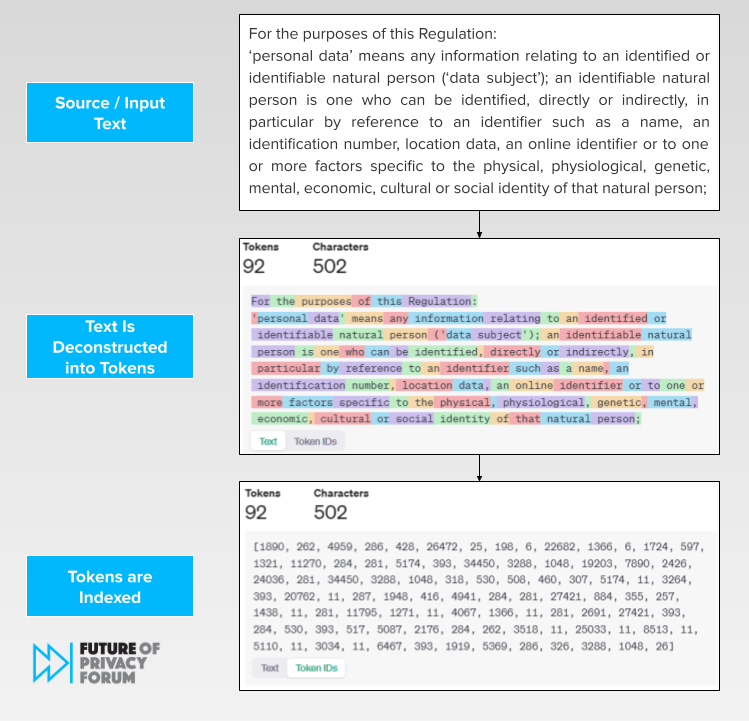
Preliminary Perspectives that Large Language Models Do Not Contain Personal Information: In July 2024, the Hamburg Data Protection Authority (Hamburg DPA) in Germany released an informal discussion paper arguing that LLMs do not store personal information under the GDPR because these models do not contain any data that relates to an identified or identifiable person. According to the Hamburg DPA, the tokenization and embedding processes involved in developing LLMs transform text into “abstract mathematical representations,” losing “concrete characteristics and references to specific individuals,” and instead reflect “general patterns and correlations derived from the training data.”
Fig. 1: Example indexed values of tokens created using OpenAI’s tokenizer tool (setting: GPT-3 (Legacy)).
The Hamburg DPA added that LLM outputs “do not store the texts used for training in their original form, but process them in such a way that the training data set can never be fully reconstructed from the model.”
Similarly, a 2023 guidance document from the Danish DPA (Datatilsynet) on AI use by public authorities also assumed that an AI model “does not in itself constitute personal data, but is only the result of the processing of personal data.” The document notes that some models can be attacked in ways that re-identify individuals whose information existed in the training data. While this would be considered a data breach, this risk “does not, in the opinion of the Danish Data Protection Agency, mean that the model should be considered personal data in itself.”
The Irish Data Protection Commission’s (DPC) 2024 guidance on generative AI acknowledged that some models may unintentionally regurgitate passages of personal training data, a key point raised by the sponsor of the California law. However, comprehensive reviews are underway, with Ireland’s DPC seeking an opinion from the European Data Protection Board (EDPB) on “issues arising from the use of personal data in AI models.”
Recently, the EDPB’s ChatGPT Taskforce Report noted that the processing of personal information occurs at different stages of an LLM’s life cycle (including collection, pre-processing, training, prompts, output, and further training). While it did not address personal information within the model itself, the report emphasized that “technical impossibility cannot be invoked to justify non-compliance with GDPR requirements.”
Opposing Perspectives that LLMs Do Contain Personal Information: In contrast, in a detailed analysis on this issue, technology lawyer David Rosenthal has argued that, according to the “relative approach” espoused by the Court of Justice of the European Union (CJEU Case C‑582/14), the question of whether an LLM contains personal information should be assessed solely from the perspectives of the LLM user and the parties who have access to the output. Whether a data controller can identify a data subject based on personal information derived from an LLM is not material; the information is considered personal information as long as the data subject can be identified or is “reasonably likely” to be identified by the party with access and that the party with access has an interest in identifying the data subject. Consequently, a party that discloses information that is personal information for another data subject is classified as disclosing personal information to a third party and must comply with GDPR.
Conversely, if an LLM user formulates a prompt that cannot be reasonably expected to generate output relating to a specific data subject—or if those with access to the output do not reasonably have the means to identify those data subjects and lacks the interest in doing so—then there is no personal information and thus data protection requirements do not apply. Other commentators that disagree with the Hamburg DPA’s discussion paper have focused on the reproducibility of training data, likening the data stored in an LLM to encrypted data.
What’s Next
Addressing these policy ambiguities will benefit from guidance and alignment between companies, researchers, policy experts, and regulators. Ultimately, it will be up to the California Attorney General and CPPA to make a determination under AB 1008 through advisories, rulemaking, or enforcement actions. Greater collaboration between regulators and technical experts may also help build a shared understanding of personal information in LLMs, non-LLM AI models, and AI systems and promote consistency in data protection regulation.
Even if California’s policy and legal conclusions ultimately differ from conclusions in other jurisdictions, building a shared (technical) understanding will help assess whether legislation like AB 1008 effectively address these issues and comports with existing privacy and data protection legal requirements, such as data minimization and consumer rights.
Updated February 25, 2025: FPF no longer coordinates the Multistate AI Policymaker Working Group
Updated February 25, 2025: FPF no longer coordinates the MAP-WG. Please read here for more information.
Future of Privacy Forum Convened Over 200 State Lawmakers in AI Policy Working Group Focused on 2025 Legislative Sessions
The Multistate AI Policymaker Working Group (MAP-WG) was convened by FPF to help state lawmakers from more than 45 states to collaborate on emerging technologies and related policy issues.
OCTOBER 21, 2024 — In the lead-up to the 2025 legislative session, FPF is excited to convene the expanded Multistate AI Policymaker Working Group (MAP-WG)—a bipartisan coalition of over 200 state lawmakers from more than 45 states, and highlight the group’s resources in a new dedicated landing page. This lawmaker-led initiative, facilitated by FPF, enables legislators to collaborate on developing a shared understanding of emerging technologies, particularly artificial intelligence, and to coordinate on related policy issues. In anticipation of significant state-level AI legislation in 2025, the group is expanding its efforts and launching a dedicated landing page (fpf.org/multistateAI) to centrally share its purpose, key resources, and insights with a broader audience.
In the absence of a comprehensive federal law regulating data privacy or AI, state lawmakers are quickly moving forward with local legislation in response to the rapid advances in AI. This has led to questions about how to best craft appropriate, consistent protections for individuals. The MAP-WG seeks to navigate these challenges by fostering collaboration and promoting better understanding of AI technologies.
FPF serves as a neutral convenor and is proud to be a trusted source of nonpartisan, practical expertise and support. While the group primarily focuses on artificial intelligence, its scope extends to related areas such as data privacy, enforcement, regulation, AI workforce development, and combating non-consensual intimate images.
“To foster better communication, idea-sharing, and support among state legislators, FPF is excited to convene and assist this group,” said Tatiana Rice, FPF’s Deputy Director for U.S. Legislation. “As a forum that brings together industry, academics, consumer advocates, and civil society to discuss emerging technologies and privacy protections, FPF is uniquely positioned to support the group’s mission of promoting the safe and equitable use of AI. We are thrilled to now provide a public resource dedicated to this vital collaboration.”
Participation in the MAP-WG is open to any U.S. state-level senator, representative, or public official, and current staff members. FPF serves as a neutral facilitator of the group. Meetings include open sessions with the participation of outside experts, and closed sessions reserved for lawmakers and staff.
The MAP-WG’s bipartisan steering committee, chaired by Connecticut Senator James Maroney (D), collaborates to decide the topics and agenda.
Other members of the lawmaker steering committee include:
Alaska Senator Shelley Hughes (R)
California Privacy Protection Agency Deputy Director of Policy and Legislation Maureen Mahoney
Colorado Senator Robert Rodriguez (D)
Florida Representative Fiona McFarland (R)
Maryland Senator Katie Fry Hester (D)
Minnesota Representative Steve Elkins (D)
Minnesota Representative Kristin Bahner (D)
New York Senator Kristen Gonzalez (D)
Texas Representative Giovanni Capriglione (R)
Virginia Delegate Michelle Maldonado (D)
Learn more about the work of the Multistate AI Policymaker Working Group here.
In recent weeks, some critics opposed to state AI legislation have made inaccurate claims about FPF on social media and other forums. I am writing to set the record straight.
FPF is an independent think tank that works with companies and policymakers to help find pragmatic solutions to support the benefits of emerging technologies, including AI. We facilitate expert, bipartisan conversations, and we are optimistic about the benefits of data use when safeguarded by pragmatic protections. FPF does not work to import European-style regulation into US states. We agree with Vice President JD Vance’s recent remarks that this model will not work for the United States. American leadership on AI is necessary, with US companies succeeding and winning against China.
FPF is not partisan. Our credibility as an honest convenor and thought leader is crucial to serving as a bridge between lawmakers, companies, and other experts. We are proud of the fact that over 90% of our funding comes from the private sector. The government grants referenced in a recent op-ed do not fund the Multistate AI Policymaker Working Group. These contracts support training in support of cross-border data flows and efforts to advance privacy enhancing technologies, which are often essential to accessing data sets that are otherwise unavailable. FPF has neither sought nor received grant support for our work facilitating the multistate group or for other work regarding state legislation.
The multistate group is bipartisan. Lawmakers drive the agenda and discussion, and FPF served as a neutral facilitator. We did not play any role in the Texas AI bill sponsored by Rep. Giovanni Capriglione (R-TX) nor have we taken a position on it. In fact, Rep. Capriglione worked with the Texas Public Policy Foundation on crafting the bill — a well-known conservative group that was previously led by President Donald J. Trump’s Agriculture Secretary Brooke Rollins.
At a recent Texas Public Policy Foundation event, Rep. Capriglione described the extensive local engagement process and local hearings he held to take input as he drafted a bill to respond to his Texas stakeholders’ concerns about AI. While lawmakers may choose to pursue different paths to legislating, the multistate group created a platform to find common ground about AI, mitigating a potential patchwork of conflicting and discordant AI laws that would be confusing for consumers and difficult to comply with. This is particularly important in the absence of a federal standard.
FPF greatly values the trust of stakeholders across the political spectrum. We do not want misperceptions about the Multistate AI Policymaker Working Group to create any misperceptions about the larger mission of FPF and our non-partisan role. As a result, we will be withdrawing from our work supporting the Working Group. We believe that Republicans and Democrats can find common ground and solutions to address issues raised by emerging technologies. FPF will continue to be non-partisan and fully transparent in our work.
Synthetic Content: Exploring the Risks, Technical Approaches, and Regulatory Responses
Today, the Future of Privacy Forum (FPF) released a new report, Synthetic Content: Exploring the Risks, Technical Approaches, and Regulatory Responses, which analyzes the various approaches being pursued to address the risks associated with “synthetic” content – material produced by generative artificial intelligence (AI) tools. As more people use generative AI to create synthetic content, civil society, media, and lawmakers are paying greater attention to some of the risks—such as disinformation, fraud, and abuse. Legislation to address these risks has focused primarily on disclosing the use of generative AI, increasing transparency around generative AI systems and content, and placing limitations on certain synthetic content. However, while these approaches may address some challenges with synthetic content, each one is individually limited in its reach and implicates a number of tradeoffs that policymakers should address going forward.
Synthetic content can raise a number of risks, including risks related to political disinformation and misinformation, fraud, and non-consensual intimate imagery (NCII) and child sexual abuse material (CSAM).
Policymakers and others are exploring various technical, organizational, and legal approaches to addressing synthetic content’s risks, such as requiring authentication techniques and placing limitations on certain uses of synthetic content.
Current approaches to regulating synthetic content may face a number of limitations and tradeoffs, including with privacy and security, and policymakers should evaluate the potential implications of these approaches.
This report is based on an extensive survey of existing technical and policy literature, recently-proposed and/or enacted legislation, and emerging regulatory guidance and rulemaking. The appendix provides further details about the current major legislative and regulatory frameworks being proposed in the U.S. regarding synthetic content.
This report is part of a larger, ongoing FPF effort to monitor and analyze emerging trends in synthetic content, including its potential risks, technical developments, and relevant legislation and regulation. For previous FPF work on this issue, check out the following:
Comment to the Federal Communications Commission (FCC) on disclosure and transparency of AI-generated content in political advertisements.
Comment to the National Institute of Standards & Technology (NIST) in response to NIST AI 100-4, “Reducing Risks Posed by Synthetic Content: An Overview of Technical Approaches to Digital Content Transparency.”
Comment to the Federal Trade Commission (FTC) on AI-driven impersonation.
Comment to the Federal Election Commission (FEC) on “fraudulent misrepresentation” in AI-generated political campaign ads.
One-pager analyzing California’s new AI Transparency Act (SB 942), which requires certain disclosures for AI-generated content (FPF members only).
Briefing analyzing general current legislative approaches to synthetic content (FPF members only).
If you would like to speak with us about this work, or about synthetic content more generally, please reach out to Jameson Spivack ([email protected]).
Out, Not Outed: Privacy for Sexual Health, Orientations, and Gender Identities
Co-authored by: Judy Wang (FPF Intern), Jeter Sison (FPF Intern), Jordan Wrigley (FPF Data and Policy Analyst, Health & Wellness)
On National Coming Out Day, it’s important to recognize that Coming Out is a right of passage for many LGBTQ+ individuals and a decision that they should be empowered to make for themselves.
Protections for health information are essential to ensuring the autonomy of an individual in choosing how to come out, to whom, and when. A person’s health information may facially reveal their sexual orientation and gender identity (“SOGI”). Alternatively, a person’s health information may not specifically include SOGI information, but SOGI information may be able to be inferred or extrapolated from other health information, especially in a personal profile that includes many different data points.
Opportunities for Health Data and Services for LGBTQ Individuals
While uses of health data may carry heightened risk for LGBTQ+ individuals, it is also particularly critical for those same individuals to have access to safe, secure, and practicable physical and mental health services. A poll by LGBT Tech shows LGBTQ+ individuals use online and digital health resources extensively to navigate information and access to healthcare. The National Coalition for LGBTQ Health has found that “LGBTQ people are more likely to report poor physical and mental health than the general population, including increased incidence of HIV and other sexually transmitted infections (STIs), long term conditions such as arthritis and chronic fatigue, and elevated risk of depression, anxiety, and other mental illness.” In addition, LGBTQ+ youth have been found to face heightened risks for mental health issues, and are 300% more likely to suffer from symptoms of depression. Unfortunately, at the same time, LGBTQ+ adults are twice as likely to report having experienced a negative health care interaction.
To address these health disparities, researchers have stressed the importance of collecting additional health information, including SOGI information. In addition, where LGBTQ+ individuals do not have local access to equitable health care resources, connected devices and services may provide new capacity for individuals to obtain valuable information about their health questions, engage with healthcare professionals, and even receive important physical and mental treatment.
Specific categories of tech services and applications have been found to play an increased role in addressing the health and wellbeing needs of LGBTQ+ individuals. Some of these include:
Mental health services: Through social media and mobile applications, the internet has been able to help connect LGBTQ+ people to accessible and appropriate LGBTQ+ mental health care. Platforms like National Queer & Trans Therapists of Color Network and LGBTQ Therapy Space connect LGBTQ+ people with specialized mental health care, resources, and community support. Mental health apps oriented towards the LGBTQ community provide a virtual format for accessing specialized, culturally competent healthcare.
Gender-affirming online care: With half of all U.S. states having passed bans on gender-affirming care, now more than ever, safe and private ways to access gender-affirming care online are needed to protect the rights of transgender Americans. 39% of U.S. transgender youth live in states that have passed bans on gender-affirming care, preventing them from accessing medically necessary care and worsening the stigma and discrimination against all transgender youth and people.
Dating & connections services: Dating and connections apps often play a crucial role in connecting LGBTQ+ users, especially in situations where it may be unsafe to do so in person. Compared to 28% of heterosexual adults who use dating apps, 50% of lesbian, gay, and bisexual adults have reported that they use dating apps. These apps have also provided an essential way for LGBTQ+ people to share and connect with others who face similar health challenges. For instance, HIV-positive LGBTQ+ people may use dating services to connect with other people living with HIV, a community of people who often face stigma while dating and in general.
Health Data Risks for LGBTQ+ People
While online health and wellbeing services can offer a lifeline to many LGBTQ+ individuals, they can also create new risks. For instance, improper uses of health information related to sexuality may undermine the autonomy of an LGBTQ+ individual. According to an article in the Oregon Law Review, data usage related to sexuality can result in pop-ups on an individual’s phone, creating worry and concern about potentially outing an individual in public or quasi-public situations. LGBTQ+ individuals are not always able to be safely out in public settings, with potential harms including impacts on employment, loss of housing opportunities, or jeopardization of personal relationships.
These risks have increased as certain U.S. states have pursued and enacted laws to undermine the rights and freedoms of LGBTQ+ people and communities. Efforts to restrict gender-affirming care have gained traction in several states, and lawmakers in Oklahoma, Texas, and South Carolina have proposed legislation to prohibit such care for transgender individuals up to the age of 26. Additionally, multiple states have implemented policies barring the use of Medicaid or other state-sponsored insurance for gender-affirming treatments, regardless of the patient’s age.
New Legal Protections for Health Data
When collected inside a health care environment, such as a telehealth service, health data, including SOGI information, is subject to protections under the Health Information Portability and Accountability Act (HIPAA) and related laws or regulations. However, these protections do not extend to similar information collected outside of that context. Filling that space, eighteen U.S. states (as of the writing of this post) have passed comprehensive privacy laws that apply more broadly, and each of them include “sexual orientation” as a category of sensitive data or sensitive personal information subject to special protections. However, of these 18 laws, only one (Maryland) affirmatively includes “gender-affirming treatment” in its scope of sensitive information, although three of the states (Oregon, Delaware, and New Jersey) do explicitly include “status as transgender or non-binary.”
In addition to comprehensive privacy laws, two states have implemented health data privacy laws – Washington (My Health, My Data Act (MHMD)) and Nevada (SB 370). Both laws have definitions for “consumer health data,” and include a non-exhaustive list of qualifying categories of information, including “gender-affirming care” information. Additionally, both laws define “consumer health data” as “health information derived or inferred from non-health data,” which could include data usages that unintentionally reveal information about a user’s sexual orientation or gender identity.
At the federal level, the Biden Administration has initiated the Federal Evidence Agenda on LGBTQI+ Equity, directing the collection of SOGI data in federal surveys and forms. The Federal Evidence Agenda on LGBTQ+ Equity follows the recommendation of implementing appropriate security and privacy safeguards with “Guideline 1: Ensure relevant data are collected and privacy protections are properly applied.” However, without comprehensive privacy legislation at the federal level, there is a lack of guidance regarding collecting and sharing data while protecting user privacy.
Additionally, in 2024, the U.S. Department of Health and Human Services (HHS) issued a rule designed to prevent discrimination based on gender identity or sexual orientation by healthcare providers and insurers that receive federal funding. Unfortunately, recently, a federal judge in Mississippi issued a preliminary injunction against the rule, citing the Supreme Court’s decision to overturn Chevron deference to administrative agencies. A recent Supreme Court decision also blocked the enforcement of a new rule from the Biden Administration that would protect transgender students from discrimination in education. The new rule included sexual orientation and gender identity within its discrimination protections for the first time.
Current best practices and recommendations
It is imperative for the collectors of health data about LGBTQ+ individuals, and in particular sexual orientation and gender identity (SOGI) data, to work toward a safer and more equitable use of SOGI data with meaningful privacy safeguards in mind.
SOGI data is inherently complex. Given its revelatory nature, SOGI data should be treated with heightened sensitivity. In 2022, FPF and LGBT Tech published a report on the Role of Data Protection in Safeguarding Sexual Orientation and Gender Identity Information. Organizations should apply regulatory safeguards robustly and approach SOGI information with appropriate care and respect for its contextual sensitivity. This can be done, for instance, by requiring consent for the use and collection of SOGI data and considering limitations before data is sent to third parties, particularly if it will make that data publicly accessible in a way that could increase the risk of outing someone. Organizations should implement appropriate security and privacy safeguards to protect any SOGI data in proportion to the sensitivity of the underlying data. They should also note that the sensitivity should be considered individually and in the community context.
Additional reports provide more information and can increase knowledge and understanding of the challenges and risks associated with the collection and use of health information for LGBTQ+ people. This includes a 2024 report by LGBT Tech that recommends that platforms adopt multifaceted strategies that prioritize user protection, inclusivity, and community empowerment. A research brief from the Center for Democracy and Technology in 2022 is also relevant, that explains how LGBTQ+ students are increasingly targeted by policies and practices that threaten their privacy in schools, with 29 percent of LGBTQ+ students reporting that they or someone they know has been outed by school-sponsored monitoring technology.
Conclusion
Coming Out Day is about having control over information. The decision to come out should be up to the discretion of the individual coming out. On Coming Out Day, and every day, robust privacy and data protection rules, policies, and practices are crucial to empower LGBTQ+ people to decide when and where to share their SOGI data.