
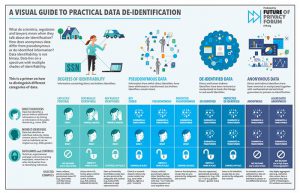
One key method for ensuring privacy while processing large amounts of data is de-identification. De-identified data refers to data through which a link to a particular individual cannot be established. This often involves “scrubbing” the identifiable elements of personal data, making it “safe” in privacy terms while attempting to retain its commercial and scientific value.
In the era of big data, the debate over the definition of personal information, de-identification and re-identification has never been more important. Privacy regimes often rely on data being considered Personal in order to require the application of privacy rights and protections. Data that is anonymous is considered free of privacy risk and available for public use.
Yet much data that is collected and used exists somewhere on a spectrum between these stages. FPF’s De-ID Project has examined practical frameworks for applying privacy restrictions to data based on the nature of data that is collected, the risks of de-identification, and the additional legal and administrative protections that may be applied.

The Future of Privacy Forum and Sen. Schumer Announce Important Agreement to Ensure Consumers Have Opportunity to “Opt-Out” Before Stores Can Track Their Movement Via Their Mobile Devices
FOR IMMEDIATE RELEASE: October 22, 2013 The Future of Privacy Forum and Sen. Schumer Announce Important Agreement to Ensure Consumers Have Opportunity to “Opt-Out” Before Stores Can Track Their Movement Via Their Mobile Devices FPF and Schumer Release New Code-of-Conduct Agreed to By Location-Technology Companies Code Includes A Requirement of Clear, In-Store […]
Solove and Schwartz Reconcile US-EU Privacy Law
In their new essay, Reconciling Personal Information in the United States and European Union, Professors Dan Solove and Paul Schwartz explore the divergence between European and US privacy law. The pair point to trans-Atlantic differences in the definition of personally identifiable information (PII) as one of the biggest challenges for harmonizing the the two legal systems’ […]
FPF Announces New Group to Develop Best Practices for Retail Location Analytics Companies
FPF Announces New Group to Develop Best Practices for Retail Location Analytics Companies
New Study Shows Need for De-identification Best Practices
Publically releasing sensitive information is risky. In 1997, Latanya Sweeney used full date of birth, 5 digit ZIP code, and gender to show that seemingly anonymous medical data could be linked to an actual person when she uncovered the health information of William Weld, the former governor of Massachusetts. Sweeney in a new study analyzes […]
Increasing Calls for a Big Data Dialog
Big Data promises to open new doors to curing diseases, cleaning the environment, and easing life’s burdens, but is it opening too many doors? Writing for The New York Times on Sunday, Steve Lohr suggested that the privacy challenges posed by Big Data are so large that it might trump any potential benefits. The surveillance […]
EU Roundtable Discussion & White Paper launch
The Future of Privacy Forum (FPF) is engaged in the discussion on the draft European General Data Protection Regulation. In particular, we are publishing white papers addressing three issues raised by the new legislation: De-identification and the definition of personal data Jurisdiction and applicable law Consent You and your colleagues are warmly invited to attend […]
From Uruguay, Chris Wolf: Privacy and Technology in Balance
On Tuesday, October 23, FPF’s Chris Wolf was one of the first plenary speakers at the 34th Annual Conference of Data Protection and Privacy Authorities in Punta Del Este, Uruguay. Here is the text of his remarks: Privacy and Technology in Balance Thank you for the opportunity to present on behalf of the Future of Privacy […]
FPF Announces Privacy Papers for Policy Makers 2012
The Future of Privacy Forum Announces Privacy Papers for Policy Makers 2012 WASHINGTON – The Future of Privacy Forum (FPF) today released the 2012 Privacy Papers for Policy Makers, highlighting eight leading privacy writings that were voted by the FPF Advisory Board to be most useful for policy makers. The papers cover a wide array […]
Senior Fellow Peter Swire Testifies at Senate Hearing
FPF Senior Fellow Peter Swire testified as part of today’s Senate Hearing on the “State of Federal Privacy and Data Security Law: Lagging Behind the Time.” The Hearing, held by the Subcommittee on Oversight of Government Management; the Federal Workforce; and the District of Columbia, aimed to address the privacy-related challenges facing federal agencies today. […]
Senate Commerce Testimony on Privacy and Self-Regulation
On June 28, Ohio State law professor and FPF Senior Fellow Peter Swire testified before the Senate Commerce Committee on “The Need for Privacy Protections: Is Industry Self-Regulation Adequate?” Other witnesses were: Alex Fowler, Global Privacy and Policy Leader for Mozilla; Bob Liodice, President and CEO of the Association of National Advertisers; and Berin Szoka […]