Nothing to Hide: Tools for Talking (and Listening) About Data Privacy for Integrated Data Systems
Data-driven and evidence-based social policy innovation can help governments serve communities better, smarter, and faster. Integrated Data Systems (IDS) use data that government agencies routinely collect in the course of delivering public services to shape local policy and practice. They can inform the design and implementation of programs, help measure and evaluate outcomes across the lifecourse, and enable policy-makers to better address complex social problems.
Respecting privacy is paramount to IDS’ success. The use of IDS to link sensitive personal data is typically governed by stringent local, state, and federal privacy laws and regulations, as well as rigorous technical safeguards and ethical norms. Nevertheless, individuals and communities routinely have questions and concerns about how their information is used and protected.
For lasting success, IDS need to develop “social license” to integrate data. Ultimately, societal acceptance and approval depend not merely on legal compliance with privacy rules, but on legitimacy, credibility, and public trust. Inclusive public engagement and effective communications around privacy are necessary for IDS to build trust in the public sector and to create strong, sustainable relationships with the communities they serve.
In order to help IDS and government leaders engage stakeholders and increase communities’ trust in the value of IDS, Future of Privacy Forum (FPF) and Actionable Intelligence for Social Policy (AISP) have created the Nothing to Hide toolkit.
This toolkit provides IDS stakeholders with the necessary tools to support and lead privacy-sensitive, inclusive engagement efforts. A narrative step-by-step guide to IDS communication and engagement is supplemented with action-oriented appendices, including worksheets, checklists, exercises, and additional resources, available below.
Future of Privacy Forum and Actionable Intelligence for Social Policy Release ‘Nothing to Hide: Tools for Talking (and Listening) About Data Privacy for Integrated Data Systems’
Future of Privacy Forum and Actionable Intelligence for Social Policy Release ‘Nothing to Hide: Tools for Talking (and Listening) About Data Privacy for Integrated Data Systems’
Washington, DC – Today, Future of Privacy Forum and Actionable Intelligence for Social Policy released Nothing to Hide: Tools for Talking (and Listening) About Data Privacy for Integrated Data Systems. Nothing to Hide provides governments and their partners working to integrate data for policy and program improvement with the necessary tools to lead privacy-sensitive, inclusive engagement efforts. In addition to a narrative step-by-step guide to communication and engagement on data privacy, the toolkit is supplemented with action-oriented appendices, including worksheets, checklists, exercises, and additional resources.
Integrated Data Systems leverage the data that agencies routinely collect in the course of delivering public services to help governments serve communities better, smarter, and faster. By linking data across government silos, IDS can inform the evidence-based design and implementation of programs, help measure and evaluate outcomes across the lifecourse, and enable policy-makers to better address complex social problems.
Respecting privacy is paramount to successful data sharing and integration efforts. The use of sensitive personal data is governed by local, state, and federal privacy laws and regulations, as well as rigorous technical safeguards and ethical norms. Nevertheless, individuals and communities routinely have questions and concerns about how their information is used and protected. The strongest IDS lean into opportunities to talk about why data are necessary for social policy improvement and innovation—and also make time to listen to and address stakeholders’ concerns, expectations, and priorities.
“The path to lasting success for IDS is establishing sound, two-way communications; empowering stakeholders; and continually serving the public good,” said Kelsey Finch, Policy Counsel at FPF. “Ultimately, societal acceptance and approval for evidence-based policy depend not merely on legal compliance with privacy rules, but on each IDS’ legitimacy, credibility, and public trust.”
“The state and local governments we work with take their role as data stewards very seriously. Like us, they believe that an ethical imperative exists to respectfully share and use data as a public asset, with the appropriate safeguards in place,” said Della Jenkins, Executive Director of AISP.
FPF and AISP hope this toolkit will help government leaders and IDS stakeholders to articulate that commitment, and do the hard work of both talking and listening about data privacy. In doing so, they are bound to increase both communities’ trust in the value of data sharing and their long-term impact.
###
This material is based upon work supported by the Corporation for National and Community Service (CNCS). Opinions or points of view expressed in this document are those of the authors and do not necessarily reflect the official position of, or a position that is endorsed by, CNCS or the Social Innovation Fund.
Thanks to our partners at Third Sector Capital Partners and the members of our Empowering Families and AISP Learning Community for sharing experiences and insights about data privacy and engagement.
About Future of Privacy Forum
Future of Privacy Forum is a non-profit organization that serves as a catalyst for privacy leadership and scholarship, advancing principled data practices in support of emerging technologies. Learn more about FPF by visiting www.fpf.org.
About Actionable Intelligence for Social Policy
Actionable Intelligence for Social Policy is an initiative that focuses on the development, use, and innovation of integrated data systems (IDS) for policy analysis and program reform. AISP encourages social innovation and social policy experimentation so government can work better, smarter and faster. Learn more about AISP by visiting www.aisp.upenn.edu.
FPF Privacy Book Club – The Known Citizen: A History of Privacy in Modern America (December 5, 2018)
The FPF Privacy Book Club provides members with the opportunity to read a wide range of books — privacy, data, ethics, academic works, and other important data relevant issues — and have an open discussion of the selected literature.
We are excited to share The Known Citizen: A History of Privacy in Modern America by Professor Sarah E. Igo was chosen as the popular favorite by our readers. We are thrilled Professor Igo will be joining us for the December book club to introduce her book and answer questions.
Please join us on Wednesday, December 5, at 2:00 pm (EST) for the next FPF Privacy Book Club. If you are an existing member of the Book Club, you will receive the virtual conference dial-in information near the discussion date. You can join the Book Club here. Please feel free to forward this sign up link to friends who also may be interested.
The Privacy Expert's Guide to AI And Machine Learning
Today, FPF announces the release of The Privacy Expert’s Guide to AI and Machine Learning. This guide explains the technological basics of AI and ML systems at a level of understanding useful for non-programmers, and addresses certain privacy challenges associated with the implementation of new and existing ML-based products and services.
Advanced algorithms, machine learning (ML), and artificial intelligence (AI) are appearing across digital and technology sectors from healthcare to financial institutions, and in contexts ranging from voice-activated digital assistants, to traffic routing, identifying at-risk students, and getting purchase recommendations on various online platforms Embedded in new technologies like autonomous cars and smart phones to enable cutting edge features, AI is equally being applied to established industries such as agriculture and telecomm to increase accuracy and efficiency. Moving forward, machine learning is likely to be the foundation of many of the products and services in our daily lives, becoming unremarkable in much the same way that electricity faded from novelty to background during the industrialization of modern life 100 years ago.
Understanding AI and its underlying algorithmic processes presents new challenges for privacy officers and others responsible for data governance in companies ranging from retailers to cloud service providers. In the absence of targeted legal or regulatory obligations, AI poses new ethical and practical challenges for companies that strive to maximize consumer benefits while preventing potential harms.
For privacy experts, AI is more than just Big Data on a larger scale. Artificial Intelligence is differentiated by its interactive qualities – systems that collect new data in real time via sensory inputs (touchscreens, voice, video or camera inputs), and adapt their responses and subsequent functions based on these inputs. The unique features of AI and ML include not just big data’s defining characteristic of tremendous amounts of data, but the additional uses, and most importantly, the multi-layered processing models developed to harness and operationalize that data. AI-driven applications offer beneficial services and research opportunities, but pose potential harms to individuals and groups when not implemented with a clear focus on protecting individual rights and personal information. The scope of impact of these systems means it is critical that associated privacy concerns are addressed early in the design cycle, as lock-in effects make it more difficult to later modify harmful design choices. The design must include on-going monitoring and review as well, as these systems are literally built to morph and adapt over time. Intense privacy reviews must occur for existing systems as well, as design decisions entrenched in current systems impact future updates built upon these models.
As AI and ML programs are applied across new and existing industries, platforms, and applications, policymakers and corporate privacy officers will want to ensure that individuals are treated with respect and dignity, and retain the awareness, discretion and controls necessary to control their own information
Learning from Europe but looking beyond for privacy law
FPF’s CEO, Jules Polonetsky, recently published an opinion piece in The Hill that discusses the need for comprehensive federal privacy legislation. Jules explains:
Any legislation should also consider the increasingly sophisticated privacy tools that are emerging, including differential privacy to measure privacy risk, homomorphic encryption that can enable privacy safe data analysis, and many new privacy compliance tools that are helping companies better manage data. A law that will stand the test of time and successfully protect privacy rights while enabling valuable uses of data should include mechanisms to incentivize such technology measures.
Today, researchers published a paper detailing how governments can use public genetic databases to identify criminal suspects. These activities raise real questions about when it’s appropriate for law enforcement to analyze genetic information, and how best to protect individuals whose genetic data has been analyzed as part of a commercial service, but who are not accused of a crime.
FPF recently published Privacy Best Practices for Consumer Genetic Testing Services. The document includes strong protections for genetic data, particularly with regard to government access: law enforcement should obtain a warrant before seeking the disclosure of genetic data from companies; firms should demand valid legal process before disclosing genetic data and publish annual transparency reports. If government representatives are deviating from this approach, lawmakers or courts should impose clear, common-sense restrictions.
The sort of law enforcement search described in the paper would not be permitted by the FPF Best Practices. The search involves uploading genetic information discovered at crime scenes to an online database to identify an individual or an individual’s relatives. We require that companies only process genetic information uploaded with an individual’s permission; a crime scene upload necessarily occurs without the unknown subject’s permission. Further, leading companies require legal process before they will disclose genetic information to the government and have vigorously pushed back against law enforcement access to genetic data, many times declining to provide data in response to what they determined to be inappropriate requests. It is hard to imagine judges issuing warrants for the sort of general searches contemplated in the paper.
It’s worth noting that the public database at the center of the current discussion – GEDMatch – explicitly tells users that their genetic data will be shared with others without granular consent and subject to government access without a warrant. GEDMatch’s policies conflict with FPF’s Best Practices and are out of step with leading companies, which restrict this kind of access. GEDMatch’s practices are also different in another key way: the service permits users to upload digital genetic profiles. Prominent companies do not typically provide for such uploads, making crime scene genetic data less susceptible to matching without valid legal process.
There are clear benefits of using genetic data to help consumers better understand their health and ancestry. Genetic data, properly obtained and analyzed, can also help law enforcement solve crimes and improve public safety. However, unfettered law enforcement access to genetic information on commercial services would present substantial privacy risks. FPF’s Best Practices articulate a framework that can prevent many of these risks while preserving the public safety value of limited, narrow genetic searches predicated on probable cause and conducted pursuant to appropriate process. As we move forward, it is worth considering additional measures, including restrictions on government activities, technical safeguards, or other steps, that could bolster trust and safety.
Privacy Features of iOS 12 and MacOS Mojave
With much media attention focused on new Apple hardware, including new iPhones, Apple also released updated versions of its mobile and desktop operating systems for public download this week. The software upgrades (iOS 12 for iPhones, and macOS 10.14 Mojave for desktop Macs) bring many new features, such as Group FaceTime, options to customize notifications, and aesthetic changes such as an optional desktop “Dark Mode.”
Amidst these upgrades, what’s new for data privacy? Consumers are increasingly aware of privacy issues, and Apple has articulated the company’s commitment to privacy “as a human right.” Meanwhile, regulators are entering the consumer privacy debate, with this week’s Senate hearing bringing further attention to the data practices and policy positions of leading technology companies.
In their Fall updates, Apple improves several existing privacy controls for iPhone users, and MacOS 10.14 brings privacy-focused technical modifications. Several of these updates were first announced at Apple’s June 2018 Worldwide Developer Conference (WWDC), which we discussed (along with major updates to Google’s Android P) earlier this summer, and have now been released to the public.
Below, we provide round-ups of privacy updates in iOS 12, macOS 10.14 (Mojave), and the App Store Review Guidelines.
Privacy Updates in iOS 12
The following privacy updates are included in iOS 12, which can be downloaded on devices as old as the iPhone 5s and iPad Air.
USB Restricted Mode: In July 2018, Apple released iOS 11.4.1 and introduced USB Restricted Mode. This feature requires iPhone users to input their passcode to unlock the phone when connecting it to a USB accessory if the phone has been locked for an hour or more. iOS 12 implements additional USB restrictions, including disabling USB connections immediately after the device locks if more than three days have passed since the last USB connection. This increases protection for users that don’t often make such connections. Overall, the USB Restricted Mode makes it much more difficult for an unauthorized person or entity, such as a stalker or phone thief, to unlock a user’s phone without permission.
On-Device Machine Learning for Siri Suggestions: A new feature called Siri Suggestions uses machine learning to decide what apps and shortcuts to surface as a banner on the iPhone home screen. Siri Suggestions will be based on users’ patterns from signals like location, time of day and type of motion (e.g., walking, running, or driving). iOS 12 analyzes this data locally on the device rather than on remote servers, providing users with personalized experiences while limiting access to the underlying information.
Privacy Updates in macOS 10.14 (Mojave)
iOS-Style Permissions for Desktop Apps: MacOS apps will now be required to request the user’s permission to access certain device sensors, such as the camera or microphone. These permissions have long been standard on iOS and other mobile operating systems.
Intelligent Tracking Prevention 2.0: Building on a feature introduced last year in the Safari browser, Apple is introducing Intelligent Tracking Prevention 2.0 (ITP 2.0) as a default feature for Safari in macOS Mojave. Earlier versions of ITP used machine learning to prevent websites from placing cookies that were identified as having “tracking abilities” after a 24-hour window. ITP 2.0 expands on this feature by immediately partitioning such third-party cookies. As a result, Safari will now prevent most website tracking from social media “Share” and “Like” buttons and other embedded content, unless the user consents to the data collection in a browser-prompted notification.
Obfuscation of Device Fingerprints: Safari in macOS Mojave will contain updates designed to prevent device fingerprinting. As FPF described in a 2015 report on cross-device tracking, devices and browsers can be identified with a degree of probability through metadata sent in web traffic – such as the system fonts, screen size, installed plug-ins, etc. This kind of digital “fingerprinting,” often referred to as server-side recognition, is often used for short-term advertising attribution and measurement. In Mojave, the Safari web browser will present websites with a “simplified system configuration,” in order to make many users’ “fingerprints” appear identical or very similar – reducing the efficacy of server-side recognition technologies.
Privacy Updates for Developers (App Store Review Guidelines)
In addition to technical updates to their operating systems, Apple has also made significant changes to its App Store Review Guidelines, the rules for how developers may collect and use personal information from users. These Guidelines, which apply to the third party developers who provide apps through the App Store, can be very influential when paired with robust oversight. In May, Apple began removing apps from the App Store for violations of policies against sharing location data with third-party advertisers without users’ consent. In August, Apple removed apps from the App Store that violated its policies against collecting data to build user profiles or contact databases.
Updates to the Guidelines include:
Developers are not permitted to create databases from users’ address book information (contact lists and photos). (5.1.2)
Developers must clearly describe new features and changes in the “What’s New” section of the App Store. (2.3.12)
Developers must request explicit user consent and provide a “clear visual indication when recording, logging, or otherwise making a record of user activity.” (2.5.14)
Developers must provide users with all information used to target a user with an ad without leaving the app. (3.1.3(b))
All apps must include a link to their privacy policy in the App Store Connect metadata field and within the app. (5.1.1)
Developers must include a mechanism to revoke social network credentials and disable data access between the app and social network from within the app. (5.1.1)
Developers must respect the user’s permission settings and not attempt to manipulate, trick, or force people to consent to unnecessary data access. (5.1.1)
New language in the Developer Code of Conduct states:
“Customer trust is the cornerstone of the App Store’s success. Apps should never prey on users or attempt to rip-off customers, trick them into making unwanted purchases, force them to share unnecessary data, raise prices in a tricky manner, charge for features or content that are not delivered, or engage in any other manipulative practices within or outside of the app.” (5.5)
Summary
Amidst new hardware and design features, Apple has introduced important technical updates to iOS 12 and MacOS that aim to empower users to better manage their information. Developers should also take note of significant changes to the App Store Review Guidelines, which help determine the ways in which apps and app partners can collect and handle user data. These changes help provide users with the ability to make more informed decisions that reflect their privacy preferences.
FPF Releases Understanding Facial Detection, Characterization, and Recognition Technologies and Privacy Principles for Facial Recognition Technology in Commercial Applications
These resources will help businesses and policymakers better understand and evaluate the growing use of face-based biometric technology systems when used for consumer applications. Facial recognition technology can help users organize and label photos, improve online services for visually impaired users, and help stores and stadiums better serve customers. At the same time, the technology often involves the collection and use of sensitive biometric data, requiring careful assessment of the data protection issues raised. Understanding the technology and building trust are necessary to maximize the benefits and minimize the risks.
These Principles define a benchmark of privacy requirements for those commercial situations where technology collects, creates, and maintains a facial template that can be used to identify a specific person – enabling the beneficial applications and services, while providing the necessary protections for individuals.
Government use of facial recognition technology has drawn a great deal of recent attention: in border control, in law enforcement, and in combatting terrorism. Others have published extensive reports on these topics. Some companies have called for regulation of how governments use these technologies, and others have refused to license the their facial recognition systems to the government until racial disparities and other accuracy challenges are overcome. Many have criticized the US government’s failure to ensure the fairness of its own biometric systems and protested law enforcement agencies who seek exemptions from long-standing accuracy requirements.
FPF agrees that we need public discussion and thoughtful regulatory action regarding government use of facial recognition technologies. These important issues deserve careful consideration and action in the context and history of government surveillance, algorithmic fairness, and equity; they are beyond the scope of our Privacy Principles for commercial use. We do not make recommendations regarding these issues in the publications we release today, but look forward to participation in the important policy discussions with civil society and government that are necessary.
The consumer-facing applications of facial recognition technology continue to evolve, and the technology will certainly be used in new ways in the future. FPF’s Privacy Principles for Facial Recognition Technology in Consumer Applicationsincludes seven core privacy principles that address the concerns surrounding personally identifiable information (PII) (templates of individual faces) collected by these systems. We expect these Principles will be used by companies as a resource for the development, refinement, and implementation of facial recognition technology in commercial settings.
The Privacy Principles Include:
Consent
Use – Respect for Context
Transparency
Data Security
Privacy by Design
Integrity and Access
Accountability
As more retailers and private companies increasingly employ various levels of facial scanning technology online and in person, and as applications for photo organizing, tagging, and sharing grow, it is time to push for greater consensus on what the appropriate privacy standards should be for commercial use cases, and what protections consumers should reasonably expect.
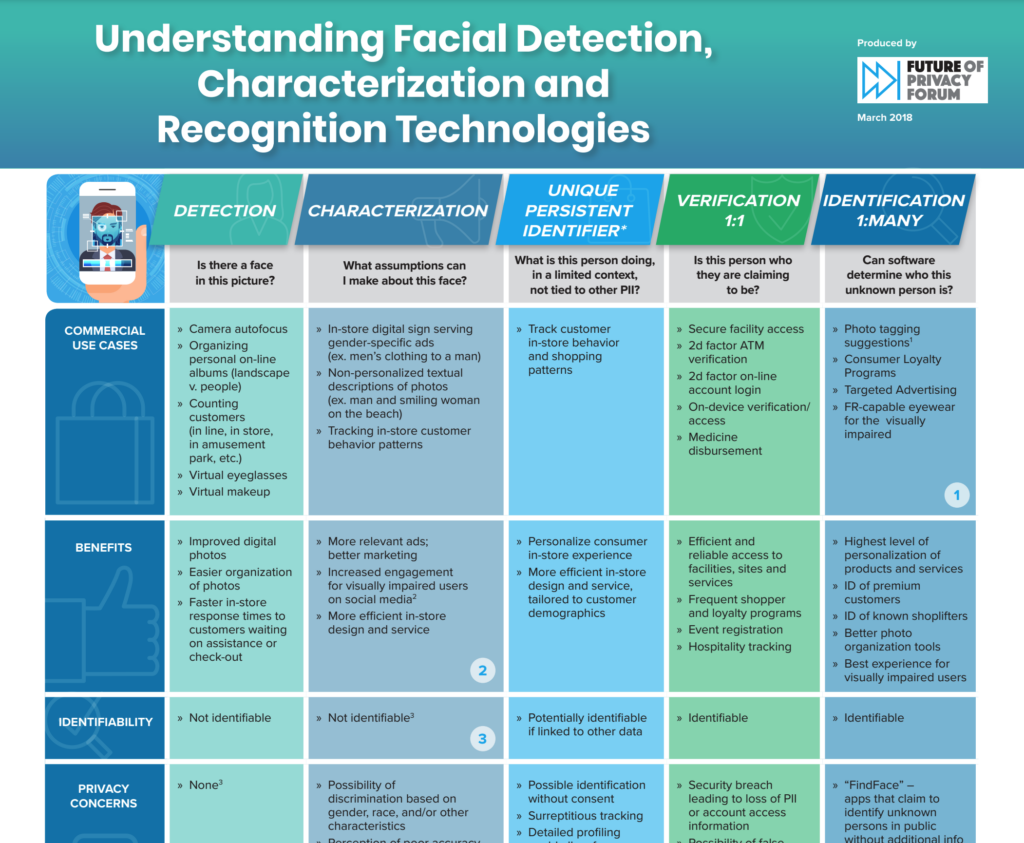
Equally relevant is the need to expand stakeholders’ awareness and understanding of the many types of facial scanning systems, as well as the impact of accuracy differences among the many systems available today. It is important to understand the distinctions between facial detection systems (which when properly designed neither create nor implicate any Personally Identifiable Information) with full-scale facial identification programs (matching a person’s image to a database in order to identify the individual to a store clerk or stadium employee who otherwise wouldn’t recognize them).
FPF’s graphic Understanding Facial Detection, Characterization, and Recognition Technologies summarizes the key distinctions between facial scanning technologies for easy reference. Relating each technology to its common use cases, benefits, concerns, and risk of identifiability, we have also outlined the minimum recommended notice and consent requirements and the Operator’s responsibilities.
In the case of facial characterization, for example, no PII is typically retained. However, characterization technologies can inform businesses whether individuals are smiling or frowning, male or female, and old or young. That means people may be treated differently – men and women may see different ads displayed on a sign, or there may be customized offers for parents or older individuals – in which case it’s important to understand that the system has been tailored to identify characteristics but not a unique identity. In these cases, notice is the key requirement, as well as attention to ensure there is no discriminatory activity. But in the examples that do involve creation of facial templates and identification, the guidance calls for increasing levels of consent.
We are pleased to announce the launch of our Privacy Book Club! The FPF Privacy Book Club will provide members with the opportunity to read a wide range of books — privacy, data, ethics, academic works, and other important data relevant issues — and have an open discussion of the selected literature.
The FPF Privacy Book Club will be held on the last Wednesday of each month. A virtual conference dial-in will be sent to book club members, which will include a video chat, phone line, and an online chat. You can join the Privacy Book Club by registering here. Please feel free to share the sign up link with your friends and colleagues who may be interested in participating.
The first FPF Privacy Book Club will be held Wednesday, September 26, 2018, at 2:00 pm (EST). We are excited to share that FPF Advisory Board member and author, Professor Woodrow Hartzog, will be joining the discussion to introduce his book, Privacy’s Blueprint: The Battle to Control the Design of New Technologies, and to answer a few questions. After hearing from Woody, we will host an open discussion of the book for the remainder of the meeting.
To learn more about FPF’s Privacy Book Club or to provide suggestions for future readings, please contact Michelle Bae, FPF Berkower Memorial Fellow, at [email protected].
Video
If privacy principles are from Venus, then engineering rules are from Mars
FPF Advisory Board member, Alisa Bergman, Vice President, Chief Privacy Officer at Adobe Systems, recently wrote an article in the IAPP Tech Privacy Advisor that we think is very useful. The article started from a presentation Bergman did for Adobe engineers (the key slide from the presentation is above).
For those participating in FPF’s Privacy War Games, the article is particularly useful as it provides a practical look at how to operationalize privacy. Bergman is a member of the Advisory Committee for the PWG. To learn more about the event and to register, please visit www.privacywargames.com.
Bergman writes:
Whether you’re a privacy professional or a software engineer, you likely have many stories about the opportunities, challenges and spirited debates within your organization, particularly in the recent run-up to EU General Data Protection Regulation. Privacy and engineering teams ultimately share a common goal: to create great customer and user experiences. Getting there, however, can feel like the other team comes from a different planet. To engineers, privacy principles advanced by privacy professionals may appear to come from Venus, while to privacy pros, engineering rules may appear to come from Mars.