

Concepts in AI Governance_ Personality vs. Personalization
C on ce p ts in AI Gove rn an ce : P ers o n alit y vs. Pers o n aliz a tio n S ep te m ber 20 25 D an ie l Berric k S ta ce y Gra y 1 A bou t FP F T he Fu tu […]

Anne Bradley

“Personality vs. Personalization” in AI Systems: Responsible Design and Risk Management (Part 4)
This post is the fourth and final blog post in a series on personality versus personalization in AI systems. Read Part 1 (exploring concepts), Part 2 (concrete uses and risks), and Part 3 (intersection with U.S. law). Conversational AI technologies are hyper-personalizing. Across sectors, companies are focused on offering personalized experiences that are tailored to […]

AI Regulation in Latin America: Overview and Emerging Trends in Key Proposals
The widespread adoption of artificial intelligence (AI) continues to impact societies and economies around the world. Policymakers worldwide have begun pushing for normative frameworks to regulate the design, deployment, and use of AI according to their specific ethical and legal standards. In Latin America, some countries have joined these efforts by introducing legislative proposals and […]
2025 FPF Privacy Groups
PRIVACY GROUPS FPF Privacy Groups bring industry leaders together with FPF staff and experts to develop best practices, share insights, and promote pragmatic public policy solutions. Privacy Group members receive regular written updates on developments in their field. FPF members can access these privacy groups via the FPF Portal communities. For those without a Member […]
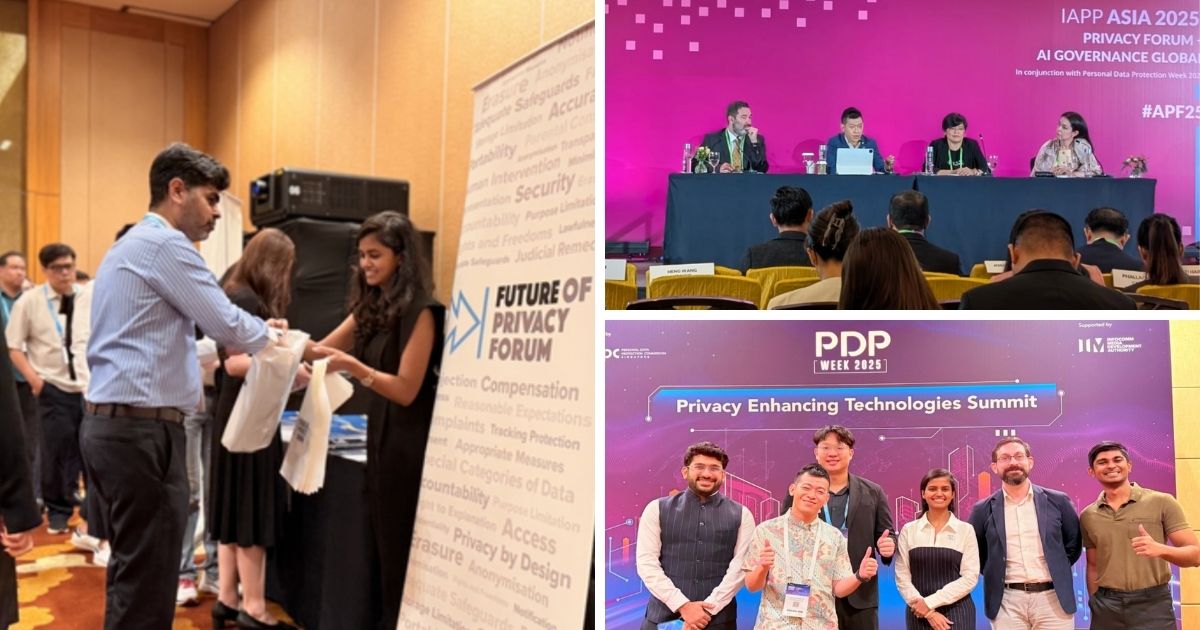
FPF at PDP Week 2025: Generative AI, Digital Trust, and the Future of Cross-Border Data Transfers in APAC
Authors: Darren Ang Wei Cheng and James Jerin Akash (FPF APAC Interns) From July 7 to 10, 2025, the Future of Privacy Forum (FPF)’s Asia-Pacific (APAC) office was actively engaged in Singapore’s Personal Data Protection Week 2025 (PDP Week) – a week of events hosted by the Personal Data Protection Commission of Singapore (PDPC) at […]

Balancing Innovation and Oversight: Regulatory Sandboxes as a Tool for AI Governance
Thanks to Marlene Smith for her research contributions. As policymakers worldwide seek to support beneficial uses of artificial intelligence (AI), many are exploring the concept of “regulatory sandboxes.” Broadly speaking, regulatory sandboxes are legal oversight frameworks that offer participating organizations the opportunity to experiment with emerging technologies within a controlled environment, usually combining regulatory oversight […]

Practical Takeaways from FPF’s Privacy Enhancing Technologies Workshop
In April, the Future of Privacy Forum and the Mozilla Foundation hosted an all-day workshop with technology, legal, and policy experts to explore Privacy Enhancing Technologies (PETs). During the workshop, multiple companies presented technologies they developed and implemented to preserve individuals’ privacy. In addition, the participants discussed steps for broadening the adoption of these technologies […]
Privacy Enhancing Technologies Workshop Proceedings
On April 25, 2025, the Future of Privacy Forum and the Mozilla Foundation co-hosted a Privacy Enhancing Technologies (PETs) Workshop in Washington, DC, convening industry, academia, and civil society experts to explore practical applications of PETs. The workshop featured two leading-edge use cases: Mastercard’s cross-border fraud detection system using Fully Homomorphic Encryption (FHE), and Oblivious’s […]
Privacy Enhancing Technologies Workshop Proceedings
I S SU E BRIE F U .S . PO LIC Y P ETs Work sh op Pro ce ed in g s E xe cu tiv e Sum mary The Future of Privacy Forum (FPF) and the Mozilla Foundation hosted a PETs Workshop featuring short, expert panels exploring new and emerging Privacy Enhancing Technology […]