
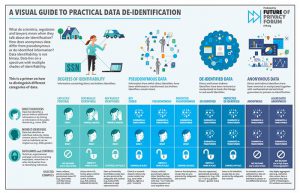
One key method for ensuring privacy while processing large amounts of data is de-identification. De-identified data refers to data through which a link to a particular individual cannot be established. This often involves “scrubbing” the identifiable elements of personal data, making it “safe” in privacy terms while attempting to retain its commercial and scientific value.
In the era of big data, the debate over the definition of personal information, de-identification and re-identification has never been more important. Privacy regimes often rely on data being considered Personal in order to require the application of privacy rights and protections. Data that is anonymous is considered free of privacy risk and available for public use.
Yet much data that is collected and used exists somewhere on a spectrum between these stages. FPF’s De-ID Project has examined practical frameworks for applying privacy restrictions to data based on the nature of data that is collected, the risks of de-identification, and the additional legal and administrative protections that may be applied.

Privacy Protective Research: Facilitating Ethically Responsible Access to Administrative Data
Jules Polonetsky, CEO, Future of Privacy Forum, Omer Tene, Senior Fellow, Future of Privacy Forum, and Daniel Goroff, Vice President and Program Director, Alfred P. Sloan Foundation authored a paper titled Privacy Protective Research: Facilitating Ethically Responsible Access to Administrative Data. This paper will be featured in an upcoming edition of The Annals of the American Academy of Political and Social Science.
Homomorphic Encryption Signals the Future for Socially Valuable Research on Private Data
Encryption has become a cornerstone of the technologies that support communication, commerce, banking, and myriad other essential activities in today’s digital world. In an announcement this week, Google revealed a new marketing attribution tool that relies on a particular type of advanced encryption to allow advertisers to understand whether their online ads have resulted in in-store purchases.

Announcing the Inaugural Issue of Future of Privacy Forum's Privacy Scholarship Reporter
Future of Privacy Forum is pleased to announce it has published the inaugural issue of the Privacy Scholarship Reporter. This regular newsletter will highlight recent privacy research and is published by the Privacy Research and Data Responsibility Network (RCN), an FPF initiative supported by the National Science Foundation.
Shedding Light on Smart City Privacy
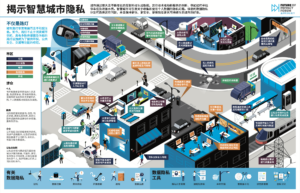
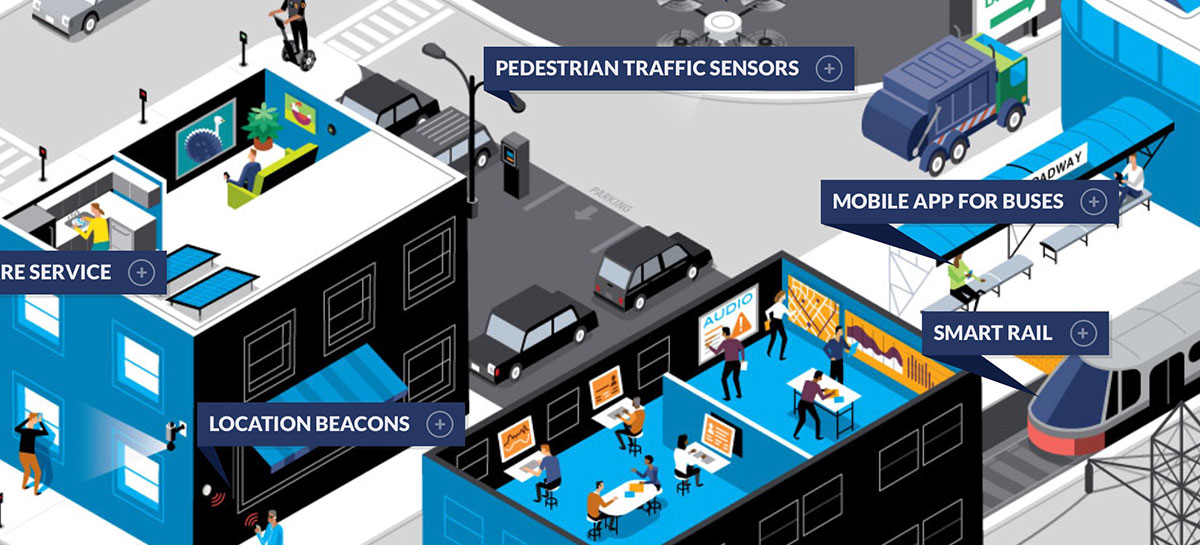
Today, the Future of Privacy Forum is releasing a new tool for municipal and technology leaders: a visual guide “Shedding Light on Smart City Privacy.” This tool will help citizens, companies, and communities understand the technologies at the heart of smart city and smart community projects – and their potential impact on privacy.

Chasing the Golden Goose: What is the path to effective anonymisation?
Searching for effective methods and frameworks of de-identification often looks like chasing the Golden Goose of privacy law. For each answer that claims to unlock the question of anonymisation, there seems to be a counter-answer that declares anonymisation dead. In an attempt to de-mystify this race and un-tangle de-identification in practical ways, the Future of Privacy Forum and the Brussels Privacy Hub joined forces to organize the Brussels Symposium on De-identification – “Identifiability: Policy and Practical Solutions for Anonymisation and Pseudonymisation”.

FPF Comments on NITRD’s Smart Cities and Communities Federal Strategic Plan
Last week, Future of Privacy Forum (FPF) submitted comments regarding the National Coordination Office for Networking and Information Technology Research and Development’s (NITRD) Request for Comment on the Draft Smart Cities and Communities Federal Strategic Plan, published in the Federal Register on January 9, 2017.

FPF in Brussels: The Law and Science of De-Identification
Last week, FPF brought together a panel of technology, legal, regulatory, and business voices to discuss “The Law and Science of De-Identification” at the 10th annual Computers, Privacy, and Data Protection conference.

Looking Back at Smart Cities Week at FPF
If you’ve been in Washington, DC this week, you may have noticed a certain buzz in the air – and not just from the wifi-connected streetlights on Pennsylvania Avenue. It’s Smart Cities Week, and D.C. has been humming all week with urban leaders, leading companies, tech and civic innovators, open data gurus, and advocates and academics from all around the globe.

First Take: Privacy in the Federal Automated Vehicles Policy
In the federal guidance for autonomous vehicles issued yesterday, the Department of Transportation and the National Highway Traffic Safety Administration have wisely recognized that privacy will play a key role in promoting trust in connected vehicles. This guidance and its emphasis on privacy is an important first step in building that trust.
Advancing Knowledge Regarding Practical Solutions for De-Identification of Personal Data: A Call for Papers
De-identification of personal information plays a central role in current privacy policy, law, and practice. Yet there are deep disagreements about the efficacy of de-identification to mitigate privacy risks. Some critics argue that it is impossible to eliminate privacy harms from publicly released data using de-identification because other available data sets will allow attackers to identify individuals through linkage attacks.