
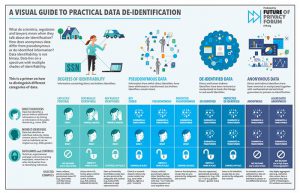
One key method for ensuring privacy while processing large amounts of data is de-identification. De-identified data refers to data through which a link to a particular individual cannot be established. This often involves “scrubbing” the identifiable elements of personal data, making it “safe” in privacy terms while attempting to retain its commercial and scientific value.
In the era of big data, the debate over the definition of personal information, de-identification and re-identification has never been more important. Privacy regimes often rely on data being considered Personal in order to require the application of privacy rights and protections. Data that is anonymous is considered free of privacy risk and available for public use.
Yet much data that is collected and used exists somewhere on a spectrum between these stages. FPF’s De-ID Project has examined practical frameworks for applying privacy restrictions to data based on the nature of data that is collected, the risks of de-identification, and the additional legal and administrative protections that may be applied.


Nature of Data in Pre-Trained Large Language Models
The following is a guest post to the FPF blog by Yeong Zee Kin, the Chief Executive of the Singapore Academy of Law and FPF Senior Fellow. The guest blog reflects the opinion of the author only. Guest blog posts do not necessarily reflect the views of FPF. The phenomenon of memorisation has fomented significant […]

Brazil’s ANPD Preliminary Study on Generative AI highlights the dual nature of data protection law: balancing rights with technological innovation
Brazil’s Autoridade Nacional de Proteção de Dados (“ANPD”) Technology and Research Unit (“CGTP”) released the preliminary study Inteligência Artificial Generativa (“Preliminary Study on GenAI”, in Portuguese) as part of its Technological Radar series, on November 29, 2024. A short English version of the study was also released by the agency in December 2024. This analysis […]

The Curse of Dimensionality: De-identification Challenges in the Sharing of Highly Dimensional Datasets
The 2006 release by AOL of search queries linked to individual users and the re-identification of some of those users is one of the best known privacy disasters in internet history. Less well known is that AOL had released the data to meet intense demand from academic researchers who saw this valuable data set as essential […]

Chile’s New Data Protection Law: Context, Overview, and Key Takeaways
On August 26, 2024, the Chilean Congress approved Law 21.719, on the Protection of Personal Data (“LPPD”) after eight years of legislative debate. The legislation was published on December 13, 2024, and will become fully effective twenty-four months after that date (in December 2026). The LPPD was introduced in the Senate in 2017 to replace […]

Twelve Privacy Investments for Your Company for a Stronger 2025
FPF has put together a list of Twelve Privacy Investments for Your Company for a Stronger 2025 that reflects on new perspectives on the work that privacy teams do at their organizations. We hope there is something here that’s useful where you work, and we’d love to hear other ideas and feedback. Privacy Investments for Your […]

OAIC’s Dual AI Guidelines Set New Standards for Privacy Protection in Australia
On 21 October 2024, the Office of the Australian Privacy Commissioner (OAIC) released two sets of guidelines (collectively, “Guidelines”), one for developing and training generative AI systems and the other one for deploying commercially available “AI products”. This marks a shift in OAIC’s regulatory approach from enforcement-focused oversight to proactive guidance. The Guidelines establish rigorous […]
Processing of Personal Data for AI Training in Brazil: Takeaways from ANPD’s Preliminary Decisions in the Meta Case
Data Protection Authorities (DPAs) across the globe are currently wrestling with fundamental questions raised by the emergence of generative AI and its compatibility with data protection laws. A key issue is under which legal basis companies might be able to process personal data for training AI models. Another one is how the rights of individuals […]
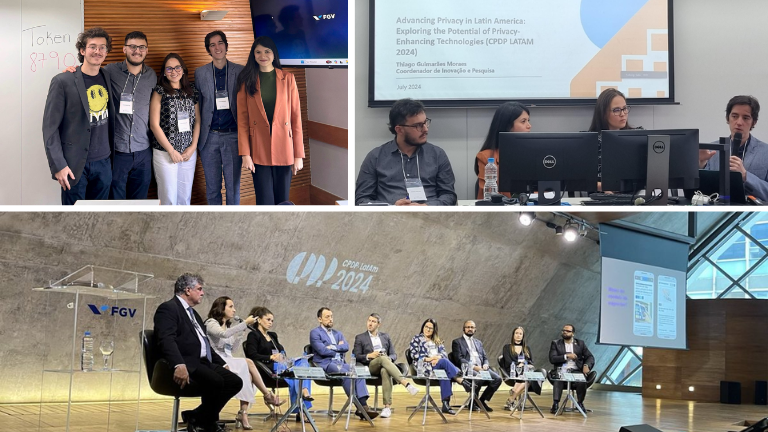
CPDP LatAm 2024: What is Top of Mind in Latin American Data Protection and Privacy? From data sovereignty, to PETs
On July 17-18, the fourth edition of the Computers, Privacy, and Data Protection Conference Latin America (CPDP LatAm) was held in Rio de Janeiro, Brazil. This year’s theme was on “Data Governance: From Latin America to the G20,” highlighting Brazil’s current presidency of the international cooperation forum. As in previous years, FPF participated on the […]
FERPA Exceptions: A Study in Studies
The Family Educational Rights and Privacy Act, or FERPA, protects personally identifiable information from education records from unauthorized disclosure. The Law has been affording parents privacy rights over their children’s education records for almost half a century now; indeed, the fiftieth anniversary of FERPA’s passage is this August 2024. As FERPA’s golden birthday approaches, FPF is […]

Connecting Experts to Make Privacy-Enhancing Tech and AI Work for Everyone
The Future of Privacy Forum (FPF) launched its Research Coordination Network (RCN) for Privacy-Preserving Data Sharing and Analytics on Tuesday, July 9th. Industry experts, policymakers, civil society, and academics met to discuss the possibilities afforded by Privacy Enhancing Technologies (PETs), the inherent regulatory challenges, and how PETs interact with rapidly developing AI systems. FPF experts […]