
Privacy Enhancing Technologies (PETs) are crucial for safeguarding individual privacy while enabling socially beneficial research, data sharing, and advancements in sectors that collect or use sensitive data. As AI systems increasingly rely on vast amounts of data, PETs like differential privacy, homomorphic encryption, federated learning, zero-knowledge proofs, and even model contract clauses can help ensure that personal data remains confidential and secure. This is vital not only for protecting individual rights but also for earning and maintaining public trust in technologies that use data about people.
Ethically implementing PETs is also essential. PETs must be designed and deployed to protect marginalized groups and avoid practices that may appear to be privacy-preserving, but actually exploit sensitive data or undermine privacy. In addition, clear policy guidelines on the deployment of PETs are necessary to help make sound business cases for their use in industry. If PETs are ethically integrated into research and business practices, and if global regulators have an opportunity to support their appropriate deployment, there is enormous potential for increasing technological innovation and societal benefits while upholding privacy and public trust.
FPF supports the development of PETs, convenes experts from around the world to deploy best practices, and provides in-depth analysis of emerging technologies and their policy implications. FPF also leads the National Science Foundation and Department of Energy-funded Research Coordination Network for the use of PETs to advance socially beneficial data sharing and protect people’s privacy as data is increasingly used to train AI models. FPF also facilitates a Global PETs Network of regulators who are interested in the lawful and ethical implementation of these tools.






Risk Framework for Body-Related Data in Immersive Technologies
Today, the Future of Privacy Forum (FPF) released its Risk Framework for Body-Related Data in Immersive Technologies for organizations to structure the collection, use, and onward transfer of body-related data. Organizations building immersive technologies like extended reality and virtual worlds often rely on large amounts of data about individuals’ bodies and behaviors. While body-related data […]

The PrivaSeer Project in 2023: Access to 1.4 million privacy policies in one searchable body of documents
In the summer of 2021, FPF announced our participation in a collaborative project with researchers from the Pennsylvania State University and the University of Michigan to develop and build a searchable database of privacy policies and other privacy-related documents, with the support of the National Science Foundation. This project, PrivaSeer, has since become an evolving, […]

A Blueprint for the Future: White House and States Issue Guidelines on AI and Generative AI
Since July 2023, eight U.S. states (California, Kansas, New Jersey, Oklahoma, Oregon, Pennsylvania, Virginia, and Wisconsin) and the White House have published executive orders (EOs) to support the responsible and ethical use of artificial intelligence (AI) systems, including generative AI. In response to the evolving AI landscape, these directives signal a growing recognition of the […]

FPF Statement on Biden-Harris AI Executive Order
The Biden-Harris AI plan is incredibly comprehensive, with a whole of government approach and with an impact beyond government agencies. Although the executive order focuses on the government’s use of AI, the influence on the private sector will be profound due to the extensive requirements for government vendors, worker surveillance, education and housing priorities, the […]

Navigating Privacy-Enhancing Technologies: Key Takeaways from the Inaugural Meeting of the Global PETs Network
In recent years, privacy-enhancing technologies (PETs) have been an increasingly popular subject on regulators’ and policymakers’ agendas. Whether by issuing guidance about these types of tools (Canada’s Office of the Privacy Commissioner; United Kingdom’s Information Commissioner’s Office; Organisation for Economic Co-operation and Development), setting up regulatory sandboxes (Singapore’s Personal Data Protection Commission; Colombia’s Superintendence of […]
Data Sharing for Research: A Compendium of Case Studies, Analysis, and Recommendations
Today, the Future of Privacy Forum (FPF) published a report on corporate-academic partnerships that provides practical recommendations for companies and researchers who want to share data for research. The Report, Data Sharing for Research: A Compendium of Case Studies, Analysis, and Recommendations, demonstrates how, for many organizations, data-sharing partnerships are transitioning from being considered an […]
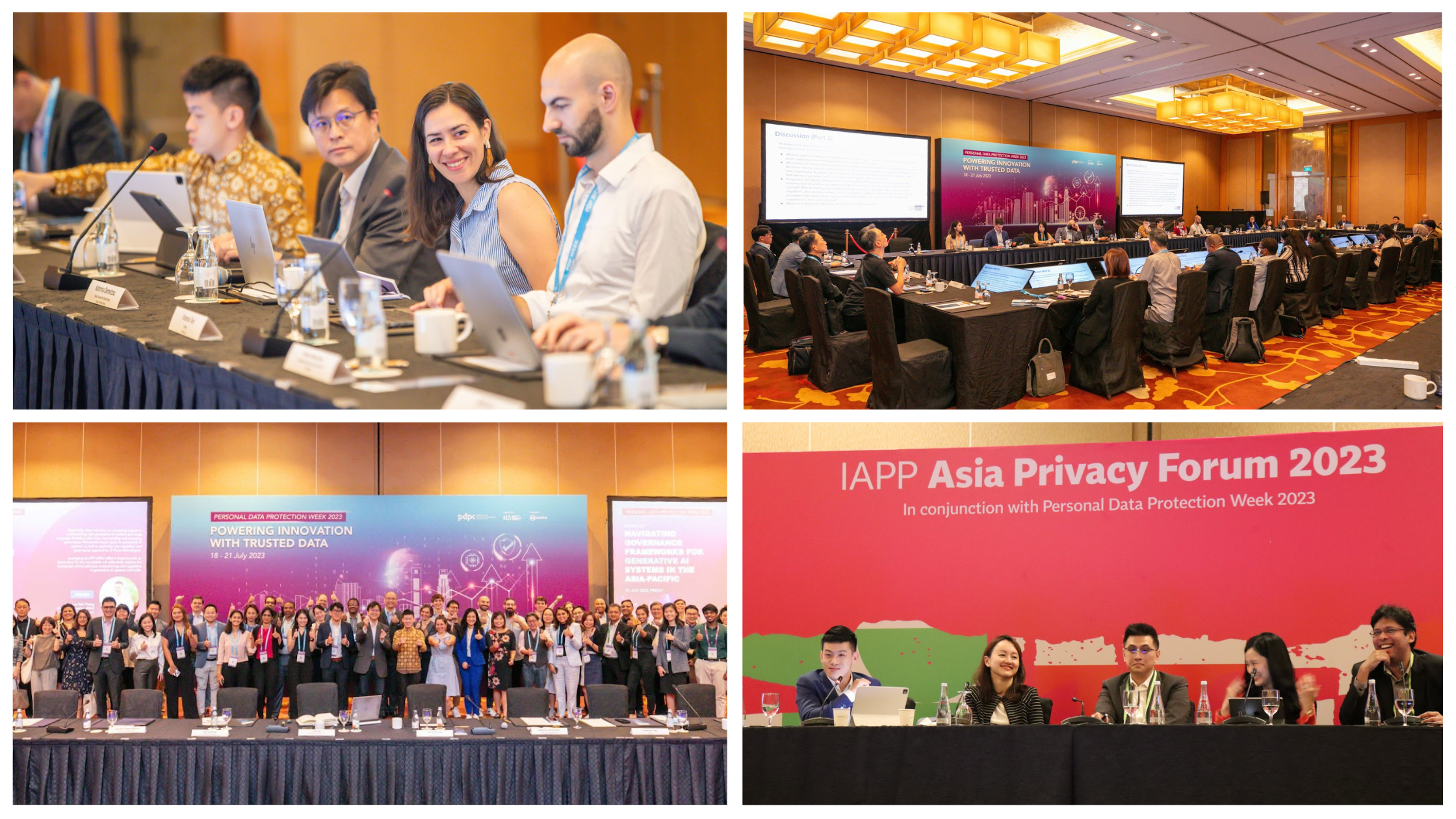
FPF at Singapore PDP Week 2023: Navigating Governance Frameworks for Generative AI Systems in the Asia-Pacific
Authors: Cheng Kit Pang, Elena Guañuna, Alistair Simmons, and Matthew Rostick Cheng Kit Pang, Elena Guañuna, Alistair Simmons, and Matthew Rostick are FPF Global Privacy Interns. From July 18 to July 21, 2023, the Personal Data Protection Commission (PDPC) of Singapore held its annual Personal Data Protection Week (PDP Week), which overlapped with the IAPP’s […]

FPF at CPDP 2023: Covering Hot Topics, from Data Protection by Design and by Default, to International Data Transfers and Machine Learning
At this year’s annual Computers, Privacy and Data Protection (CPDP) conference in Brussels, several Future of Privacy Forum (FPF) staff took part in different panels, organized by FPF, as well as academic, industry, and civil society groups. This blogpost provides a brief overview of these exciting events, and CPDP will publish recordings of them shortly. […]
New FPF Report: Unlocking Data Protection by Design and by Default: Lessons from the Enforcement of Article 25 GDPR
On May 17, the Future of Privacy Forum launched a new report on enforcement of the EU’s GDPR Data Protection by Design and by Default (DPbD&bD) obligations, which are outlined in GDPR Article 25. The Report draws from more than 92 data protection authority (DPA) cases, court rulings, and guidelines from 16 EEA member states, […]

FPF in 2022: A Year in Review
As 2022 comes to an end, we wanted to reflect on a year that saw the Future of Privacy Forum (FPF) expand its presence both domestically and around the globe, while producing engaging events, thought-provoking analysis, and insightful publications. Global Expansion In 2022, FPF closely followed and advised upon significant developments in Asia, the European […]