
Across the United States, evolving data collection and processing practices and advances in artificial intelligence are driving new digital services, technologies, and socially beneficial research – while also raising new opportunities, risks, and questions for individuals and communities. In response, state and federal policymakers are considering new legislative and regulatory frameworks on three interconnected fronts: comprehensive consumer privacy laws that establish baseline rights and protections for personal data across the economy; frameworks that target specific sectors and practices such as automated decisionmaking, biometric identification, companion chatbots, data-driven pricing, data brokerage, frontier AI model safety, genetic data, and health data; and youth-specific privacy and online safety laws that set distinct rules for minors. These three tracks rarely stay in their lanes: a comprehensive privacy law may include AI provisions, an AI safety bill may carve out rules for minors, a youth online safety law may hinge on biometric age verification. Understanding the landscape requires understanding both the individual pieces and how they fit together.
FPF’s U.S. Legislation team provides expert, independent, pragmatic analysis of state and federal legislative and regulatory approaches to privacy, AI, and youth online safety – three distinct but increasingly intertwined issue areas. The team tracks emerging proposals, compares new laws against existing frameworks, analyzes implementation and compliance implications, and helps policymakers and stakeholders understand how legal requirements interact with current technologies, business practices, and data uses.
Through reports, blog posts, legislative and policy analyses, webinars, in-person and virtual peer-to-peer gatherings, and educational programs, FPF helps the broader technology policy and governance community understand the mechanisms and strategies available to protect privacy, promote responsible AI development and deployment, and advance youth online safety. FPF does not typically support or oppose particular bills. Instead, the U.S. Legislation team focuses on explaining the practical and legal implications of proposals – individually and as they interact with one another. This work helps ensure that privacy, AI, and youth safety compliance and policy strategies remain future-looking, adaptable, and workable for the continued, beneficial use of data and AI.
FPF’s U.S. Legislation team is led by Tatiana Rice, Senior Director.






FPF Unveils Report on the Anatomy of State Comprehensive Privacy Law
Today, the Future of Privacy Forum (FPF) launched a new report—Anatomy of State Comprehensive Privacy Law: Surveying the State Privacy Law Landscape and Recent Legislative Trends. By distilling this broad landscape to identify the “anatomy” of state comprehensive privacy law, this report highlights the strong commonalities and the nuanced differences between the various laws, showing […]

U.S. Legislative Trends in AI-Generated Content: 2024 and Beyond
Standing in front of the U.S. flag and dressed as Uncle Sam, Taylor Swift proudly proclaims that you should vote for Joe Biden for President. She then wants you to vote for Donald Trump in a nearly identical image circulated by former President Trump himself. Both the images, and the purported sentiments, are fabricated, the […]

Do LLMs Contain Personal Information? California AB 1008 Highlights Evolving, Complex Techno-Legal Debate
By Jordan Francis, Beth Do, and Stacey Gray, with thanks to Dr. Rob van Eijk and Dr. Gabriela Zanfir-Fortuna for their contributions. California Governor Gavin Newsom signed Assembly Bill (AB) 1008 into law on September 28, amending the definition of “personal information” under the California Consumer Privacy Act (CCPA) to provide that personal information can […]
Updated February 25, 2025: FPF no longer coordinates the Multistate AI Policymaker Working Group
Updated February 25, 2025: FPF no longer coordinates the MAP-WG. Please read here for more information. Future of Privacy Forum Convened Over 200 State Lawmakers in AI Policy Working Group Focused on 2025 Legislative Sessions The Multistate AI Policymaker Working Group (MAP-WG) was convened by FPF to help state lawmakers from more than 45 states […]

Synthetic Content: Exploring the Risks, Technical Approaches, and Regulatory Responses
Today, the Future of Privacy Forum (FPF) released a new report, Synthetic Content: Exploring the Risks, Technical Approaches, and Regulatory Responses, which analyzes the various approaches being pursued to address the risks associated with “synthetic” content – material produced by generative artificial intelligence (AI) tools. As more people use generative AI to create synthetic content, […]
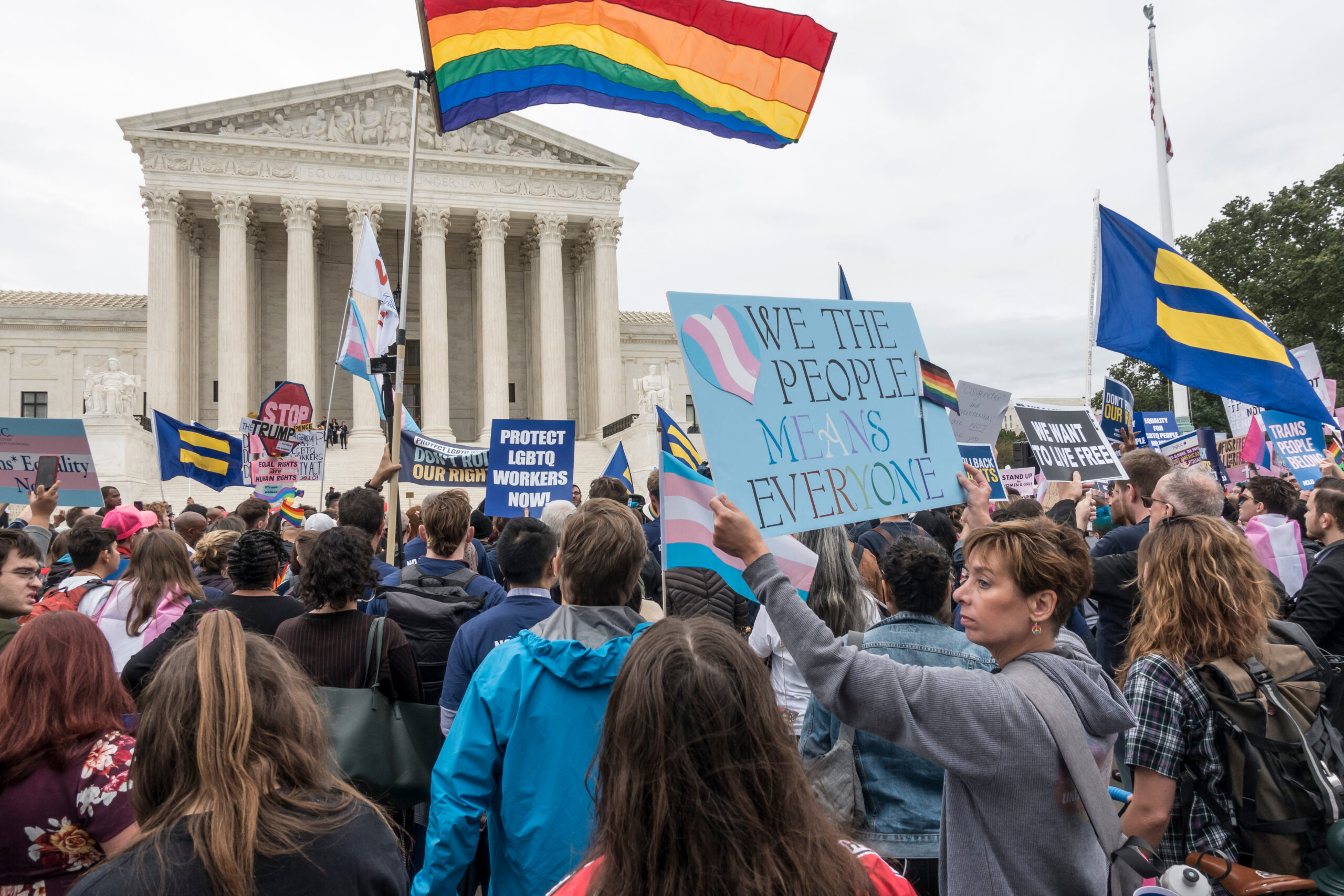
Out, Not Outed: Privacy for Sexual Health, Orientations, and Gender Identities
Co-authored by: Judy Wang (FPF Intern), Jeter Sison (FPF Intern), Jordan Wrigley (FPF Data and Policy Analyst, Health & Wellness) On National Coming Out Day, it’s important to recognize that Coming Out is a right of passage for many LGBTQ+ individuals and a decision that they should be empowered to make for themselves. Protections for […]

FPF Analysis of New Requirements for Generative AI Use by Healthcare Entities in Patient Communications
Co-Authored by Judy Wang, FPF Communications Intern On September 28, Governor Gavin Newsom signed California AB 3030, among a host of AI bills. CA AB 3030 amended the California Health & Safety Code and requires specified healthcare entities to disclose the use of generative artificial intelligence (AI) in provider-patient communications through visual or verbal disclaimers […]

FPF Submits Comments to Inform New York Children’s Privacy Rulemaking Processes
At the end of the 2024 legislative session, New York State passed a pair of bills aimed at creating heightened protections for children and teens online. One, the New York Child Data Protection Act (NYCDPA), applies to a broad range of online services that are “primarily directed to children.” The NYCDPA creates novel substantive data […]
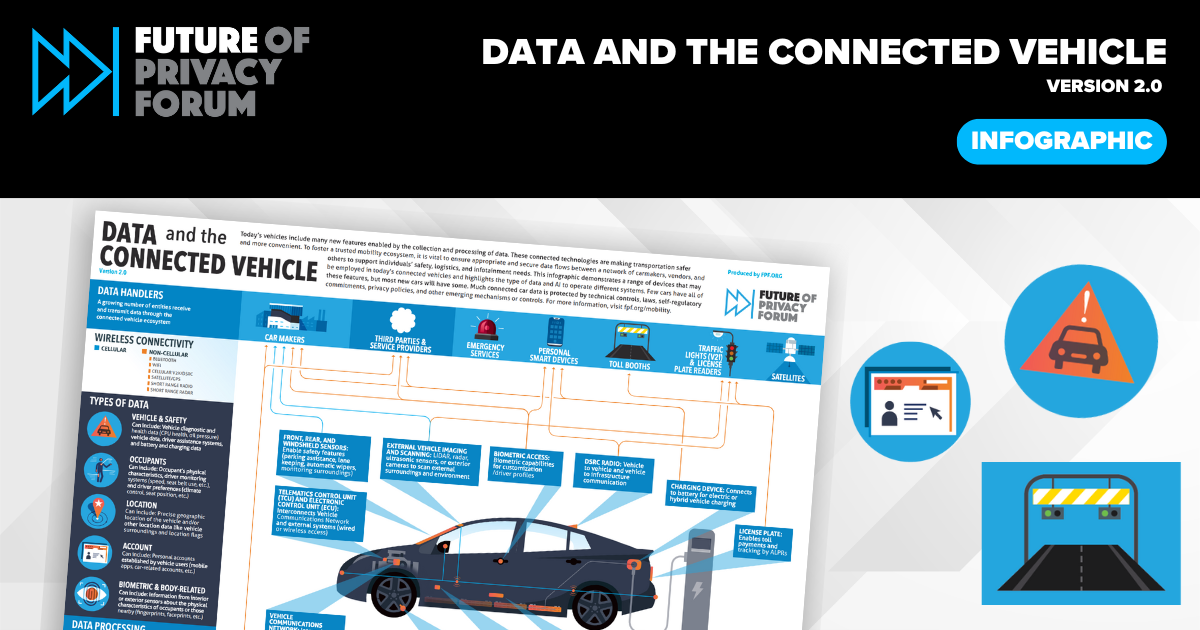
Updated FPF Infographic Explores Data in Connected Vehicles
Today, The Future of Privacy Forum is launching the Data and the Connected Vehicle Infographic 2.0, including new updates to account for the types of data associated with connected vehicles, features in and outside of the vehicle, and data handlers who receive and process data. Lawmakers, manufacturers, privacy professionals, and consumers are actively engaged in […]

FPF Unveils Report on Emerging Trends in U.S. State AI Regulation
Today, the Future of Privacy Forum (FPF) launched a new report—U.S. State AI Legislation: A Look at How U.S. State Policymakers Are Approaching Artificial Intelligence Regulation— analyzing recent proposed and enacted legislation in U.S. states. As artificial intelligence (AI) becomes increasingly embedded in daily life and critical sectors like healthcare and employment, state lawmakers have […]