
Showing results for viiia20 2011va 20how 20to become 2011va agent viiia20 2011va 20how 20to become 2011va

2026: A Year at the Crossroads for Global Data Protection and Privacy
[…] breaking point, as they descend from research to market, will be: hyper-personalization – think of the decades-old debate around targeting and individual profiling, but on steroids; AI agents by themselves or acting together – for one thing, “control” of a person over their information is at the core of data protection, while the fundamental […]

6 Privacy Tips for the Generative AI Era
[…] review retention timelines can give you a clearer picture of how long your information sticks around, and help you decide what you’re comfortable sharing. Define Boundaries for Agentic AI Agentic AI, a form of generative AI that can complete tasks for users with greater autonomy, is becoming increasingly popular. For example, companies like Perplexity, […]
Future of Privacy Forum to Honor Top Scholarship at Annual Privacy Papers for Policymakers Event
[…] notice-and-choice frameworks. Left unchecked, the data acquisition status quo favors established corporate players and impedes the law’s ability to constrain the arbitrary exercise of private power. AI Agents and Memory: Privacy and Power in the Model Context Protocol (MCP) Era by Matt Steinberg and Prem M. Trivedi The shift from chatbots to autonomous agents […]
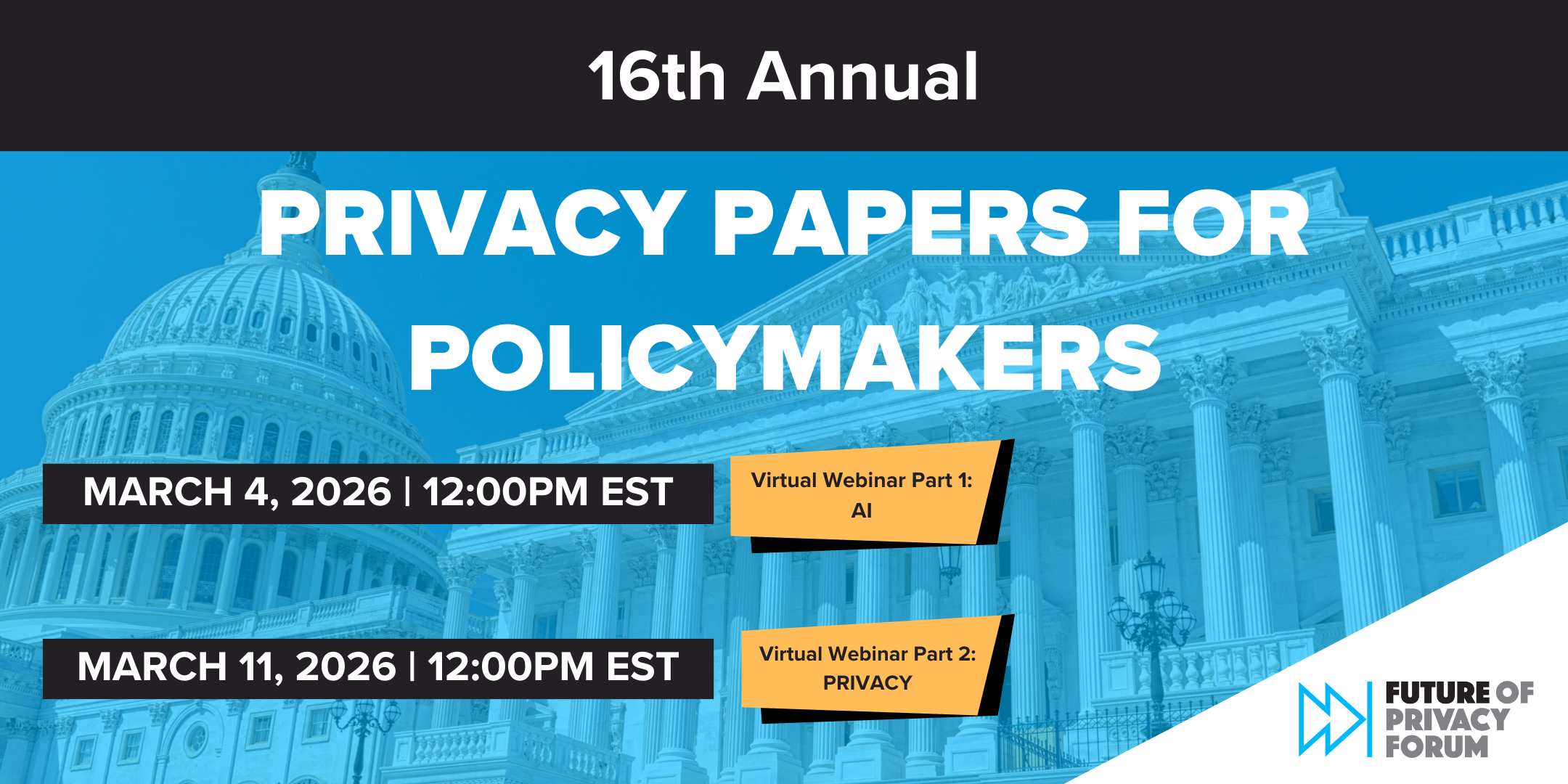
16th Annual Privacy Papers for Policymakers
[…] 16th Annual Privacy Papers for Policymakers Award are listed below. To learn more about the papers, judges, and authors, check out our 2025 PPPM Digest. AI Agents and Memory: Privacy and Power in the Model Context Protocol (MCP) Era, by Matt Steinberg and Prem M. Trivedi AI and Doctrinal Collapse, by Alicia Solow-Niederman […]

FPF Year in Review 2025
[…] the most commonly enacted frameworks focus on healthcare, chatbots, and innovation safeguards, (4) policymakers signaled an interest in balancing consumer protection with AI growth, (5) definitional uncertainty, agentic AI, and algorithmic pricing are likely to be key topics in 2026. Learn further in a LinkedIn Live event with the report’s authors here. FPF Unveils […]
FPF Anatomy of a State Comprehensive Privacy Law Report
[…] establish one or more context appropriate secure and reliable means for individuals to submit a rig hts request; verify the identity of the individual (or their authorized agent) maki ng the request for certain rights; and more. 30 This language was taken from Connecticut’s law as being representative of others, but there are nuances […]

Brussels Privacy Symposium 2025 Report – A Data Protection (R)evolution?
[…] models and automated decision-making, emphasizing the need for lifecycle-based risk management, robust oversight. In a guest speaker talk, Professor Norman Sadeh addressed the growing role of AI agents, and the need for interoperable standards and protocols to support user autonomy in increasingly automated environments. European Data Protection Supervisor Wojciech Wiewiórowski and Professor Gianclaudio Malgieri […]

FPF Inaugural EU Privacy Leadership Forum
[…] changing landscape of EU digital law and policy, as well as other critical topics, such as children’s privacy, online safety, age verification, and the latest developments in agentic AI. We will communicate changes and details for the agenda as they are available. If you have any questions about the event or registration, please contact […]
Comparison of COPPA 2.0
[…] PARENT OR TEEN PROTECTED Notwithstanding paragraph (1) (A), neither an operator of such a website , or online service , or application nor the operator’s th e agent of such an operator shall be held to be liable under any Federal or State law for any disclosure made in good faith and following reasonable […]
The State of State AI: Legislative Approaches to AI in 2025
[…] in healthcare, chatbots, and innovation safeguards. Legislatures signaled an interest in balancing consumer protection with support for AI growth, including testing novel innovation-forward mechanisms, such as sandboxes and liability defenses. Looking ahead to 2026, issues like definitional uncertainty remain persistent while newer trends around topics like agentic AI and algorithmic pricing are starting to emerge.