
Connected technologies and always-on data flows are helping make today’s cities and communities more livable, productive, and sustainable. At the same time, these technologies raise concerns about individual privacy, freedom of choice, and institutional discrimination. How do we leverage the benefits of a data-rich society while giving members of our community the confidence of knowing their privacy is protected? How can we address pressing local problems — from housing to highways, potholes to policing — and deliver public services in equitable, privacy-conscious ways?
Working collaboratively with public, private, academic, and civil society leaders, FPF builds tools and best practices to guide how cities and local communities collect, manage, and use personal data to improve services for individuals. A cornerstone of this work is FPF’s Civic Privacy Leaders Network, a peer network supported by the National Science Foundation that brings together privacy leaders from 30+ local governments across the U.S. and Canada to navigate emerging privacy issues, share practical guidance, and promote fair and transparent data practices.
Visit the Smart Communities Resources web page for a comprehensive list of FPF’s ongoing work in this area.





FPF at CPDP 2022: Panels and Side Events
As the annual Computers, Privacy and Data Protection (CPDP) conference took place in Brussels between May 23 and 25, several Future of Privacy Forum (FPF) staff took part in different panels and events organized by FPF or other organizations before and during the conference. In this blogpost, we provide an overview of such events, with […]
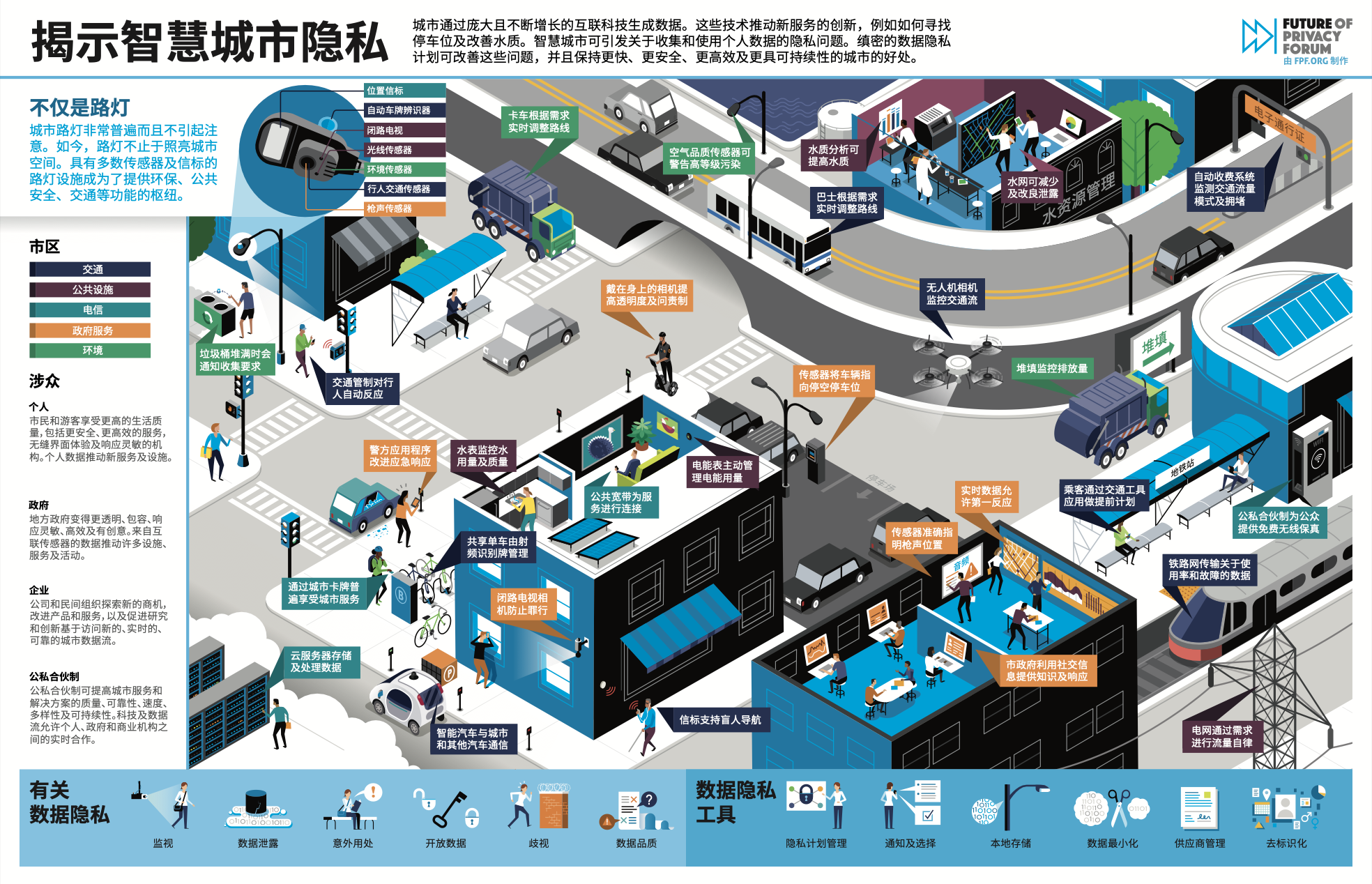
FPF Launches Infographics in Chinese
As FPF’s work expands to include an international audience, we are pleased to relaunch FPF’s popular infographics in various languages. Because conversations around data protection have become more global, the need for high-quality information and new forms of communication in different languages continues to increase. The infographics translation project aims to help FPF provide a […]

BCI Commercial and Government Use: Gaming, Education, Employment, and More
This post is the third in a four-part series on Brain-Computer Interfaces (BCIs), providing an overview of the technology, use cases, privacy risks, and proposed recommendations for promoting privacy and mitigating risks associated with BCIs. Click here for FPF and IBM’s full report: Privacy and the Connected Mind. In case you missed them, read the […]

FPF and Mobility Data Collaborative Release Resources to Help Organizations Assess the Privacy Risks of Sharing of Mobility Data
The Mobility Data Sharing Assessment was developed by Chelsey Colbert and Kelsey Finch. The Future of Privacy Forum (FPF) and SAE’s Mobility Data Collaborative (MDC) have created a transportation-tailored privacy assessment that provides practical and operational guidance to organizations that share mobility data, such as data from the use of ride-hailing services, e-scooters, or bike-sharing […]

Privacy Impact Assessment Policies Help Cities Use and Share Data Responsibly with their Communities
As the world urbanizes, local governments are turning to “Smart City” initiatives and the data they generate to more effectively manage transportation systems, support real-time infrastructure maintenance, automatically administer public services, enable transparent governance and open data, and support emergency services in public areas. Data held by public and private organizations have the potential to […]

Chelsey Colbert Discusses Trends in Mobility & Location Data
Chelsey Colbert, Policy Counsel, leads FPF’s mobility and location data portfolio. Prior to joining FPF, Chelsey was a lawyer at an international business law firm in Canada and was seconded as in-house privacy and data governance counsel to Sidewalk Labs, an Alphabet company that designs and builds urban innovations. Chelsey holds a J.D. with a […]

FPF & Dataskydd.net Webinar – Privacy in High Density Crowd Contexts
Authors: Hunter Dorwart and Rob van Eijk On 30 September 2020, Future of Privacy Forum (FPF) and Dataskydd.net jointly organized the webinar ‘Privacy in High Density Crowd Contexts’. A key aspect of the webinar was the role of industry-driven privacy standards in the development and deployment of privacy-friendly technologies for crowd management, mobile connectivity, and […]

Five Top of Mind Data Protection Recommendations for Brain-Computer Interfaces
By Jeremy Greenberg, [email protected] and Katelyn Ringrose [email protected]. Key FPF-curated background resources – policy & regulatory documents, academic papers, and technical analyses regarding brain-computer interfaces are available here. Recently, Elon Musk livestreamed an update for Neuralink—his startup centered around creating brain-computer interfaces (BCIs). BCIs are an umbrella term for devices that detect, amplify, and translate […]

Civic Data Privacy Leaders Convene at MetroLab Annual Summit
By Kelsey Finch, FPF Senior Counsel The MetroLab Network’s Annual Summit brought together an inspired group of civic, academic, industry, and nonprofit leaders to discuss the most important issues in smart cities and civic innovation. For the third year in a row, FPF partnered with MetroLab Network to promote data privacy perspectives and to advance responsible […]

What is 5G Cell Technology? How Will It Affect Me?
The leap from 3G to 4G technology brought with it faster data transfer speeds, which supported widespread adoption of data cloud and streaming services, video conferencing, and Internet of Things devices such as digital home assistants and smartwatches. 5G technology has the potential to enable another wave of smart devices: always connected and always communicating to provide faster, more personalized services.