The EU Commission’s Approach to Age Verification: Mobile Apps, DSA Enforcement, and Challenging National Social Media Bans
On 29 April 2026, the European Commission published its Recommendation for a common approach for EU-wide age verification technologies, a non-binding policy document with the aim of harmonizing future measures for the protection of children online.
This blog post outlines the Commission’s emerging strategic approach to the implementation of EU-wide age verification measures, provides an analysis of the legal framework envisioned for their deployment, and includes notes on the Commission’s thinking with regard to possible social media bans in individual Member States. A number of key takeaways emerge:
In response to growing tensions surrounding the possibility of social media bans in a number of EU countries, theCommission is accelerating its attempts to enable the roll-out of age verification solutions, urging Member States to implement these by 31 December 2026;
An analysis of the applicable legal framework, and primarily the Digital Services Act (DSA), shows that since none of its Articles include specific mention of minimum age requirements or of age verification measures, it is still unclear whether age verification solutions will be voluntary or mandatory – it is worth noting here, however, that this does not mean that age assurance methods should not be implemented, as shown by emerging DSA enforcement on the topic;
While the Commission’s 2025 Guidelines on the protection of minors under the DSA focus on a variety of age assurance methods, this Recommendation aims to advance the EU’s strategic approach to age verification in particular, contributing to a growing global trend focused on age verification for service access or limitations;
The Commission aims to develop an EU age verification blueprint – a publicly available technical specification comprising the architecture, protocols, and interfaces to be used by Member States and providers to roll out national age verification measures;
An EU age verification schemewill also be developed by the Commission to establish the framework for “proof of age attestations,” including a list of trusted EU-based providers for such attestations;
While significant references are made to privacy and to ensuring that age verification measures are “privacy-preserving,” there is no reference to the GDPR and little detail regarding the technical parameters that will be expected;
Invoking Directive 2015/1535 on technical regulations and two CJEU cases from 1996 and 2000, the Commission aims to make it procedurally challenging for any individual EU Member State to implement a social media ban.
1. Applicable legal framework – From the Digital Services Act to the (not-yet-published) Digital Fairness Act
Article 28(1) DSA states that “providers of online platforms accessible to minors shall put in place appropriate and proportionate measures to ensure a high level of privacy, safety, and security of minors, on their service.” While the remainder of the Article covers advertising based on profiling and the further processing of personal data for the purpose of proving whether the user is a minor, it does not include mention of age verification measures.
The Commission’s Recommendation, in paragraph 3, also makes reference to the July 2025 Guidelines for the protection of minors under the DSA, also issued by the Commission, which specifies general guidance on the application of age assurance measures. It is worth noting that, while in the 2025 DSA Guidelines the Commission focuses on self-declaration, age estimation, and age verification as tools to ensure the protection of minors online, the 2026 Recommendation aims to advance the EU’s strategic approach to age verification in particular, recognizing the higher degree of accuracy of the latter.
The Recommendation additionally references Articles 34 and 35(1) of the Digital Markets Act (DMA) in which Very Large Online Platforms and Online Search Engines are required to “assess and mitigate actual or foreseeable risks that their service may pose to the protection of minors.” It also references Article 44(1)(j) DSA which enables the Commission to develop voluntary targeted standards to protect minors online, and recognizes that no such standards have been developed yet.
The Audiovisual Media Services Directive, through which video-sharing platforms have an obligation to protect minors from accessing harmful audiovisual content, and the Unfair Commercial Practices Directive which recognizes minors as vulnerable users that must be protected, similarly form the basis of the applicable legal framework for age verification in the EU. Finally, the upcoming Digital Fairness Act is expected to fill any gaps left unaddressed, though the Recommendation does not specify which ones.
Two notes are particularly relevant when considering the applicable legal framework:
Mandatory or voluntary? – While the requirement to implement age verification tools is not explicitly included in any of the abovementioned laws as a legally binding obligation for digital services providers, both the Commission’s DSA Guidelines and the Recommendation may be taken into consideration by national Courts when interpreting existing, binding EU law.
Lessons from emerging enforcement under the DSA is, however, showing the inadequacy of age assurance methods currently being implemented for compliance which are, so far, largely based on self declaration and age estimation (rather than age verification) – for example, the Commission preliminarily finds (April 2026) Meta in breach of the DSA for failing to prevent minors under 13 from accessing Facebook and Instagram; and the Commission opens an investigation into Snapchat (March 2026) for not preventing users under 13 from accessing the app, and not adequately assessing whether users are under 17, which it deems necessary in order to ensure an age-appropriate experience.
Enforcement also shows inconsistencies in EU harmonization regarding the age of a minor – While there is no consistent and agreed upon age of the child under EU law, the Recommendation defines a “minor” as anyone under the age of 18 – however, across individual Member States the age of the minor can range from 13 to 18.
Under the GDPR, which is not referenced by the Recommendation, the processing of personal data of a child in relation to the offer of information society services directly to them is lawful where that child is at least 16 years old (Article 8(1)), though Member State law may provide for a lower age (which must not be under 13).
Since Member States have discretion in defining the age of a minor within their national territory, “EU-wide” age verification measures may become fragmented depending on this definition.
2. Age verification blueprint and age verification scheme
When it comes to operationalizing EU-wide age verification tools, the Commission will develop a blueprint consisting of the technical specifications that such tools should follow and an open source implementation as a mobile app that can be customized to national contexts. This will be consistent with the EU Digital Identity Wallet, acting as an additional “age verification functionality”, which Member States are expected to operationalize by the end of 2026. It is worth noting that the EU Digital Identity Wallet is also voluntary for citizens and businesses, although Member States have the obligation to make the option available.
The Commission will additionally develop an age verification scheme, with requirements for providers of proof of age attestations and age verification solutions to meet, and including a list of EU-based trusted providers of such attestations. The role of the attestation is to ensure conformity with the criteria of effectiveness of the age verification solution, namely accuracy, reliability, robustness, non-intrusiveness, and non-discrimination (these criteria are outlined in the Commission’s 2025 DSA Guidelines, mentioned above).
Two notes are particularly relevant here:
While the Recommendation does not include significant details regarding the proof of age attestations, its reference to conformity is reminiscent of the Conformity Assessment required under the EU AI Act, hinting at the further expansion of a product safety approach across the EU digital regulatory ecosystem;
The Recommendation specifically notes that the trusted providers of such attestations, which can be public or private entities, must be EU-based, recalling the Commission’s broader strategic goals in the area of EU digital sovereignty.
From a global perspective, the Commission’s age verification scheme may be comparable to recent age assurance developments in other jurisdictions—such as the ongoing rulemaking efforts by the New York Attorney General’s Office to establish age assurance standards and accuracy benchmarking requirements under the SAFE for Kids Act, and Australia’s Age Assurance Technology Trial which assessed a variety of age assurance solutions and vendors but sought only to determine the feasibility of age assurance mechanisms from participating vendors rather than assess provider conformity with legal requirements. Notably, the Commission’s efforts seemingly go beyond both New York’s and Australia’s since it aims to establish requirements for conformity supplemented by a list of EU-vetted, trusted providers for use in legal compliance.
3. “Privacy-preserving” age verification?
Notable references are made throughout the Recommendation to the importance of privacy. Through this Recommendation, the Commission aims to facilitate the development of “harmonised, privacy-preserving, cybersecure, data protection compliant and robust EU age verification solutions.” Without reference to the GDPR, the Recommendation nonetheless relies on key data protection principles and requirements, interpreting “privacy-preserving” as preventing unnecessary data collection, unauthorized access or misuse of personal information.
To be privacy-preserving, the age verification solution should, by default, limit the information shared to the relying party to a true or false response regarding the age of the individual, without providing any further information about them. Additionally, the Recommendation states that verification methods “should include technical safeguards to protect citizens from privacy and data protection risks, such as tracking of their online activity, including the use of zero knowledge proofs.”
While there is no further elaboration of the expected technical safeguards or the privacy-enhancing technologies that could be deployed, it is likely that there will be significant interest in these attributes, particularly following the security flaws found in the EU “age checking app” launched by the Commission in early April.
4. On social media bans: From political debate to procedural impossibility
The Commission’s Recommendation is timely in that it comes as some individual EU Member States, such as France (for under 15s), Spain (for under 16s), and Germany (for under 14s, with stricter rules for under 17s), consider social media bans.
With a view to harmonization and the prevention of barriers within the internal market, the Recommendation invokes an administrative requirement found in Directive 2015/1535 laying down a procedure for the provision of information in the field of technical regulations and of rules on Information Society services. On this basis, where Member States consider introducing technical measures restricting minors’ access to online platforms, they have an obligation to report such measures to the Commission beforethey are adopted. This notification triggers a 3-month (extendable) standstill period during which the Member State is prevented from adopting the restriction, and a series of dialogues both with the Commission and with other Member States through the Digital Services Expert Group. Digital Services Coordinators, on the basis of the DSA, can also bring the issue for consideration to the European Board for Digital Services, a forum for cooperation for ensuring the coherent enforcement of the DSA.
Should a Member State fail to notify the Commission of the draft technical measure they are considering for restricting minors’ access to online platforms, it would be considered “a procedural defect that renders the measure unenforceable against individuals in national court proceedings”, and would be inapplicable to individuals. The Recommendation cites CJEU Case C-194/94, CIA-Security and Case C-443/98, Unilever in its reasoning. Furthermore, the Commission could initiate proceedings against a Member State should the proposed national measures regarding restricting minors’ access to online platforms be found to be incompatible with the DSA.
As regulators globally continue to navigate the intensifying youth online safety space, the Commission’s Recommendation adds another thread to the global patchwork of proposals aimed at restricting or banning social media access for minors. Several countries outside the EU are considering bans for minors, such as Australia and Indonesia which both recently started implementing social media bans (for under 16s), or targeted restrictions on social media access, such as in Brazil (which requires that accounts of minors under 16 are linked to a parent account in the recently effective Digital ECA) and the US (where legislation is pending that would ban minors under 13 from holding accounts and restrict use of certain platform features within teen accounts).
5. Concluding Notes
It is still uncertain how the age verification landscape will develop across the EU. As enforcement shows that the currently implemented lower-accuracy age assurance measures are increasingly deemed incompatible with the DSA, and political pressure grows within and across Member States to more adequately protect minors online, the Commission is attempting to set the tone for a harmonized approach.
While the Recommendation is a non-binding, soft law instrument, it shows the Commission’s strategic direction and positioning regarding age verification measures. Nevertheless, specific details regarding the technical specifications, protocols, interface, the interoperable and privacy-preserving features of such tools, as well as how (and when) each individual Member State will operationalize them, remain open questions.
Taking stock: The Impact of the India AI Impact Summit 2026
India’s hosting of the AI Impact Summit 2026 was an ambitious undertaking. With 600,000 attendees and 92 signatories to the New Delhi Declaration, the Summit was a showcase of a Global South country taking a leading role in shaping the AI governance agenda. The Summit’s official framing centered on infrastructure, compute, and equitable access to AI. What emerged across the week, and across FPF’s engagements in New Delhi before and during the Summit, was a global AI governance conversation defined by the tension between ambitious multilateral declarations and the slower, harder work of building the institutions and tools needed to make them real.
Now that the dust has settled, this blog post takes stock of the impact the Summit has had on the global AI governance conversation, drawing takeaways from FPF’s participation in events across Pre-Summit and the Summit itself. The threads that emerged from our engagements with the programming in New Delhi and now continue to manifest in various ways are: (1) the growing role of sandboxes as governance infrastructure; (2) whether global AI policy conversations can hold together in the face of geopolitical divergence; and (3) the sharpening focus on children’s safety and agentic AI as specific governance challenges that are moving faster than the frameworks designed to address them.
Theme 1: For AI governance to scale, it needs the right testing environments, and sandboxes are emerging as an answer
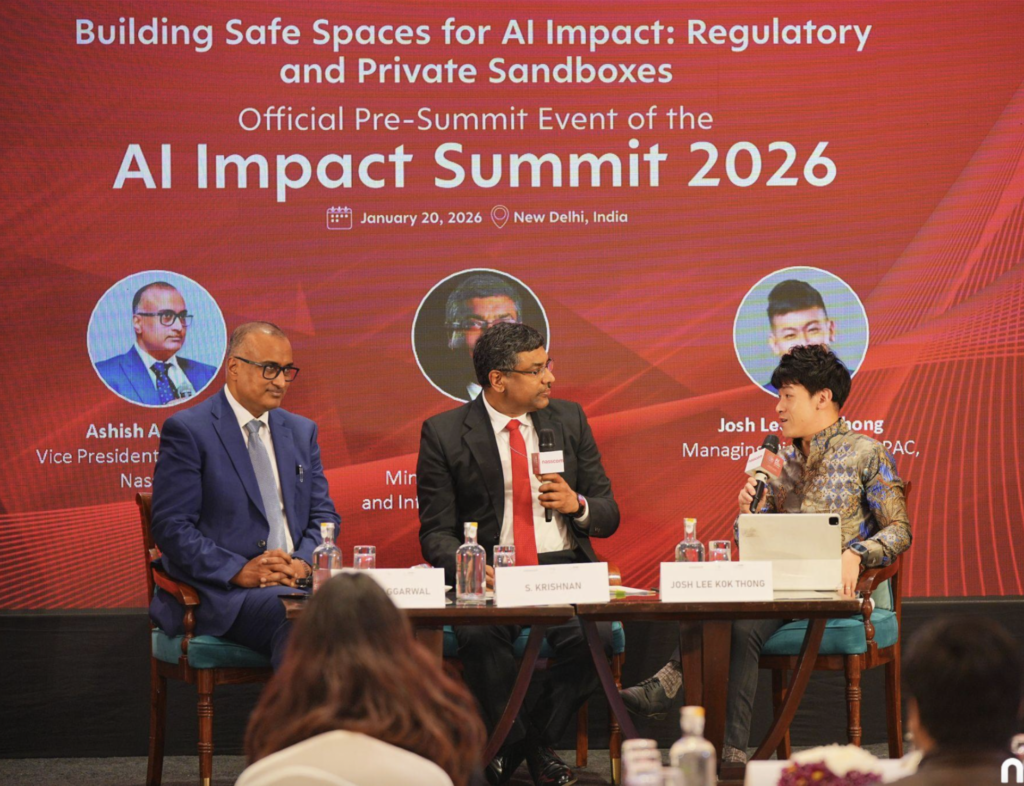
FPF participated in two events tied to India’s AI Impact Summit 2026, both co-organized with Nasscom. On 20 January 2026, FPF and Nasscom co-hosted a Pre-Summit Event in New Delhi titled “Building Safe Spaces for AI Impact: Regulatory and Private Sandboxes,” bringing together senior government leaders, regulators, global industry representatives, and policy experts. From 16–21 February 2026, Jules Polonetsky, CEO of FPF, Josh Lee Kok Thong, Managing Director for APAC, and Bilal Mohamed, Policy Manager for India, represented FPF at the Summit itself, co-organizing a high-level panel with Nasscom, hosting an FPF Salon Dinner on 17 February, and participating in bilateral engagements throughout the week.
The FPF delegation at the India AI Impact Summit 2026. From L-R: Josh Lee Kok Thong, Managing Director (APAC); Jules Polonetsky, CEO; Bilal Mohamed, Policy Manager for India Photo credit: Josh Lee
One of the clearest messages from the Pre-Summit Event was that the global AI governance conversation has moved decisively beyond the question of what principles should govern AI toward the more difficult question of how to build the regulatory infrastructure needed to put those principles into practice. Sandboxes (whether in their regulatory and private organizational forms), are emerging as one possible lever to achieving this.
The Pre-Summit Event’s first panel, moderated by Josh, brought together regulators from India, Singapore, and Brazil alongside industry experts to examine the evolution of regulatory sandboxing. Two key insights emerged:
First, sandboxes have seen global uptake as a mechanism for translating governance principles into practice. Over 200 regulatory sandboxes are now in operation globally, 70 of which are focused on AI. More importantly, their function is changing. Where early sandboxes primarily granted permission for testing, well-designed sandboxes today generate the real-world evidence regulators need to write better-calibrated rules. Singapore’s Infocomm Media Development Authority (IMDA) has pioneered a phased methodology moving from case studies to guidelines to formal standards, offering a model of prospective enforcement grounded in observed technical reality.
Second, sandboxes are becoming interoperable by necessity. AI-driven products cut across sectors in ways that engage multiple regulators simultaneously. The Reserve Bank of India’s Interoperable Regulatory Sandbox mechanism, introduced in 2022, was designed to test products that trigger obligations across jurisdictional lines. Similarly, Brazil’s Agencia Nacional de Proteção de Dados (ANPD) deliberately involves other regulators, technical experts, and civil society from the outset, recognizing that the questions sandboxes address are rarely confined to a single institution’s mandate.
The second panel examined how organizations are building private sandboxes for AI governance. The discussion, featuring representatives from Coforge, PayPal, Salesforce, Palo Alto Networks, and European Data Protection Supervisor (EDPS) AI Unit, highlighted two practical insights:
First, private sandboxes help organizations build trust with both consumers and regulators. Sudheer described Salesforce’s “Customer Zero” approach: before any AI product reaches customers, it is deployed internally across Salesforce’s 80,000-person workforce. The Salesforce philosophy of “build it, use it, fix it, scale it, and then sell it” surfaces real-world failures that may be limited by laboratory testing and allows governance guardrails to be refined before external rollout. Sam described how Palo Alto Networks used isolated “dirty lab” environments to subject models to curated malicious prompts, simulating prompt injection, data leakage, and adversarial manipulation, to establish a behavioural baseline before deployment. For companies navigating frameworks like India’s Digital Personal Data Protection Act, 2023 (DPDP Act), internal sandboxes serve as a signal of due diligence to regulators, demonstrating structured processes throughout the product lifecycle.
Second, unlike generative AI systems (whose failure modes are at least probabilistically characterized), agentic systems take autonomous actions, which means sandboxing must simulate intent rather than just behavior. More broadly, governance frameworks must be built to outlast the specific technologies they regulate. As Christian Lau of Dynamo AI described during the first panel, organizations must “separate the governance layer from the tech layer,” building accountability mechanisms that remain intact as models evolve.
Theme 2: Geopolitical divergence is exposing the limits of international AI governance
As the first Global South host of the AI Summits, India played an important bridging role, keeping the focus on how AI can drive economic development across Africa, South America, and Asia. The adoption of the New Delhi Declaration, signed by 92 countries and international organizations – including the US, China, and G7 nations – reflected genuine multilateral ambition, even as its voluntary and non-binding character also revealed the limits of that ambition.
The Summit provided a platform for different philosophies on AI governance and oversight to be articulated, with geopolitics in the backdrop. Michael Kratsios, Director of the White House Office of Science and Technology Policy, argued that AI policy must remain national and local, and that international fora risk creating centralized oversight that could stifle innovation under the guise of safety. Implementing this vision, the US outlined a set of parallel initiatives: an American AI Exports Program, new development finance instruments, a Tech Corps initiative embedding US technical experts with partner governments, and an AI Agent Standards Initiative through the Department of Commerce.
On the other hand, the President of France, Emannuel Macron, who hosted the previous edition of the AI Summit in Paris, promoted the EU AI Act in his speech as evidence that responsible and competitive AI are not in opposition, and argued for an approach that treats oversight as foundational to AI development rather than an obstacle to it.
India, as host, articulated its own approach. During the fireside chat concluding the Pre-Summit Event, S. Krishnan, Secretary, Ministry of Electronics and Information Technology (MeitY), outlined a philosophy of regulation “only when necessary,” explaining that India’s constitutional framework allows sectoral regulators such as Securities and Exchange Board of India (SEBI) and the Royal Bank of India (RBI) to oversee AI within their respective domains, rather than relying on a single, prescriptive national law. This middle path eyed by India relies heavily on the kind of regulatory infrastructure discussed in Theme 1.
FPF’s Managing Director for APAC Josh Lee Kok Thong engaging MeitY Secretary S. Krishnan during the fireside chat at the FPF-Nasscom Pre-Summit Event. Photo credit: Nasscom
FPF’s own Summit panel, titled “From Policy to Practice: Governing AI for Global Impact“, co-organized with Nasscom and moderated by Ashish Aggarwal (Nasscom), brought this tension into sharper relief. The panel featured Carina Prunkl (INRIA), Jules Polonetsky (FPF), Gail Kent (Google), Ivana Bartoletti (Wipro), and Wifredo Fernandez (xAI). Three insights from the discussion stood out.
First, it was highlighted that a critical question for the adoption of responsible AI practices is whether emerging baselines are clear and accessible enough to prevent a race to the bottom on safety. As Jules Polonetsky noted, weak or expensive compliance infrastructure creates competitive pressure to cut corners, a particular risk for startups and smaller players.
Second, governance frameworks must be built for specific contexts rather than transplanted from elsewhere. As Gail Kent noted, Indian users rely heavily on voice, video, and image-based inputs rather than text, which fundamentally changes the safety and privacy challenges that need local attention. Third, as Ivana Bartoletti argued, India’s “techno-legal” approach positions it to be an architect of governance solutions rather than a recipient of frameworks designed elsewhere.
These observations point to something important that focusing on divergent regulatory philosophies can obscure. The real risk in global AI governance may lie less in countries choosing different regulatory models, and more in those models being either ineffective overall or inaccessible to smaller actors that a shared floor on safety ceases to exist.
A packed full house at FPF’s and Nasscom’s official session at the India AI Impact Summit. Photo credit: Josh Lee
Theme 3: There is a cross-border consensus to regulate for children’s safety, but approaches vary
Despite differences in AI regulatory philosophies exposed during the Summit, child safety emerged as a point of cross-border consensus. Prime Minister of India, Narendra Modi, called for AI to be child-safe and family-guided, and for mandatory authenticity labels on AI-generated content. President Macron urged India to join a coalition restricting social media access for children.
Prime Minister Modi’s remarks were also grounded in a domestic regulatory development that had unfolded days before the Summit. On 10 February 2026, MeitY notified the IT (Intermediary Guidelines and Digital Media Ethics Code) Amendment Rules, 2026, introducing India’s first formal framework for synthetically generated content. The amendments require intermediaries to label AI-generated content, block the creation and dissemination of child sexual abuse material and non-consensual intimate imagery, and comply with a three-hour takedown window for prohibited content.
In India, the momentum has not been limited to the federal government. On 6 March 2026, the state government of Karnataka announced in its 2026–27 State Budget a proposed ban on social media use for children under 16, citing concerns over digital addiction, mental health, and declining academic performance. On the same day, the Chief Minister of Andhra Pradesh, Chandrababu Naidu, announced that the state would implement a ban on social media for children under 13 within 90 days. At the federal level, the DPDP Act already requires parental consent for the processing of personal data of children below the age of 18.
India’s actions sit within a broader global trend. In July 2025, the EU adopted guidelines on the protection of minors under the DSA; Australia implemented a social media age ban for under-16s in December 2025; and Singapore’s IMDA introduced age assurance requirements for app stores. In the weeks since the Summit, that response has accelerated. The White House’s National Policy Framework for AI placed children’s safety at the center of its legislative recommendations. Dozens of chatbot safety bills are under consideration in state legislatures across the US, and the US Congress. In the UK, Prime Minister Keir Starmer announced that AI chatbots will be brought under the Online Safety Act. The World Economic Forum’s Global Risks Report 2026 ranked online harms among the top risks of the next decade.
Taken together, this activity signals that child safety in the age of AI has become the rare governance issue that commands cross-jurisdictional political consensus, even as the jurisdictions diverge on almost every other dimension of AI oversight. The harder question is whether frameworks across jurisdictions, which share the same underlying concerns but differ in their approaches to age assurance, parental consent, and platform liability, can converge enough to hold platforms to consistent and effective standards. It is a question that India, with its large minor population and newly enacted synthetic media rules, has a significant stake in helping to answer.
Conclusion
The vivid debates at the Summit showed that AI governance approaches will be shaped by the economic, political, and legal contexts in which different nations operate. The real question is whether enough common ground can be built to prevent a race to the bottom on safety and responsible AI, as was highlighted by the FPF-Nasscom panel.
India’s hosting of the Summit was an important signal that this work is genuinely global in its participants and ambitions. The governance gaps that came into focus in New Delhi, from agentic AI accountability to the protection of children in AI-mediated spaces, to the question of whether voluntary multilateral declarations can be turned into durable commitments, represent the agenda for the conversations ahead.
The New(ish) Architecture of Consumer Health and Artificial Intelligence
The rise of AI-powered health tools is prompting new thinking about how, where, and when sensitive health information receives legal protection. According to media reports, consumers are now using general-purpose AI tools to upload or query health information, including medical records, and several companies have recently released large language model (LLM)-based tools customized for consumer health uses. While such records are protected by the Health Insurance Portability and Accountability Act’s (HIPAA) Privacy Rule when collected by healthcare providers and health plans, they largely fall outside HIPAA’s protections once uploaded to consumer-facing AI platforms.
Using online tools to seek health information is not new and consumers have long used health and wellness wearables and apps to share medical information for holistic health experiences, often with beneficial outcomes. Where downloading medical records is still a frustrating or limited experience, policy and technical architectures have emerged to facilitate consumer-directed health information-seeking. What is new is the underlying health data architecture utilized by AI tools and LLMs. This new architecture is a combination of policy shifts, product features, and public privacy commitments – setting new consumer expectations for how consumer health data should be handled based on old frameworks like HIPAA.
This blog post examines the emerging architecture of AI-powered health tools and its implications for privacy, governance, and consumer protection. We explore:
A New(ish) Health Data Architecture: Under mandatory patient access policies, patients are transferring HIPAA-protected data out of covered environments—effectively stripping it of its HIPAA status—where it is commingled with consumer health information in AI and LLM-based tools. Novel data and privacy protection practices and policies are emerging that seek to meet patient-consumer expectations for protection and may establish new industry standards around health data architecture.
Key Implications: This evolving architecture raises critical questions about regulatory applicability when medical records move outside HIPAA’s scope, how platforms should handle inferred health information about non-users, whether AI can adequately account for clinical nuance and medical judgment, and how to measure the effectiveness of voluntary privacy safeguards.
Traditional Health Data Architectures: Client-Server
A fundamental challenge in consumer health technology has been navigating the governance practices and technical architecture needed to handle two categories of health information regulated by distinct legal frameworks. Medical Records or Protected Health Information (PHI) held by healthcare providers, health plans, and their business associates are protected by HIPAA—a highly regulated, entity-based framework that attaches protections based on who holds the data and in what context it was collected. Consumer Health Data or Information, by contrast, collected by commercial entities like health and wellness apps that fall outside HIPAA’s scope, is governed by a variety of state consumer privacy and protection laws—which are data-based frameworks where protections depend on the type of information collected and where the individual lives. This divide is not new: even before AI, online symptom checkers and wellness tools required personal health information to function while operating outside HIPAA’s regulatory perimeter.
Until recently, patient portals which siloed HIPAA-protected data in authorized environments and consumer informational websites used a similar technical architecture of client-server. In a client-server architecture, users would input information into a web-based form (client), which would then send this data to a central server that would store the data according to protection requirements. Servers would run a pre-programmed, rules-based logic engine to organize, analyze, and respond to user requests or queries. The process was largely deterministic and relied on the explicit technical rules encoded by human experts.
Patient/Consumers as the New(ish) Arbiters of Data and Privacy
Another architectural shift in policy is the enforcement of the individual patient’s power to access and move their electronic health records (EHRs) between systems and protection frameworks. Individuals have historically had tacit but inconsistent access to their electronic health information (EHI) as facilitated by the HIPAA covered entity. Federal law penalizes Information blocking where medical information is not accessible to individuals who are entitled to access. The 21st Century Cures Act (Cures Act) defines information blocking as “a practice by an individual or entity that is likely to interfere with, prevent, or materially discourage the access, exchange, or use of electronic health information except as required by law or as specified in an information blocking exception.” As of February 2026, the Information Blocking Complaint Portal has been open and actively used, with over 1,600 complaints submitted and some predicting enforcement in the future.
The requirement for HIPAA-covered entities to facilitate access and transfer of EHI, per the Cures Act, allows individuals to control that version of their information and upload or transfer it as they want or need. This policy transformation is facilitated by an associated technical shift under the Cures Act where healthcare entities must maintain standardized APIs allowing data to be interoperationalized and more easily moved between systems. This interoperability and access is the essential precursor to the consumer health AI that may include previously HIPAA-protected information. Without this first step, many individuals may not have had easy access or transferability of EHI, whereas now, individuals may largely access, download, and upload their EHI at will with few barriers. Simply put, individuals are, now more formally, the arbiters of their own data and privacy protections regarding their EHI and will choose which systems to move their medical records into or out of. Individuals, however, may or may not be aware of what protections apply, meaning that at least in regards to data and privacy protections, individuals may not always be making informed decisions when moving their EHI.
LLMs can integrate patient-accessed and -uploaded medical records with non-HIPAA consumer health data; these systems go far beyond existing querying tools familiar to stakeholders and into longitudinal, pattern-aware platforms. This convergence creates a centralized point of sensitive and variably-regulated health data, fundamentally shifting privacy obligations and trade-offs for all stakeholders throughout the data lifecycle.
The New Architecture for Health Data Protection
The confluence of shifting from deterministic client-server to AI architectures and the evolution of individuals’ access to the information in their medical records changes health data systems. This technological and regulatory evolution redefines how organizations handle consumer health data, creating new data ecosystem practices and expectations.
Key examples of the practices starting to emerge in response to this evolved ecosystem center on public promises to maintain HIPAA level data and privacy protections for consumer data. Simultaneously, governance frameworks beyond traditional regulations—such as voluntary public commitments and AI ethics boards—proactively manage AI risks. These technical and policy changes, coupled with heightened privacy commitments that exceed legal requirements, establish new expectations for handling consumer health data (regardless of HIPAA status). This new architecture—involving technology, policy, and design— merits careful evaluation, introducing challenges in explainability, bias, and control that require innovative policy and technical responses.
Examples of Revised Architectural Approaches
Some entities have explored mechanisms for revising this traditional architecture. For example:
Health Data Segmentation and Expanded Protection Promises: While traditional consumer health tools may have had the option to upload health records from various sources, the health records would not remain separate or receive additional protections. Once a user had voluntarily shared health data, regardless of source, with a non-HIPAA entity, the data was protected in the same way as other health or wellness data. Some AI companies are now purporting to implement “purpose-built isolation, separate memories, and compartmentalized storage” – continuing the practice of allowing individuals to upload their medical records but offering separate digital space for centralization that also encompassed health and wellness data.
Data Minimization, Necessity Requirements, and AI Training Policies: Another growing piece of policy architecture emerges around how AI platforms and downstream entities handle user data, which can be understood through two distinct regulatory developments with potentially overlapping impacts. First, new laws and regulations are increasingly imposing substantive data minimization requirements that tie the collection or processing of personal data strictly to what is “necessary” to provide a requested product or service. If these necessity requirements are interpreted narrowly, or if they fail to include exceptions for routine activities such as product improvement and development, they may effectively prohibit companies from training AI models on uploaded or shared consumer health data, regardless of company’s promises to not train on the data.
Second, distinct from general data minimization rules, new AI-specific laws and regulations may take a more direct approach by outright banning the training of AI models on some or all user input data. Together, these legal frameworks aim to limit the potential for secondary uses and unintentional data leakage, fundamentally shifting the responsibility for data protection upstream to foundational AI providers. This proactive and multi-pronged approach underscores that restricting data use is likely an essential aspect of data governance as consumer health data increasingly intersects with powerful, continuously learning AI systems.
Critical Implications This Architecture Raises
Regulatory Fragmentation Meets Novel Architecture in Health Data and Privacy Protections
The architectural convergence of patient-controlled and interoperable HIPAA-protected data with non-HIPAA health data creates unique regulatory compliance challenges. When individuals upload medical records to AI platforms that aren’t HIPAA-covered entities, that data may lose HIPAA protection and become subject to a fragmented patchwork of state and federal laws—with protections varying significantly based on the user’s location and the nature of the data.
What makes this particularly complex for LLM-based health tools is that the same system may be simultaneously subject to multiple, sometimes conflicting, regulatory frameworks. A single platform might need to comply with:
Youth protection laws, when known minors share health information that contains or signals their age and with verifiable-parental consent (VPC.)
The bottom line: both standard general purpose LLMs and health-focused LLMs will be subject to similar standards of consumer protection, privacy, and AI laws. Furthermore, where companies publicly state a health-focused LLM will have increased protections due to the sensitive nature of the health information uploaded to the LLM, regulators may enforce those public statements.
Multi-Party Consent for Auxiliary Data in Single-User Systems
Though the conversation around consumer health AI often remains focused exclusively on the data of the individual user who is sharing, medical records and health conversations often contain information about people who didn’t consent to share their data with an AI platform. Although a platform may not retain the medical record itself, a range of information and inferences may be drawn from the information it contains. This auxiliary data can include:
Group Data: Information pertaining to third parties, such as children, older adults, or family members, whose data may be present in a shared record (including separately regulated genetic information), regardless of the user’s purpose for uploading it (which could range from well-intentioned care coordination to malicious use).
Provider Data: Identifiers, tax numbers, notes, or references concerning healthcare providers and potentially medical facility staff, raising privacy concerns for these employees.
Intellectual Property: Data that may be subject to copyright, trade protections, or clinical secrecy (e.g., specific internal protocols, proprietary clinical methodologies, or copyrighted educational materials found within a medical record).
Because traditional consent frameworks often assume a single data subject, this architecture reveals the limitations of that assumption.
Medical practice routinely involves judgment calls that fall outside standard protocols but serve patients well. Off-label prescribing (e.g. using FDA-approved drugs for conditions they weren’t officially approved to treat) is one common example. This practice is evidence-based and widespread in clinical medicine, but general-purpose LLMs may flag it as incorrect or potentially dangerous, creating questions around liability.
The implication extends beyond off-label prescribing to any clinical decision involving nuance: evolving treatment guidelines, patient-specific contraindications, or the expert reasoning that experienced practitioners apply to complex cases. When AI systems interpret these decisions as errors rather than judgment calls, they risk undermining the patient-provider relationship and creating confusion about appropriate treatment. The challenge is designing systems that can acknowledge uncertainty and defer to clinical expertise rather than treating medicine as a domain with algorithmic certainty.
Conclusion
The integration of AI into health data introduces a new challenge by centralizing highly-regulated medical records with less-regulated consumer health information, often outside of HIPAA protections. This shift raises critical questions about the practical implementation of technical privacy safeguards, the management of sensitive “auxiliary data” (like information about family members or providers) within uploaded records, and the ability of AI models to interpret complex clinical nuances, such as off-label prescribing. Moving forward, clarity in protections and applicable state and federal regulations are crucial to ensure the benefits of these changing technologies going forward.
Celebrating Another Year of Privacy and AI Governance: FPF at the 2026 IAPP Global Summit
Authored by FPF Communications Intern Celeste Valentino
FPF experts participated in the 2026 IAPP Global Summit and hosted FPF privacy executive convenings in Washington, D.C. from March 31 to April 2. As a major gathering for privacy professionals, the event featured a heavy schedule of workshops and panels focused on the intersection of U.S. and global governance with shifting technology and policy. From exploring high-stakes AI regulation and youth-centered design to discussing the future of the privacy workforce, FPF experts joined industry pioneers and global regulators to provide expert analysis on the most pressing issues in privacy and AI governance.
Through member meet-ups, vibrant networking at our annual Spring Social, and engaging discussions at our Exhibition Hall Booth, FPF spent the week equipping practitioners with the frameworks and foresight needed to navigate a rapidly shifting digital landscape.
We kicked off our member convenings with a Privacy Executives Network (PEN) breakfast on March 30 at the Marriott Marquis Anthem. Attendees discussed data mapping and minimization, AI vendor deployment, agentic AI controls, and more.
Later on, FPF Senior Fellow, Tanya Richardson, spoke on a panel titled “In AI We Trust? Governing High-Stakes AI Before Regulators Step In.” Appearing alongside Hope Anderson (Partner, Data, Privacy and Cybersecurity, White & Case), Taylor Galusha, (Lead Privacy and AI Counsel, Chime), and Marisha Pareek (Senior Privacy Counsel, DoorDash), the panel provided a comprehensive toolkit and actionable framework designed to help organizations navigate the rapidly tightening landscape of AI regulation and enforcement.
As the first day of the conference came to a close, FPF welcomed visiting DPAs, VIPs, and industry leaders into our Washington, D.C. office for our annual Spring Social. The evening featured fantastic networking, stimulating conversation, and fresh introductions as we toasted to another exciting year in privacy and data protection. A special thank you to our sponsors FTI Consulting, RadarFirst, and TrustArc!
The next morning, FPF held a Global PEN breakfast roundtable. CEO Jules Polonetsky and V.P. of Global Policy, Gabriela Zanfir-Fortuna facilitated a conversation centered around global privacy and AI regulation. Members and special guests discussed global anonymization frameworks, synthetic data, digital sovereignty, and tools to help scale AI and privacy governance.
In the afternoon, FPF hosted a PEN lunch with Mike Macko, Deputy Director of Enforcement at the California Privacy Protection Agency. Macko discussed the CPPA’s enforcement strategy and 2026 priorities, including the critical role of internal privacy teams for organizational risk management, the agency’s interpretation of data minimization in enforcement actions, expectations for user interfaces handling consumer preferences, and coordination with state Attorneys General on cross-jurisdictional enforcement.
FPF CEO Jules Polonetsky joined Joe Jones (IAPP), Julie Brill (Harvard Law School and Innovation Labs), and Nicole Wong (NWong Strategies) at “(De)coding for (de)regulation”. The group examined how the global push for technological sovereignty and data-driven growth is fundamentally transforming traditional regulatory compliance into a strategic driver for innovation.
At the same time, FPF Director for Youth Policy, Holly Hawkins, spoke on the panel “Personal, Private, Protected: The Future of Youth Personalization.” This discussion featured Emily Kirstein (Google), Morgan Reed (ACT | The App Association), and Yalda Uhls (Center for Scholars & Storytellers, University of California, Los Angeles); where they challenged the idea that AI-driven personalization must come at the expense of youth safety, arguing instead for a “youth-centered by design” framework.
Next door, FPF Senior Fellow Doug Miller was part of the panel “Beyond Automation: Growing the Next Generation of AI-ready Professionals,” with industry leaders including, Noga Rosenthal (Ampersand), Andrew Dale (OpenAP), and Katherine Fick (IBM), where Doug shared practical strategies for mentoring the next generation, focusing on fostering human judgment and evolving skillsets to ensure leadership remains resilient in an AI-augmented workplace.
Closing out the conference, two FPF experts led immersive training sessions, sharing their deep expertise and insights with fellow practitioners.
In the morning, FPF Senior Director for U.S. Legislation, Tatiana Rice helped lead “U.S. State Privacy Crash Course — What is New and What is Next?”, guiding participants to understand the commonalities in U.S. legal requirements. In the afternoon, Tanya Richardson took over to co-lead “Adtech, Marketing and the Future of Consent in the Era of AI”, a workshop intended to examine how shifting AI regulations are reshaping legal and technical decision-making in adtech.
Throughout the week, the FPF booth served as a central hub for IAPP GS attendees, attracting a diverse crowd of policymakers, industry executives, and privacy scholars. Visitors engaged with our staff to explore FPF membership and discuss pressing initiatives such as the regulation of AI agents and the everchanging landscape of U.S. privacy regulation while picking up infographics, and other resources.
We hope you enjoyed this year’s IAPP Global Summit as much as we did! If you missed us at our booth, visit FPF.org for all our reports, publications, and infographics. Follow us on X, LinkedIn, Instagram, and YouTube, and subscribe to our newsletter for the latest.
Adapting the Privacy Profession to Changing Times
As spring comes into full bloom, the changing of the seasons offers an opportunity for privacy teams to start thinking about how they can be more effective in their workplaces. Privacy work needs to evolve in a couple of important ways, and the value of that work for the organization may have its highest manifestation as a strategic partner helping the organization itself re-invent its work.
One path is through alliance. It is true that many new issues are coming up that, to some organizations, may seem to be a higher priority than privacy. These issues of course include AI but also youth online safety, age assurance, and cybersecurity. There is a growing basket of privacy and compliance issues: governance risk and compliance, data protection, trust and safety, content moderation, AI governance, cybersecurity, and in advertising, debates around the appropriate role of generative AI in creating ads. We might previously have thought of these issues as “privacy adjacent” but increasingly we can think of them as “data governance gateways.” The organization prioritizes these issues because they must, and yet each one is a gateway back to privacy concerns. Leading with these other issues can create a path back to the key data governance issue on the agenda of the privacy team.
Managing these data governance gateways means building alliances with the other people at the organization integral to concerns. Some privacy teams have felt stretched as their work on AI privacy and governance has grown, but these issues can be reframed as a gift to the privacy team because it is something that the organization deems important and a high priority. Leading on governance in a strategically critical area allows privacy teams to get the attention of the C-Suite and other key stakeholders and make the case for why resources are needed to fulfill it. The organization probably already is prioritizing cybersecurity, so a good relationship with the CISO team is vitally important: it may have budget resources that the privacy team does not. These other issues and teams offer the potential for networks of alliances. On an organization chart, these developments might look like a diminution of privacy team influence. But real influence is shaped by productive interactions, effective communication of a clear message, and the finesse and persistence entailed in effective leadership across different teams of stakeholders. The skill and mindset for privacy executives of leading across teams has never been more important.
It’s also possible for privacy teams to continue to evolve. In their early stages, the privacy team was the “Lonely Voice,” an appendage to the legal department or the marketing team that tried desperately to get attention to its issues but was often a low priority voice. We certainly hope that no privacy teams are still stuck there. Many of them advanced to a higher evolution, establishing effective partnerships in the organization with other key stakeholders, including marketing teams, sales teams, product teams, and privacy engineers. Successful teams positioned themselves to be the “Pathfinder” helping guide the organization through the minefield of increasing regulation and law and enabling the organization to execute its goals.
Over the past few years, we have started seeing the next evolution of the privacy team’s role, initially to a broader data governance role and now to a position more readily perceived as a strategic partner, helping the organization compete in the age of AI. More than ever legal regulatory and enforcement trends demand consideration of data stewardship, accuracy, bias, transparency, and safety in the business planning and strategy processes. Cybersecurity, always a major risk, is deeply stressed by the new threats enabled by AI. Beyond regulatory and enforcement trends, AI is reshaping how every business plans and operates and data protection and governance issues are increasingly strategic, if AI enablement is to advance.
The alliances across various compliance or data governance gateway stakeholders that the privacy executive builds now become of strategic importance not just for the privacy team but for the organization itself. It’s helpful to think of “data governance” not just as the small basket of privacy issues but as a larger basket of “data governance gateway” or “privacy adjacent” issues for which there is a cohort of allies – a “compliance alliance” – with significant influence across the organization. This new compliance cohort now must be the strategic partner helping the organization succeed. These executives, whether Chief Privacy Officer, Data Governance Leader, Responsible AI executive or other, are well positioned to lead this effort as they work across teams and silos.
Consider cybersecurity, where substantial investment is required in core technology and resources, but equally important are cultural changes that need to be made to reduce risk from avoidable human mistakes made by employees. Focusing on cultural change with deeper business awareness across all teams, not just the cybersecurity team, will ultimately help the organization protect itself. The cybersecurity team benefits from this compliance alliance.
In advertising and ad tech, AI drives a substantial strategic imperative for companies to think about how to incorporate AI into their offerings. The challenge of offering opt outs from targeting, sharing, selling, across many state regimes is trending toward more comprehensive, perhaps browser-based approaches that likely will increase opt out rates. Some companies may benefit from reducing their emphasis on ID-based targeting and shift resources toward a strategic approach that includes building audiences using AI and more multichannel pathways to finding people to buy products. Digital advertising still has a future, but so do many other forms of marketing. Advertisers not thinking more holistically about the various ways that they could connect to consumers are going to miss out. Publishers can be thinking more clearly about adopting AI and being able to interact with the likely growth in standardized agentic AI. Advertisers need to get their arms around generative AI that creates the ads at a far greater speed but needs to also deepen connection to actual humans, because many consumers may respond better to more meaningful human connection. Publishers and advertisers have a strategic interest in finding more creative ways of connecting to actual consumers in a way that actually matters for those consumers, rather than responding to the various measurement techniques that might be counting clicks or traffic or eyeballs without really focusing on what’s actually moving products. Given the dependence on new uses of data, continual engagement with data governance teams on these issues is paramount.
New laws that promise protections to people who are under 18 (beyond COPPA’s 12 and under consent requirement) are an increasingly urgent area of focus for companies. These laws are generating serious strategic conversations about whether under-eighteens should be part of their business at all, and if so, how they can provide age-appropriate experiences for that cohort. Privacy leaders, as part of the larger “compliance alliance,” are well positioned to tee up that discussion.
In what parts or regions of the world will the organization compete, given the diversity and changing nature of digital rules outside the United States? Companies might well think about what other regions they operate in, balancing that with the various state laws in the United States, and reflect on how to plan and design systems to efficiently address regulatory and enforcement trends. We have probably passed the point where ad hoc adaptation suffices. Once again, the privacy team brings strategic value.
For the privacy team that is facing expanded work with limited resources, there is opportunity to build alliances and to reframe this work in a way that is more germane and central to the organization’s mission. Becoming a genuine strategic partner that helps the business rethink how it profits in the face of new regulations and new technologies builds the case of expanded resources.
Unquestionably, this approach raises the degree of difficulty and level of effort for privacy teams and data governance executives. A strategic executive needs to develop the skills of connection, leadership without authority, and leading across teams. Performing at this level requires highly effective communication – and what makes communication most effective is persistent and consistent messaging. It will require advancing pragmatic solutions focused more on cost and revenue opportunity and much less on risk and fear. It will require motivating privacy teams that may feel demotivated with clarity, purpose, and in-the-trenches support so that they know someone is looking out for them.
One note of caution: A commitment to collaboration and saying, “Yes, and . . . “ to business initiatives cannot mean that privacy teams or the “compliance alliance” never say no. They obviously can’t be perceived as a blocker by default, but they have to earn trust to effectively encourage responsible design decisions that consumers and other business partners trust. This is a key part of the partnership: Honest guidance that builds a successful business, not enablement that ignores the fact that success is not when the ship sails, but when it arrives safely in port, having delivered the goods.
Dwight Eisenhower is credited with saying that if a problem seems unsolvable, make it bigger. What this gets at is that often we try to solve problems by breaking them into smaller pieces, but sometimes the solution is found by reframing, up-leveling, and finding new pathways into the problem. That is going to be the pathway for privacy teams to show their value to organizations now: They’ve got to make the compliance problem – and the business opportunity – bigger. Making the business challenge bigger makes it more relevant and facilitates development of alliances with influential stakeholders in the organization. It also elevates privacy professionals as strategic partners at a moment in which the business has little choice but to rethink how it grows in a time of rapid change. It is seizing a propitious moment. It is embracing the uncertainty of moving forward with the promise of success and growth rather than being diminished. It embraces hope, not fear. It centers the idea that technology is part of how the organization will progress and yet it still preserves the fundamental truth that it will be humans working together, communicating effectively, and uniting around a common purpose of helping the organization succeed that will make privacy teams continue to be relevant in 2026 and beyond.
FPF has launched a project which I lead to help senior privacy and data governance executives more effectively frame their value to senior management and boards. While full participation is limited to our members, please reach out with any useful ideas. If you would benefit from participating and want to learn more about FPF membership, contact [email protected].
More Parties, More Risks, More Opportunity? Evolving Governance to Support Cyber Resilience Amidst Evolving Policy and Technological Change
*Special thanks to Jim Siegl and Jocelyn Aqua for their advice and expertise.
Summary: Artificial Intelligence (AI) presents fundamental opportunities and challenges for defense of increasingly complex digital ecosystems amid rising attack costs, fragmented regulation, and evolving industry practices. A coordinated response across the public and private sectors, including smart deployment of AI tools for risk detection and defense, is critical to building resilient AI systems and securing supply chains. This article describes emerging risks, identifies regulations and governance frameworks relevant to addressing them, and proposes governance steps that organizations can take to improve supply chain resilience.
In recent years, third-party and supply chain cybersecurity attacks have become one of the most significant risks to national and organizational security. The 2020 SolarWinds breach demonstrated how integrated environments built on shared code, automated updates, and implicit trust in upstream vendors can allow a single vendor breach to cascade across agencies and enterprises. That incident granted foreign adversaries unauthorized access to more than 200 public and private organizations, including the Departments of Homeland Security, Treasury, and Commerce. Although the U.S. Securities and Exchange Commission (SEC) ultimately dismissed the SEC’s civil enforcement action against SolarWinds, this incident illustrates how an attack on one trusted software provider can lead to system-wide failures. In 2023, PyTorch, an open-source artificial intelligence/machine learning (AI/ML) framework, was injected with malware following a supply chain attack. In 2024, the XZ Utils backdoor illustrated how a single vulnerability in a trusted open-source library can compromise the build process and enable remote code execution across countless systems.
The threat became more pronounced in 2025. Approximately 30% of cybersecurity breaches last year originated from third-party relationships – double the percentage from just two years earlier. This rise tracks closely with increased reliance on external vendors, cloud platforms, model providers, and open-source components. While the growth of these interconnected supply chains can yield efficiencies and service improvements and accelerate innovation, they can also multiply the number of attack surfaces that bad actors can exploit.
Over several years, FPF has been exploring the ways that AI can accentuate security risks, while also creating new detection and defense capabilities. The recent announcement of Project Glasswing put a spotlight on the presence of both opportunity and risk as AI technologies rapidly evolve. Autonomous and agentic systems, add new layers of complexity and risk – as well as opportunities to more effectively detect, combat and mitigate those risks. Unlike traditional software, agentic AI systems may ingest external data, reuse pretrained models, and act across organizational boundaries with limited human intervention, which introduces or exacerbates distinct vulnerabilities. These risks intersect with traditional cybersecurity concerns but require new or expanded governance mechanisms around data provenance, model integrity, and automated decision-making.
Emerging Risks in AI-Enabled Supply Chains
Organizations must navigate an evolving industry landscape while managing an interconnected network of vendors, cloud services, and open-source components, creating systemic risk from a single compromised dependency that can cascade across operations.
Risks and Opportunities from Third-Party Components and Systems
Third-party software libraries, datasets, and cloud infrastructure can yield enormous value for organizations, including for risk management and cyber defense. At the same time, these tools can introduce vulnerabilities that are difficult to detect or control. In AI ecosystems, dependency chains are often deeper and less transparent than in traditional software systems, encompassing not just code, but models, training data and pre-trained weights. The proliferation of new AI-driven technologies and services, particularly those that involve agents, amplifies these risks. Once deployed, these agentic AI systems can act independently and potentially bypass traditional security controls.
Amplified Risk by AI Systems
AI systems and plugins can introduce new or exacerbate established cyber attack methods. These techniques exploit the model’s reliance on data and user input to manipulate system behavior or extract sensitive information. Specific examples include:
Data and model poisoning through compromised training data or dependency libraries that alter model behavior at scale;
Prompt injection attacks where malicious inputs manipulate model outputs or downstream actions without altering underlying infrastructure;
Autonomous agent exploits, where AI agents interact with external systems or application programming interfaces (APIs) using delegated credentials, tool access, or persistent permissions without sufficient guardrails; or
Cross-system interdependency, when a compromise in one model, tool, or plugin spreads across an entire interconnected ecosystem.
Agentic AI systems introduce a distinct risk profile characterized by autonomy, multi-step decision-making, and the ability to take actions in external environments. Rather than producing static outputs in response to bounded inputs, these systems can plan, iterate, and take actions across external environments using delegated tools and credentials. This shift effectively extends the operational boundary of the system to include external services, APIs, and data sources in real time. As a result, risk is no longer confined to model performance or data integrity, but includes the downstream effects of autonomous decision-making and execution across interconnected systems.
These risks are amplified in environments where agents operate with persistent credentials or broad API access. In such contexts, a single compromised interaction can propagate across systems, particularly when agents are designed to optimize for task completion without sufficiently robust constraints on permissible actions. The resulting behavior may be difficult to predict or audit, as it emerges from the interaction between model outputs, tool responses, and external system states rather than from a single deterministic process.
As organizations deploy agentic AI, institutional decisionmaking can risk becoming more distributed and opaque. Agents may interact autonomously with external systems, exacerbating cybersecurity risks such as propagation of incorrect or malicious instructions across the supply chain, extraction of confidential data, and escalation-of-privilege scenarios (if access controls are misconfigured). The autonomy of agents may require new or evolved forms of oversight, logging, and training.
AI Governance and Accountability
Technical controls alone are insufficient to mitigate AI-specific supply chain risks. Effective enterprise cybersecurity requires active leadership oversight and a culture of accountability. Executives must move beyond a “baseline understanding” and toward a risk-aware mindset where cybersecurity training is tailored to AI specific industry roles and threat models. Company policies and protocols should incorporate this understanding. Human governance is essential to assess and enforce organizational standards.
Applicable Regulations and Governance Frameworks
In the absence of a single statutory framework that governs the intersection of AI and cybersecurity, federal and state agencies have developed a range of guidelines, voluntary frameworks, certifications, and procurement requirements that seek to address growing cyber and AI governance risks.
Security Guidance from the Federal Government
Several federal frameworks provide relevant guidance for companies around third-party and supply chain cyber risk:
National Institute of Standards and Technology (NIST) Cybersecurity Framework(CSF) and NIST Special Publications (SPs) 800-171and 800-161: Offers detailed technical guidance for supply chain risk management (SCRM), with emphasis risk assessments, dependency mapping, continuous monitoring, and vendor due diligence.
The NIST Cybersecurity Framework is a voluntary and scalable cybersecurity risk guidance. The updated CSF 2.0 includes “govern” as a key function, which embeds cybersecurity governance into enterprise risk management, aligning strategy, policy, and oversight with business objectives.
NIST SP 800-161 provides comprehensive guidance for enterprise SCRM. It recommends a multidisciplinary governance structure, emphasizes iterative risk assessment and monitoring, and integrates risk management into procurement processes.
Cybersecurity and Infrastructure Security Agency (CISA) Secure by Demand Guide: Provides buyers a checklist of questions to assess software manufacturers’ supply chain security practices, such as establishing secure authentication defaults, reporting vulnerabilities, and providing security logs and a software bill of materials (SBOMs).
CISA Tabletop Exercise Packages (CTEPs) and Tips: Supports agencies and vendors in evaluating their cloud and procurement-related cybersecurity frameworks.
CISA also offersbest practicesfor cloud security and third-party risk management that emphasize shared responsibility models, continuous monitoring, and secure integration of AI services.
Department of Defense’s Cybersecurity Maturity Model Certification (CMMC): Sets standards for federal contractors, including vendors supplying AI services or model components to defense agencies.
Federal Risk and Authorization Management Program (FedRAMP): Establishes security requirements for cloud service providers, and its procurement standards now extend to AI services deployed within federal environments.
AI Guidance from the Federal Government
Federal guidance on AI-related cybersecurity continues to evolve, offering several guides for how to approach AI-related risks in supply chains:
NIST AI Risk Management Framework (AI RMF): Provides a structured approach for assessing AI-related risks, encouraging transparency and accountability across the AI lifecycle.
The White House AI Action Plan sets out high-level policy principles around safety, transparency, and procurement/vendor accountability, calling for stronger oversight mechanisms to ensure that AI tools integrated into supply chains are trustworthy and secure.
State Governance
States are taking an increasingly active role in regulating AI and related cybersecurity risks. In particular, California has a number of strong AI procurement and cyber requirements.
New York Department of Financial Services (NYDFS) – 2025 Industry Guidance: Highlights the importance of incorporating AI governance into cybersecurity compliance (and noted that automation can amplify existing vulnerabilities), requiring financial institutions to evaluate AI model risks, confirm training data provenance, and assess vendor-level AI controls.
California Privacy Protection Agency (CPPA) – 2025 Regulations: One of the first comprehensive state-level efforts to regulate AI systems and third-party data handling practices. Applicable provisions govern automated decision-making technologies (ADMT), mandatory cybersecurity audits for parties meeting certain thresholds associated with business volume and the selling and sharing of data; and and vendor accountability.
Industry Guidance
In addition to regulatory guidance and frameworks from federal and state government agencies, there are a number of industry standards and best practices that may address AI- and agent-related third-party and supply chain cybersecurity risks. Examples include:
Open Worldwide Application Security Project (OWASP) GenAI Security Project – CheatSheet – A Practical Guide for Securely Using Third-Party MCP Servers 1.0: Provides a framework for companies and developers using a third-party Model Context Protocol (MCP). Along with mapping out common threat types, this cheat sheet provides actionable controls and workflows, such as strong authentication processes, sandboxed environments, and validation measures (e.g., establishing a “trusted MCP registry” and instituting periodic audits).
SysAdmin, Audit, Network, and Security (SANS) Institute – Critical AI Security Guidelines: Provides a practitioner-oriented framework to help organizations build, deploy, and operate secure AI systems. Recommends developing strict access or authentication controls, safe deployment strategies (e.g., sandboxing or red-teaming), risk-based deployment, and regular data sanitization and validation.
Snowflake – AI Security Framework: Develops a threat taxonomy of security and privacy risks specific to AI systems to help cross-discipline teams evaluate AI risk in a systematic way. The framework also provides mitigation strategies to address listed risks, though specific implementation would depend on the architecture, environment, and threat model.
Massachusetts Institute of Technology (MIT) AI Risk Initiative – Mapping Frameworks at the Intersection of AI Safety and Traditional Risk Management: Although this analysis does not provide specific risk mitigation strategies, it provides an overview of almost a dozen AI risk management frameworks that sit “at the intersection of traditional risk management and AI safety” (with a particular emphasis on frontier, general-purpose, or “high-risk” AI systems). The MIT initiative could serve as a starting point for companies who want to ground their AI risk-management in proven safety or risk frameworks.
Across the public and the private sector, guidance on third-party and AI-related cyber risk is converging around core principles of transparency, accountability, and continuous oversight and governance. Federal frameworks have established baseline expectations for secure procurement and vendor management, while states are advancing more specific AI governance requirements. Industry standards can complement these efforts by offering practical controls and methodologies for implementing secure and responsible AI practices. Collectively, these frameworks underscore the need for organizations to adopt an integrated, risk-based approach to managing third-party and AI supply-chain security.
Recommendations and Next Steps
To strengthen AI-driven supply chain resilience, organizations should prioritize:
AI Models and Agents Monitoring: Establish passive AI agent monitoring, then consider moving toward active “guardrails” to intercept and block anomalous agent actions, cross-system API calls, or unauthorized data exfiltration in real-time.
Provenance for Third-Party AI Models Requirements: Consider creating AI Bills of Materials (AI-BOM), which would mandate vendors to provide a standardized AI-BOM that inventories code libraries (a “Software Bill of Materials” or SBOM), model provenance, training dataset origins, and cryptographic signatures of model weights to prevent tampering.
AI-Specific Vendor Risk Assessments: Evaluate not only traditional cybersecurity controls but also model lineage, dataset provenance, and plugin dependencies. Consider AI-specific adversarial red-teaming (i.e., updating vendor risk assessments to include results from adversarial testing such as prompt injection and data poisoning resilience).
Contracts and Procurement Controls: Include model security obligations, and update notification requirements and audit rights. Consider updating vendor contracts to ensure that no high-impact decision is made without a clear path for human intervention.
Organizational Literacy: Ensure boards and executives understand AI-specific supply chain risks to enable informed oversight decisions. Elevate AI literacy beyond the IT department. Form a committee of legal, security, and business leaders to define the organization’s risk appetite for third-party AI dependencies and agentic autonomy.
Conclusion
The accelerating convergence of AI adoption, complex vendor ecosystems, and increasingly sophisticated cyber threats has elevated third-party and supply-chain security to a critical strategic priority for industry leadership. Recent incidents and rising breach rates demonstrate that traditional governance models must evolve for environments characterized by autonomous systems, complex dependency chains, and cross-system interdependencies. Both the private and public sector are responding with increasingly aligned expectations that emphasize transparency, accountability, and continuous monitoring across the AI lifecycle and vendor ecosystem.
For organizations, the imperative is to move beyond fragmented or compliance-only approaches and adopt an integrated, risk-based governance model that unifies traditional cybersecurity controls with AI-specific safeguards and robust oversight. Businesses that strengthen vendor accountability, implement continuous model monitoring, and invest in organizational education will be best positioned to mitigate systemic risks, realize new opportunities to strengthen defenses, maintain operational resilience, and meet evolving regulatory obligations.
For questions about FPF membership or our ongoing work related to the topics discussed in this blog, please contact [email protected].
Contextualizing the Proposed SECURE Data Act in the State Privacy Landscape
Special thanks to FPF’s Dr. Gabriela Zanfir-Fortuna, VP of Global Policy, for her contributions to this analysis.
The House Committee on Energy and Commerce’s Republican data privacy working group released their long-awaited comprehensive consumer privacy bill on April 22, titled the “Securing and Establishing Consumer Uniform Rights and Enforcement over Data Act” (SECURE Data Act) (H.R. 8413). Compared to prior federal efforts, the SECURE Data Act closely resembles many of the existing state comprehensive privacy laws—particularly those based on the Washington Privacy Act (WPA) framework—in terms of its structure, terminology, consumer rights, and business obligations.
This blog post provides a detailed overview of the SECURE Data Act, including its scope, provisions, and how it compares to the other state laws based on the WPA framework.
Our key observations:
Reflects Narrow WPA Baseline: The bill is closest to some of the narrower iterations of the WPA controller/processor framework, such as the laws in Kentucky, Iowa, Tennessee, Utah, and Alabama’s recently enacted law. It does include certain provisions absent from some of the narrowest state frameworks, such as data minimization (not in Iowa or Utah) and anti-discrimination protections (not in Utah). The comparisons to state privacy laws focus on the laws other than the CCPA because they share the same key terms and structure as this bill. We simply note that this bill is consistently narrower and less prescriptive than what is required under the CCPA.
Adopts Narrow Outlier Provisions: The bill selects particular narrow approaches used by only a handful of states: Virginia’s narrow biometric data definition (which broadly exempts photos, videos, and audio without limiting language), the pseudonymous data exception for consumer opt-out rights (Tennessee, Iowa, Florida, Alabama only), the absence of data protection impact assessments (Iowa, Utah, Alabama only), and no requirement for controllers to recognize opt-out preference signals (although the Secretary of Commerce would be required to conduct a study on the feasibility of such).
Novel Additions: While narrow overall, the bill includes elements beyond typical state frameworks: a federal data broker registry, classification of all teens’ data (ages 13-16) as sensitive data with parental controls, application to common carriers, and a Code of Conduct certification process (modeled on COPPA safe harbor), providing a rebuttable presumption of compliance. The bill would recognize Global Cross-Border Privacy Rules (CBPR) as an approved code. Only Tennessee has a comparable affirmative defense provision.
Broad Preemption: The bill’s scope and broad preemption language could preempt state comprehensive privacy laws, sectoral laws (Illinois BIPA, Washington My Health My Data Act, kids’ privacy laws), and data broker laws (California Delete Act or similar registration laws in Texas, Nevada, Oregon, and Vermont). Preemption is not automatic though and would require litigation on a state-by-state basis. Laws like the CCPA/CPRA that cover exempted categories (employee data, B2B data) may prove difficult to fully preempt.
1. Scope
Applicability: The bill would apply to businesses subject to the FTC Act or a common carrier subject to title II of the Communications Act of 1934 that, excluding personal data controlled or processed solely for completing a payment transactions, either (1) have gross annual revenue in excess of $25 million and collect or process the personal data of at least 200K consumers annually or (2) collect and process personal data of at least 100K consumers and derive at least 25% of their annual gross revenue from selling such personal data.
These default and data sale thresholds are structurally similar to how most state comprehensive privacy laws are scoped, but the figures themselves are higher than in any of the states.
Nonetheless, direct comparison is difficult since these thresholds are comparing state laws applicability at 100,000 consumers per state, while the federal bill applies at 200,000 consumers nationally. Thus, for businesses operating across multiple states, the federal threshold may be easier to meet despite the higher absolute number, while the bill’s additional revenue requirement ($25M) could exclude smaller data-intensive entities within scope of many state laws.
Exemptions: Consistent with most of the state laws, this bill includes a variety of entity-level exemptions, such as: federal, state, or local governmental entities (or any entities acting as a processor on behalf of a federal or state governmental entity); financial institutions subject to the Gramm-Leach-Bliley Act (GLBA); HIPAA-covered entities or business associates; nonprofits; and institutions of higher education.
Notable data-level exemptions include: HIPAA-protected health information; health records; personal data that may impact the creditworthiness, credit standing, character, or general reputation of a consumer and is collected or disclosed by a consumer reporting agency or a furnisher engaged in activities subject to the Fair Credit Reporting Act (FCRA); and information subject to other laws such as the Drivers Privacy Protection Act (DPPA), the Family Educational Rights and Privacy Act (FERPA), and GLBA. As mentioned above, the bill also broadly exempts “publicly available information.” This is defined consistently with many state privacy laws as information that (1) is lawfully made available through government records or (2) “information that a business has reason to believe is lawfully made available to the public through widely distributed media, by the consumer, or by a person to whom the consumer has disclosed the information, unless the consumer has restricted the information to a specific audience.” There are also exceptions for deidentified and pseudonymous data, both of which are defined in the bill.
One point of comparison with the state legislative landscape is the distinction between entity- and data-level exemptions. The newer and recently amended state laws have tended to eschew entity-level exemptions, particularly under GLBA and HIPAA, in favor of data-level exemptions. This bill opts for the broader entity-level exemptions. Although financial institutions would be broadly exempted from the bill, Congress is working on financial privacy as well. The SECURE Data Act was jointly released alongside the House Committee on Financial Services’ GUARD Financial Data Act, which would update GLBA to strengthen financial privacy protections.
In addition to the entity- and data-level exemptions, the bill also includes a variety of exceptions for common business activities, such as cooperation with law enforcement, providing a product or service specifically requested by a consumer or a parent of a consumer, preventing security incidents, engaging in public or peer-reviewed scientific or statistical research in the public interest (subject to safeguards), conducting internal research for product development and improvement, performing internal operations reasonably aligned with consumers’ expectations, and more. These exceptions are common in state privacy laws.
Key Definitions: The definitions in this bill are generally consistent with the majority of state comprehensive privacy laws, including common core definitions such as “consumer” (an individual acting in their individual or household capacity and not in a commercial or employment context), “personal data” (any information that is linked or reasonably linkable to an identified or identifiable natural person, excluding deidentified data or publicly available information); and “sensitive data” (includes sensitive characteristics [such as race and ethnicity, religious belief, sexual orientation, citizenship], genetic and biometric data, and personal data from a child). As discussed below, the bill includes a novel extension of sensitive data to also include teens, defined as individuals aged 13 or over but under 16.
There are a few definitions that, while consistent with some state laws, are among the narrowest versions of those definitions. “Biometric data,” for example, does not include data generated from photographs or video or audio recordings, even if such data is used to identify an individual. The “sale of personal data” is also defined narrowly as the exchange of personal data for “monetary consideration,” whereas many states have extended this to include exchanges “for other valuable consideration.”
2. Consumer Rights
Similar to much of the bill, the consumer rights most closely resemble the narrower iterations of the WPA framework. This bill includes the standard consumer rights to: confirm whether the controller is processing one’s personal data and to access that data; correct inaccuracies in one’s personal data, taking into account the nature of the personal data and the purpose of the processing; delete one’s personal data provided by, or obtained from, the consumer; obtain a copy of one’s personal data in a portable format (if technically feasible); and to opt-out of the processing of one’s personal data for targeted advertising, the sale of personal data, and profiling in furtherance of a solely automated decision that has a legal or similarly significant effect on the consumer. The bill also includes the requirement to obtain consent prior to processing a consumer’s sensitive data as a consumer right rather than a controller obligation.
Although the standard rights are all present, this bill lacks some of the newer rights that have been included in a few of the state laws. For example, Oregon, Delaware, Maryland, and Minnesota all provide a right to know third party recipients of one’s personal data. Minnesota and Connecticut include rights to contest certain adverse profiling decisions. Neither of those rights are in this bill.
Another significant aspect of these rights is the pseudonymous data exemption. Consistent with a few of the state privacy laws, this bill provides that the consumer rights do not apply to pseudonymous data. This arguably narrows the right to opt-out of targeted advertising, if a controller is able to demonstrate that “any information necessary to identify the consumer is kept separately and is subject to appropriate administrative and technical measures to ensure that the personal data is not attributed to an identified or identifiable natural person.” Because the requirement to obtain consent before processing a consumer’s sensitive data is included in the same section as the consumer rights, this also arguably brings pseudonymous data outside the scope of that opt-in consent requirement, which is something that none of the state comprehensive privacy laws have done. However, that is debatable. The pseudonymous data exception provides that “[a]n assertion of any consumer right under section 2 does not apply to pseudonymous data” provided additional protections are met. The word “assertion” implies an affirmative action on the part of the consumer, which may limit the exception to only the consumer rights and not the consent requirement. Furthermore, Section 2, although labeled “Consumer privacy rights,” has distinct subheadings for “(a) Consumer Privacy Rights” and “(b) Consent Required for Processing Sensitive Data.” Although the exception says “any consumer right under section 2,” it could be interpreted to apply only to the rights in subsection 2(a). Nevertheless, pseudonymous data is still subject to a number of protections under the bill, such as data minimization and data security obligations.
Finally, it is notable that this bill does not impose a requirement for controllers to recognize and comply with opt-out preference signals (OOPS) / a universal opt-out mechanism (UOOM). Privacy scholars and advocacy groups have long criticized the control-based model of American privacy law for requiring consumers to affirmatively exercise data rights, which is difficult for consumers to do at scale. A growing number of states—including California, Colorado, Connecticut, Delaware, Maryland, Minnesota, Montana, Nebraska, New Hampshire, New Jersey, Oregon, and Texas—have added the ability for consumers to exercise their opt-out rights on a default basis via a UOOM, such as the Global Privacy Control. While this bill does not require controllers to comply with such signals, it does direct the Secretary of Commerce to conduct a study on the feasibility and efficacy of such tools.
3. Business Obligations
The duties for controllers and processors under this bill largely align with those commonly found in state comprehensive privacy laws. For example, controllers are subject to procedural data minimization and purpose limitation requirements that tie data collection and processing to what is disclosed in a controller’s privacy notice. This is consistent with the approach taken in most of the state privacy laws. A controller must—
Limit the collection of personal data to what is adequate, relevant, and reasonably necessary in relation to the purposes for which such data is processed, as disclosed to the consumer; and
Obtain the consumer’s consent to process personal data for purposes that are neither reasonably necessary to nor compatible with the disclosed purposes for which such data is processed, as disclosed to the consumer.
Data security is another requirement that closely tracks the language adopted in almost every state comprehensive privacy law. A controller is required to establish, implement, and maintain reasonable data security practices to protect the confidentiality, integrity, and accessibility of personal data, and such practices must be appropriate to the volume and nature of the personal data at issue. While this is consistent with the language commonly seen in the state laws, the bill deviates slightly by adding a rebuttable presumption that a controller has taken appropriate security measures if the controller (1) complies with a relevant code of conduct (see below) or (2) has data security practices that are “state-of-the-art . . . including such a practice demonstrated by adherence to a widely-accepted technical specification or through a third-party attestation” and its security program “reasonably conforms to a relevant Federal or widely-accepted international risk management framework.”
Controllers are also subject to familiar requirements, such as providing a privacy notice that meets enumerated criteria (including a more novel requirement that the privacy notice disclose if personal data has been transferred to, processed in, stored in, or sold to North Korea, China, Russia, or Iran), a prohibition on processing personal data in violation of civil rights law, and oversight/contractual requirements with respect to their processors.
Notably absent from the bill is a requirement to conduct data protection impact assessments (DPIAs). All of the state comprehensive privacy laws except those in Alabama, Iowa, and Utah require some form of assessment for processing activities that present a heightened risk of harm to consumers. DPIAs are also a core component of most industry best practices.
4. Youth Privacy
As is commonly the case in comprehensive privacy laws, the bill classifies personal data of children (under 13) as sensitive data. However, the bill extends this classification to all teens’ data (aged 13 through 15), requires parental consent for teen data processing and consumer rights, and omits a defined knowledge standard—representing a meaningful departure from typical state (and federal) approaches. Additionally, this bill does not include a duty of care or heightened privacy protections and risk assessment requirements, such as those adopted in Connecticut, Colorado, and Montana.
As discussed above, controllers would be prohibited from processing a consumer’s sensitive data without consent. Consistent with the state laws, there is a clarification that processing the sensitive data of a child (although this is normally restricted to a “known child”) must be done in accordance with the Children’s Online Privacy Protection Act (COPPA). This bill goes further, however, by also requiring the verifiable consent of a parent to process the sensitive data of a teen. In turn, VPC, under the bill, would require direct notice to the parent and unambiguous pre-collection authorization for both initial and subsequent personal data processing or use. Note that “sensitive data of a child” or “sensitive data of a teen” means any personal data of either category because sensitive data includes “personal data collected from a child or teen.”
Furthermore, consumer rights requests on behalf of children and teens would only be exercised by a parent, defined broadly to include natural parents, adoptive parents, legal guardians, and those with legal custody. This is arguably narrower than under the state laws, which often provide that a parent or guardian “may” invoke rights on behalf of the child. Similar to state laws that aim to deconflict consumer rights requests with COPPA requirements, controllers who comply with consumer rights processes under COPPA for children’s data requests would be deemed compliant with consumer rights requirements under this bill. These parental rights with respect to processing teens’ sensitive data and invoking teens’ data rights are a contrast to the state privacy laws. While a growing number of states envision some layer of heightened protections for teens, these laws typically do not require parental consent for processing the data of minors above the age of 12, broadly maintaining teen autonomy over data collection and processing decisions.
The bill notably omits a knowledge standard for child and teen requirements—arguably creating ambiguity regarding when controllers should be on notice to implement age-specific protections and obligations. In contrast, state privacy laws commonly utilize either “actual knowledge” or “actual knowledge or wilful disregards” standards. Note that Congress is concurrently considering several other youth privacy and online safety legislative proposals—including COPPA 2.0 and the App Store Accountability Act—which could inform the future trajectory of this bill’s minor-specific protections and age-based knowledge triggers among related frameworks.
5. Novel Requirements: Data Brokers, Cross-Border Data Transfers, and Codes of Conduct
While the majority of this bill borrows heavily from existing laws in states like Kentucky and Tennessee, it includes a few requirements that are either atypical or completely novel: data broker registration, explicit authority for the Secretary of Commerce to advise on cross-border data transfers, and Codes of Conduct under the law.
First, the bill requires data brokers to register with the FTC, which would then publish a searchable registry. Similar requirements are seen in standalone data broker registry laws in Vermont, California, Nevada, Texas, and Oregon, though each varies in definitions and specific obligations. California’s Delete Act goes the furthest by creating an accessible deletion mechanism that allows a consumer to submit a deletion request to all registered data brokers. Compared to most state data broker laws, however, the bill’s definition of “data broker” is fairly narrow, covering a controller that (i) collects and processes personal data of a consumer who is not a customer or client of the controller or a user, reader, or subscriber of a product or service by the controller and (ii) derives at least 50% of its annual gross revenue from selling personal data. “Data broker” does not include a person acting as a processor.
A novel addition to this bill compared to past iterations of a federal privacy framework are provisions concerning international data flows and the protection of personal data in international commerce. Notably, though, the bill does not propose any restrictions for the transfer of personal data of US persons across borders. On the contrary, the provisions seem to converge towards supporting the international flow of personal data.
The bill would designate the Secretary of Commerce as the President’s principal advisor on international personal data flows and empower the Secretary to: assess foreign governments’ data protection frameworks for alignment with the bill’s protections; develop policy recommendations addressing topics such as the impact of international data flows on consumer rights, economic competitiveness, and U.S. security interests, including mitigation of risks posed to the international flow of personal data by “covered nations” (i.e., North Korea, China, Russia, and Iran); and negotiate international agreements with foreign governments, forums, or political and economic unions to promote cross-border data flows. The latter provision would seemingly cover agreements such as the existing EU/UK/Switzerland – U.S. Data Privacy Framework, opening the possibility for such agreements with other nations or political unions as well (more ambiguous is how the provision would relate to coverage of cross-border data transfers in international trade agreements, like the US-Mexico-Canada Agreement and the US-Japan Digital Trade Agreement). The concept of “assessing” foreign governments’ data protection frameworks for “alignment” with the protections in the bill is reminiscent of “adequacy assessments” in global international data transfers legal regimes. A data protection regime found adequate usually means that personal data can flow with no restrictions to that foreign nation. However, it is not clear to what end the assessment proposed in the bill would be conducted.
Finally, one of the more interesting additions to the bill is codes of conduct. Any controller or processor (or group thereof) would be able to submit an application to the Secretary of Commerce for “approval of a code of conduct that meets or exceeds the requirements . . . under this Act.” Such a code of conduct must include an independent organization to administer the code, assess compliance, and refer would-be violators to the FTC or a state attorney general. There would be a public comment period prior to approval, and the Secretary could later withdraw approval. Controllers or processors in compliance with an approved code of conduct would be entitled to a rebuttable presumption that they are in compliance with the relevant requirements of the Act. These codes of conduct appear loosely comparable to the safe harbor program provided in the COPPA Rule. Notably, a certification by the controller pursuant to the Global Cross Border Privacy Rules system (or any successor system) or a a processor pursuant to the Global Cross Border Privacy Rules System Privacy Recognition for Processors (or any successor system) would be treated as participation in an approved code of conduct. This appears to be inspired by similar provisions in Tennessee’s law and is consistent with efforts across successive U.S. administrations to promote the Global CBPR system.
6. Preemption
With respect to state law, the bill includes broad preemption language that would prohibit any state, or political subdivision of a state, from prescribing, maintaining, or enforcing any law, rule, regulation, or other provision if it “relates to the provisions of this Act.” This broad “relates to” standard could preempt:
State comprehensive privacy laws;
Sectoral privacy laws including Illinois BIPA, Washington My Health My Data Act, and kids’ privacy laws; and
Data broker laws, including the California Delete Act and state data broker registration requirements.
Nonetheless, if this law passed, preemption would not be automatic. State laws would need to be challenged individually in court to determine whether specific provisions conflict with or “relate to” the federal law. For example, the CCPA/CPRA may be more difficult to fully preempt because it covers employee data, B2B data, and applicant data—categories the federal bill exempts.
With respect to federal law, the bill explicitly preserves a number of federal privacy laws and regulations, including COPPA, GLBA, HIPAA, FCRA, and FERPA (to the extent a controller or processor is an educational agency or institution). The Communications Act of 1934 and any FCC regulations promulgated under that law would not apply to a controller or processor with respect to the collection, use, processing, transferring, or security of personal data. This bill would repeal the Video Privacy Protection Act (VPPA), 18 U.S.C. § 2710.
7. Enforcement
Enforcement authority for violations of the bill would be given exclusively to the FTC and state attorneys general. This approach is consistent with all of the state comprehensive privacy laws—but for California’s narrow private right of action (PRA) with respect to data breaches, none of the state comprehensive privacy laws include a PRA.
The FTC would enforce violations of the bill as a violation of a trade regulation rule regarding unfair or deceptive acts or practices under the FTC Act. The FTC would also be authorized to enforce the bill against common carriers under the Communications Act of 1934. Notably, the FTC would be prohibited from enforcing any violation of section 3(c) of the bill, which prohibits a controller from processing personal data in violation of a federal law that prohibits unlawful discrimination against a consumer. Rather, the FTC would be directed to transmit any information indicating a violation of that provision to any agency with authority to initiate an enforcement action concerning it.
The bill also empowers state attorneys general as parens patriae to bring civil actions seeking injunctive relief, damages, restitution, and other legal and equitable relief. Prior to filing an action, a state AG must provide the FTC with written notice of the action, allowing the FTC to intervene in the matter. A state AG would be prohibited from bringing an action against any defendant named in an ongoing civil action under the bill instituted by the FTC or the Attorney General of the United States (note: this is the only reference to the Attorney General of the United States under the bill). Overall, this enforcement structure is conceptually similar to that under COPPA, under which the FTC is the federal enforcement authority but state attorneys general are empowered to pursue actions providing that they notify the FTC, which has the right to intervene. It is notable that the state enforcement authority is limited solely to attorneys general whereas prior efforts such as the ADPPA and the APRA included carve-outs for a “State Privacy Authority of a State” or “an officer or office of a State authorized to enforce privacy or data security laws.” Without a comparable exception, CalPrivacy would not be able to enforce this bill.
The bill includes a right to cure, requiring the FTC or a state AG to provide notice of an alleged violation and allowing 45 days for the controller or processor to cure the violation and promise that no such further violation shall occur. The state privacy laws are split as to whether they include a right to cure—some include no right to cure, some include a permissive cure option at the AG’s discretion, some have a right to cure that will sunset after a set date, and some have a mandatory right to cure with no sunset provision. An additional source of flexibility is the addition of codes of conduct (discussed below) which can entitle a participating controller or processor to a rebuttable presumption of compliance with this bill.
8. Conclusion
It’s a running joke in the privacy community that important bills always drop on Friday afternoons or holidays, so it was no surprise that this bill was released on everyone’s favorite spring holiday—Earth Day. Humor aside, a federal comprehensive privacy law is long overdue, and it is encouraging to see Congress renewing its attention to this topic. It remains to be seen whether the SECURE Data Act will fare better than prior efforts such as the ADPPA and the APRA. Although it appears that significant partisan consensus building has already gone into this process, which could ease the bill’s passage through committee, time is running out for the 119th United States Congress.
What is already evident, however, is how much influence the state comprehensive privacy landscape exerted on this bill as compared to prior efforts. The bill’s key terms, rights, obligations, and overall structure closely resemble that of most of the state comprehensive privacy laws, based on the flexible WPA framework, even if the specific provisions selected hew more closely to the narrower iterations of that framework. We note that a number of the exclusions or omissions in the bill are likely intended to create a margin for negotiations with other members and stakeholders in order to garner support. Although the time frame is uncertain, this bill is the first significant proposal drafted to reflect the current landscape of state laws that already protect a majority of U.S. residents and may reflect a first draft of a framework that eventually becomes law.
FPF will continue to monitor how this bill evolves as it progresses through committee and a broad set of stakeholders across industry, civil society, and academia provide their feedback.
FPF on the Securing and Establishing Consumer Uniform Rights and Enforcement Over Data (“SECURE Data”) Act
The U.S. is overdue to adopt comprehensive federal consumer privacy legislation. Baseline protections for personal information in a federal privacy law would provide an essential foundation for progress on other Congressional priorities, including AI governance and youth online safety, and it’s encouraging to see Congress renewing its attention to this topic. In the absence of a federal law, twenty-one states have enacted comprehensive privacy laws that, while varying in detail, have generally converged around a common framework. The “SECURE Data Act” largely follows that consensus model, which could facilitate compliance for businesses already navigating state requirements. However, several states have taken different approaches or amended their laws in recent years, including expansions related to health data, minors’ data, and geolocation—raising questions about the extent to which a federal baseline should reflect these alternatives. Arriving at consensus will require careful analysis of which state provisions represent essential protections versus regulatory variation, and consultation with diverse stakeholders including industry, consumer advocates, state regulators, and technical experts. – Matthew Reisman, FPF Vice President for U.S. Policy
The Alabama Personal Data Protection Act Brings Consumer Privacy to the Heart of Dixie
We had to wait almost two years between when the 19th and 20th state comprehensive privacy laws were enacted, but the gap between the 20th and 21st proved to be a mere month. Governor Ivey signed HB 351, the Alabama Personal Data Protection Act (APDPA) into law on April 16. While this law is based on the popular Washington Privacy Act framework, it departs from that framework in a few ways (most notably in terms of what it is missing). For example, the law lacks a requirement to conduct data protection assessments and makes only passing references to authorized agents and opt-out preference signals.
The APDPA will go into effect on May 1, 2027. This blog post provides an overview of the law’s scope, definitions, consumer rights, business obligations, and enforcement provisions.
Scope
Covered Entities: The APDPA includes low applicability thresholds, applying to persons that conduct business in, or target products or services to the residents of, Alabama and either (1) control or process the personal data of more than 25,000 consumers (excluding data processed solely for completing a payment transaction), or (2) derive more than 25% of gross revenue from selling personal data, regardless of the number of consumers whose personal data is processed or sold. These thresholds are low. Most state comprehensive privacy laws set the main processing threshold at 100,000 affected consumers and the data sales revenue threshold usually also requires a minimum number of affected consumers (e.g., 25,000). For a list of applicability thresholds in other laws, see page 34 in FPF’s report on the state comprehensive privacy laws.
Entity and Data-Level Exemptions: This law includes a broad set of entity-level exemptions, including familiar exemptions for political subdivisions of the state, institutions of higher education, national securities associations, financial institutions and affiliates subject to 15 U.S.C. Chapter 94 or Title V of GLBA, and covered entities and business associates under HIPAA. The law also includes exemptions for certain political organizations and business entities that sell data primarily to certain political organizations. The law’s data-level exemptions include protected health information under HIPAA (in addition to other health and research -related exemptions), personal data covered by GLBA, personal information used for activities regulated by and authorized under FCRA, personal data regulated by FERPA, and more. Exceptions for Common Business Activities: Consistent with other state privacy laws, the APDPA includes a list of broad exceptions, such as: complying with federal, state, and local laws, regulations, inquiries, and investigations; preparing legal defenses; providing a product or service specifically requested by a consumer; performing a contract to which a consumer is a party or taking steps at the request of a consumer prior to entering a contract; taking immediate steps to protect an interest essential for the life or physical safety of an individual; preventing, detecting, or responding to security incidents or illegal activity; engaging in public or peer-reviewed research or processing in the interest of public health, subject to enumerated safeguards; internal research for product improvement; internal operations reasonably aligned with consumers’ expectations; and more.
Is there a small business exemption? State comprehensive privacy laws typically try to exclude small businesses, either by imposing high processing thresholds or by including an exemption for small businesses as a defined term. The APDPA includes a small business exemption, but the language departs from what other states have done. The law provides: “This act shall not apply to any of the following: . . . A business, including an organization cooperatively organized under Chapter 6 of Title 37, Code of Alabama 1975, or an entity that is an instrumentality of a municipal corporation, with fewer than 500 employees, provided the business does not engage in the sale of personal data.” The nonprofit exemption similarly applies only to nonprofits of a certain size (fewer than 100 employees) and who do not sell personal data.
As drafted, the small business exemption is a little ambiguous. Based on the original language in the bill as introduced, the intent appears to be to broadly exclude businesses with fewer than 500 employees that do not sell personal data. However, the added language concerning cooperatively organized public utilities and entities that are instrumentalities of a municipal corporation could be read as narrowing the exemption to apply only to such entities. The distinction lies in whether the language “or an entity that is an instrumentality of a municipal corporation” applies to “[a] business” or “an organization cooperatively organized . . . .”
Assuming the broader interpretation is correct and this applies to businesses other than those that are instrumentalities of municipalities, this exception is nonetheless different than how other states—Texas, Nebraska, and Minnesota—have approached this issue. Those states’ laws exempt “small businesses” as defined by the U.S. Small Business Administration—a definition that varies based on industry—and allow small businesses to sell sensitive data with a consumer’s consent.
Definitions
The definitions generally align with the majority of state comprehensive privacy laws. For example: biometric data includes information generated from a photograph, video, or audio recording if used to identify an individual; consumer is defined as an individual acting in their personal (non-employment) capacity; controller is defined as an entity that determines the purposes and means of processing personal data; personal data is defined as any information that is linked or reasonably linkable to an identified or identifiable individual and does not include deidentified data or publicly available information; and there is nothing novel in the definition of sensitive data.
One unique definition worth noting is the “sale of personal data.” The most common definition under state comprehensive privacy laws is the exchange of personal data for monetary or other valuable consideration by the controller to a third party. (See, e.g., Conn. Gen. Stat. § 42-515). Under the APDPA, a sale of personal data means the exchange of personal data (1) for monetary consideration by a controller to a third party, or (2) “for other valuable consideration by a controller to a third party where the controller receives a material benefit and the third party is not restricted in its subsequent uses of the personal data.” The “other valuable consideration” prong is potentially narrower than other laws that do not explicitly limit sales to exchanges where the data-recipient is “not restricted” in how they subsequently use the data. Depending on how specific a “restriction” on subsequent use must be, this could bring a number of data sharing agreements outside of the scope of the consumer opt-out right. More importantly, however, a sale of personal data does not include a “disclosure or transfer of personal data to a third party for the purposes of providing analytics services.” Given the prevalence of data-sharing for analytics agreements, this exception could narrow the consumer right to opt-out of the sale of personal data.
Consumer Rights
This law includes the standard suite of consumer rights to: confirm whether one’s personal data is being processed and to access such data; correct inaccuracies in one’s personal data; have one’s personal data deleted; obtain a copy of one’s personal data in a portable format; and opt-out of the processing of one’s personal data for the purposes of targeted advertising, the sale of one’s personal data, and profiling in further of solely automated significant decisions concerning a consumer. Controllers must allow consumers to revoke previously given consent. These rights (including the opt-out right) do not apply to pseudonymous data if the controller is able to demonstrate that information necessary to identify the consumer is kept separately and subject to effective technical and organizational controls that prevent the controller from accessing the information.
State comprehensive privacy laws typically allow consumers to exercise their opt-out rights via an authorized agent and, increasingly, via opt-out preference signals (“OOPS”). OOPS are usually introduced with a delayed effective date and a number of requirements for such a signal to be valid (e.g., it may not unfairly disadvantage another controller or make use of a default setting). This law does not explicitly provide for authorized agents or OOPS. However, the law does include a tacit acknowledge that a controller must comply with an OOPS because it describes what a controller must do if an OOPS conflicts with a consumer’s existing controller-specific privacy setting or voluntary participation in a controller’s bona fide loyalty program: “[T]he controller shall comply with the consumer’s opt-out preference signal but may notify the consumer of the conflict and provide the choice to confirm controller-specific privacy settings or participation in such a program.” Similarly, the only reference to an “authorized agent” comes when the law specifies that the means for consumers to exercise rights must consider “the ability of the controller to authenticate the identity of the consumer or authorized agent making the request” (emphasis added). These passing references to OOPS and authorized agents create significant ambiguity for controllers as to when they must comply with an OOPS or an authorized agent request (and, for authorized agents, which rights would be in scope).
Business Obligations
Controllers and processors have enumerated responsibilities under the law, including transparency, data minimization, data security, non-retaliation, oversight of processors, and consent requirements for adolescents. Notably, this law does not require controllers to conduct data protection assessments for processing activities that pose a heightened risk of harm, breaking from the majority of state comprehensive privacy laws.
Transparency: A controller is required to provide consumers with a “reasonably accurate, clear, and meaningful privacy notice” that includes required information, such as categories of personal data processed and processing purposes. Processing personal data for targeted advertising or selling personal data to third parties must be clearly and conspicuously disclosed in addition to how to opt-out of such.
A controller must limit the collection of personal data to what is adequate, relevant, and reasonably necessary in relation to the purposes for which the personal data is processed, as disclosed by the controller;
A controller cannot process personal data for purposes that are not reasonably necessary to, or compatible with, the disclosed purposes for which the personal data is processed, as disclosed by the controller; and
A controller cannot process a consumer’s sensitive data without obtaining the consumer’s consent.
Data Security: A controller must establish, implement, and maintain reasonable administrative, technical, and physical data security practices to protect personal data.
Non-retaliation: Controllers are prohibited from denying goods or services or providing a different level of quality for goods or services to a consumer in response to a consumer exercising an op-t-out right, subject to exceptions (e.g., if the data is necessary to providing a service or the data is processed in connection with a bona fide loyalty program). The law separately provides that, if a controller responds to a consumer opt-out request by informing the consumer of a charge for using a product or service, the controller must present the terms of any financial incentive for the retention, use, or disclosure of the consumer’s personal data.
Processors: Processors are required to adhere to the instructions of a controller and assist the controller in meeting its obligations under the law, including by assisting the controller in responding to consumer rights requests as appropriate. There must be a valid contract in place between the controller and processor that meets statutory criteria (e.g., setting forth instructions for processing data, imposing a duty of confidentiality with respect to the personal data, obligating subcontractors to meet the processor’s obligations).
Adolescent Privacy: This law approaches children’s and adolescents’ privacy similar to other state privacy laws. Personal data collected from a known child is considered sensitive data, a parent or legal guardian of a known child may exercise the consumer’s rights on behalf of the known child, and a controller cannot process personal data concerning a known child unless the processing is in accordance with COPPA. Additionally, the law has heightened protections for teenagers. Consistent with a growing minority of the state privacy laws—California, Montana, Oregon, Delaware, New Jersey, New Hampshire, and Minnesota—Alabama has heightened protections for teenagers. For consumers whom the controller has actual knowledge are at least 13 years of age but younger than 16, the controller cannot process the consumer’s personal data for targeted advertising or sell the personal data without the consumer’s consent.
Enforcement
The law will go into effect on May 1, 2027 and will be enforced by the attorney general. The enforcement language is slightly ambiguous with respect to private rights of action (PRA). It is common under other state privacy laws to explicitly foreclose private lawsuits by providing that the law will be enforced “exclusively” by the attorney general and that nothing in the law will be interpreted as a basis for a private right of action under that law “or any other law.” (See, e.g., Conn. Gen. Stat. § 42-525(d).) The APDPA, in contrast, merely provides that “[t]he Attorney General may enforce violations of this act.” Absent a disclaimer to the contrary, plaintiffs may try to allege that a violation of the APDPA gives rise to a cause of action under another law.
The law includes a mandatory cure period, requiring the AG to notify a controller of alleged violations and allowing 45 days to resolve violations. Civil penalties for violations are higher than most other states—up to $15,000 per violation.
Pictured: Alabama receiving its star on the FPF “Privacy Patchwork” quilt.
The Price is Right: Responsible Uses of Personal Data in Pricing
The way prices are set is changing: more accessible data, sophisticated algorithms, and ubiquitous online shopping have given retailers the ability to automatically tailor offers to customers in real-time or near-real-time based on increasing amounts of data about markets and consumers. A number of pricing strategies involving personal data, market data, and advanced machine learning—what this resource refers to collectively as “data-driven pricing”—have recently become common marketing practice. While data-driven pricing is often deployed to attract, retain, or reward customers, it can also provide retailers with insights that could be used to individualize prices in ways that average consumers might find unexpected or unfair, or that cause unintended disparities across groups. For these reasons, data-driven pricing has become the subject of increasing scrutiny from civil society, lawmakers, and enforcers in the United States.
This resource provides an overview of how data is used to inform pricing; contextualizes data-driven pricing in existing U.S. law, enforcement activity, and emerging legislation; and recommends a number of best practices for guiding retail and e-commerce platforms in using data responsibly when it affects pricing. These practical recommendations, developed in consultation with companies working to build trustworthy pricing practices, are aligned with how leading organizations have built robust, responsible AI Governance programs based on frameworks like National Institute of Standards and Technology (NIST)’s AI Risk Management Framework (AI RMF).
Map and track the collection and use of all data that informs consumer pricing over time, including data sources and provenance.
Rigorously test all relevant datasets and pricing algorithms for bias.
Establish clear internal policies around what data types and uses of data are permitted for informing consumer prices, based on an analysis of fairness, context, and consumer expectations.
Provide clear disclosures to consumers about how data informs pricing, and how personal data may inform personalized offers.
Ensure that personalized discounts exist in relation to real “baseline” prices.
Implement stronger safeguards around data-driven pricing for essential products.
Ensure alignment on data use policies when partnering with pricing algorithm vendors.