
Organizations are increasingly developing or deploying “immersive technologies,” a collection of hardware and software products that substitute, enhance, or alter users’ individual, physical-world experiences. These emerging technologies—which include tools like extended reality (XR), virtual worlds, and brain-computer interfaces (BCIs)—have the potential to transform healthcare, education, entertainment, advertising, and other sectors. However, because they often rely on large amounts and kinds of personal, potentially sensitive data, they also raise important privacy and data protection questions. Without safeguards, data about people’s bodies, behaviors, and surrounding environments could be inferred and used to manipulate, discriminate against, or otherwise harm both users and bystanders. FPF works with experts from industry, academia, and civil society to identify the unique privacy and data protection risks in this nascent field, analyze how existing and emerging regulations implicate immersive technologies, and develop best practices and policy recommendations.





FPF in 2023: A Year in Review
As 2023 comes to an end, we want to reflect on a year that saw the Future of Privacy Forum (FPF) continue to expand its presence globally and domestically while organizing engaging events, publishing thought-provoking analysis, providing the latest expert updates, and more. FPF continues to convene industry experts, academics, consumer advocates, and other experts […]
Risk Framework for Body-Related Data in Immersive Technologies
Today, the Future of Privacy Forum (FPF) released its Risk Framework for Body-Related Data in Immersive Technologies for organizations to structure the collection, use, and onward transfer of body-related data. Organizations building immersive technologies like extended reality and virtual worlds often rely on large amounts of data about individuals’ bodies and behaviors. While body-related data […]

ICYMI: FPF Webinar Discussed The Current State of Kids’ and Teens’ Privacy
Privacy by design for kids and teens has expanded across the globe. As policymakers, advocates, and companies grapple with the ever-changing landscape of youth privacy regulation, the Future of Privacy Forum recently hosted a webinar discussing the current state of kids’ and teens’ privacy policy. The webinar explored the current frameworks that are influential worldwide, […]

Old Laws & New Tech: As Courts Wrestle with Tough Questions under US Biometric Laws, Immersive Tech Raises New Challenges
Extended reality (XR) technologies often rely on users’ body-based data, particularly information about their eyes, hands, and body position, to create realistic, interactive experiences. However, data derived from individuals’ bodies can pose serious privacy and data protection risks for people. It can also create substantial liability risks for organizations, given the growing volume of lawsuits […]
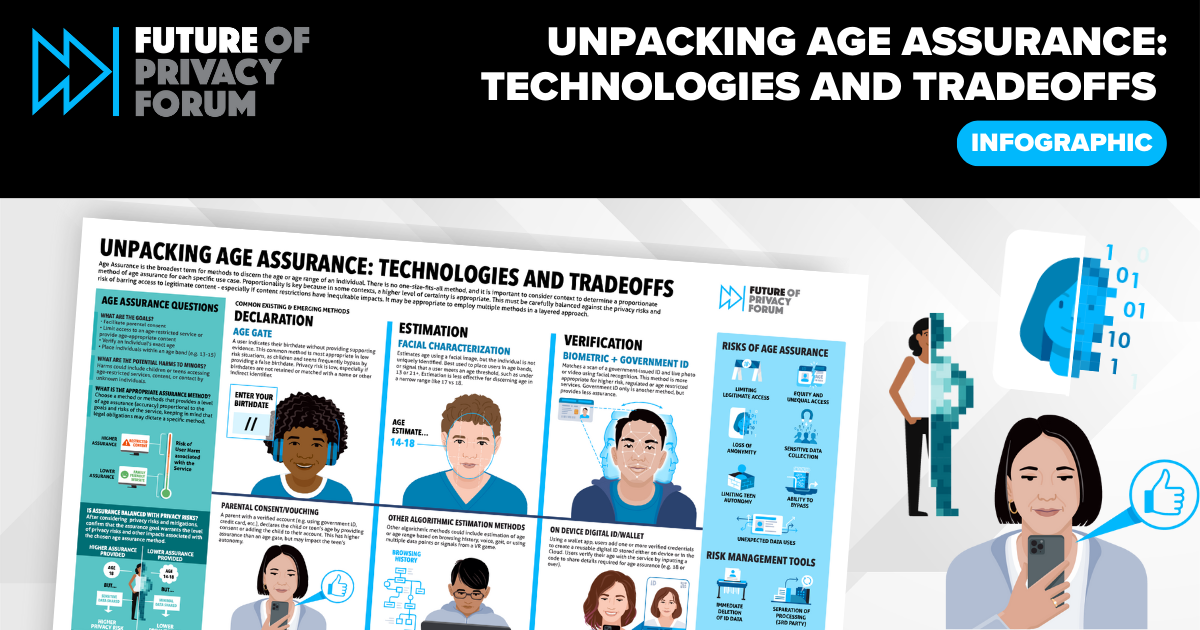
New FPF Infographic Analyzes Age Assurance Technology & Privacy Tradeoffs
As a growing number of federal and state children’s online privacy and safety proposals seek to age-restrict social media and other online experiences, FPF released a new infographic, Unpacking Age Assurance: Technologies and Tradeoffs. The infographic analyzes the risks and potential harms associated with attempting to discern someone’s age online, as well as potential mitigation […]

FPF in 2022: A Year in Review
As 2022 comes to an end, we wanted to reflect on a year that saw the Future of Privacy Forum (FPF) expand its presence both domestically and around the globe, while producing engaging events, thought-provoking analysis, and insightful publications. Global Expansion In 2022, FPF closely followed and advised upon significant developments in Asia, the European […]

Understanding Extended Reality Technology & Data Flows: Privacy and Data Protection Risks and Mitigation Strategies
This post is the second in a two-part series. Click here for FPF’s XR infographic. The first post in this series focuses on the key functions that XR devices may feature, and analyzes the kinds of sensors, data types, data processing, and transfers to other parties that power these functions. I. Introduction Today’s virtual (VR), […]
Understanding Extended Reality Technology & Data Flows: XR Functions
This post is the first in a two-part series on extended reality (XR) technology, providing an overview of the technology and associated privacy and data protection risks. Click here for FPF’s infographic, “Understanding Extended Reality Technology & Data Flows.” I. Introduction Today’s virtual (VR), mixed (MR), and augmented (AR) reality environments, collectively known as extended […]

New Infographic Highlights XR Technology Data Flows and Privacy Risks
As businesses increasingly develop and adopt extended reality (XR) technologies, including virtual (VR), mixed (MR), and augmented (AR) reality, the urgency to consider potential privacy and data protection risks to users and bystanders grows. Lawmakers, regulators, and other experts are increasingly interested in how XR technologies work, what data protection risks they pose, and what […]

FPF and Singapore PDPC Event: “Data Sovereignty, Data Transfers and Data Protection – Impact on AI and Immersive Tech”
On July 21, the Future of Privacy Forum (FPF) and Singapore’s Personal Data Protection Commission (PDPC) co-hosted a workshop as part of Singapore’s Personal Data Protection Week, titled “Data Sovereignty, Data Transfers and Data Protection – Impact on AI and Immersive Tech” at Marina Bay Sands Expo and Convention Center in Singapore. The event focused […]