
Showing results for fire2020 221the free promo code today western sahara fire2020 221the
FPF Anatomy of a State Comprehensive Privacy Law Report
[…] of State Comprehensive Privacy Law: Surveying the State Privacy Law Landscape and Recent Legislative Trends, November 2024, papers.ssrn.com/abstract_id=5309115. ACKNOWLEDGEMENTS All FPF materials that are released publicly are free to share and adapt with appropriate attribution. Learn more . B etween June 2018 and June 2024, nineteen U.S. states enacted comprehensive consumer privacy laws that […]

17th Annual Advisory Board Meeting 2026
[…] networking among peers, fostering new connections and addressing common challenges. We anticipate lively group discussions and encourage active participation from each attendee. (Chatham House Rules & FPF’s Code of Conduct are to be followed please). Hotel Information We encourage all members to take advantage of our discounted room block at the Yours Truly DC Hotel. […]
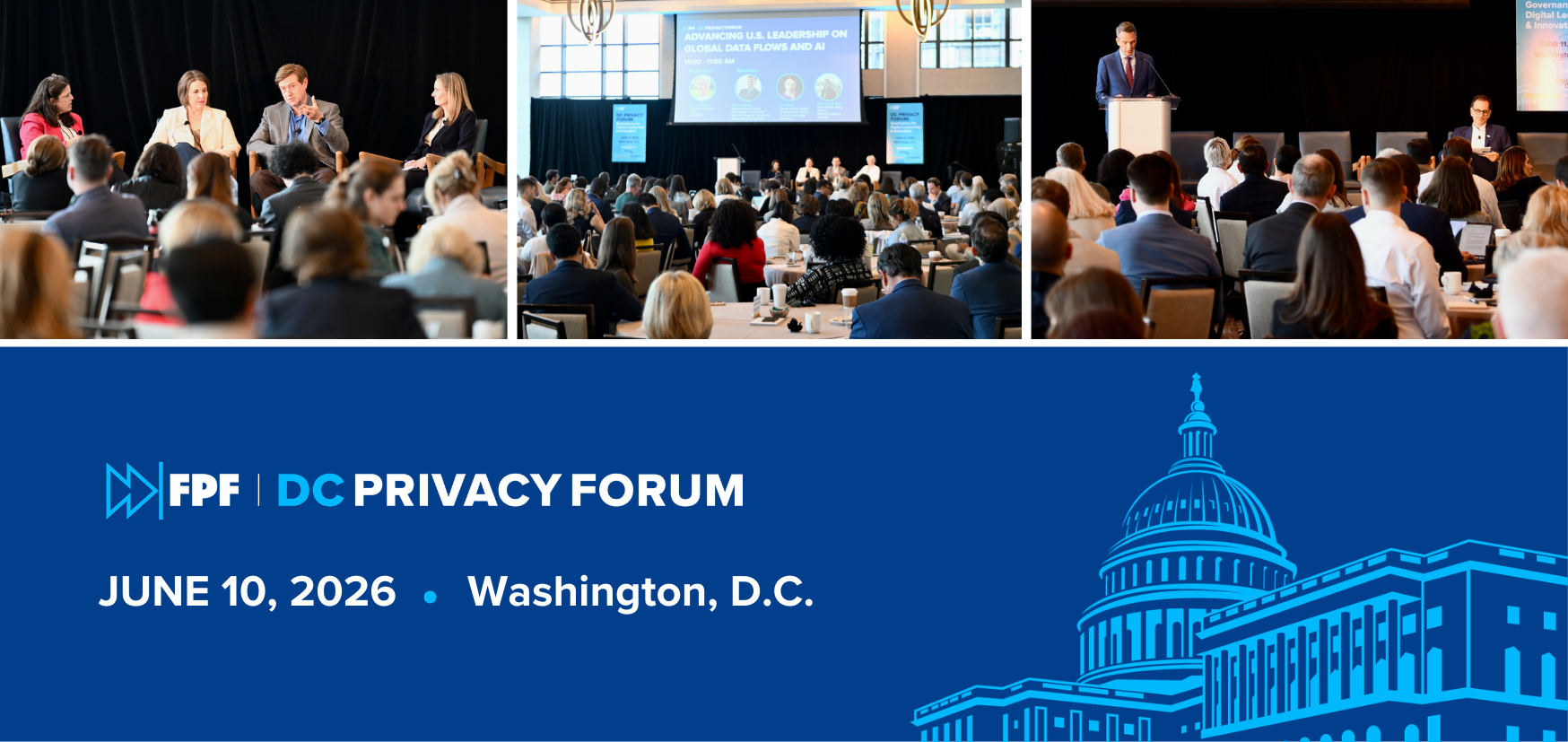
FPF DC Privacy Forum: Advancing Principled Data Protection, AI, and Digital Governance Practices 2026
[…] digital governance practices. The program will include: Panel Discussions & Lightning Talks: Insightful panel discussions & lightning talks focused on AI, policy, and critical topics in privacy today. The Big Debate: Engage in stimulating debates where leading experts share their insights and challenge conventional assumptions on critical AI and privacy topics. Networking Opportunities: Connect […]
FPF AARNET Youth Privacy in Australia
[…] Future of Privacy Forum Jordan Wrigley Data and Policy Analyst for Health & Wellness, Future of Privacy Forum AUTHORS All FPF materials that are released publicly are free to share and adapt with appropriate attribution. Learn more . The Future of Privacy Forum (FPF) is a non-profit organization that serves as a catalyst for […]

What’s New in COPPA 2.0? A Summary of the Proposed Changes
On November 25th, U.S. House Energy and Commerce introduced a comprehensive bill package to advance child online privacy and safety, which included its own version of the Children and Teens’ Online Privacy Protection Act (“COPPA 2.0”) to modernize COPPA. First enacted in 1998, the Children’s Online Privacy Protection Act (COPPA) is a federal law that provides important online protections […]
What’s New in COPPA 2.0? A Summary of the Proposed Changes
[…] old, many advocates, stakeholders, and Congressional lawmakers are pushing to amend COPPA to ensure its data protections are reflective and befitting of the online environments youth experience today. The new House version of COPPA 2.0, introduced by Reps. Tim Walberg (R-MI) and Laurel Lee (R-FL), would amend the law by adding new definitions, revising […]
Comparison of COPPA 2.0
[…] use, and disclosure practices of the operator with respect to personal information ; and ( B) before the personal information of the child or teen is collected, freely and unambiguously authorizes — (i) the collection, use, and disclosure, as applicable, of that the personal information ; and 6 (ii) the any subsequent use of […]
FPF ANPR Comment 10 17_submitted
[…] our congressional testimony, FPF considers that the typical regulatory course is to be silent about fees between business parties, which can be addressed via contract and the free market. However, FPF recognizes the unique challenges raised in the open banking context since the data provider holds the information needed by the consumer and third […]
Rethinking Personal Data: The CJEU’s Contextual Turn in EDPS vs. SRB
[…] the means to reasonably identify the individuals: if they do not process personal data, the GDPR does not apply. On the other hand, pseudonymization is not a free pass. A dataset may still qualify as personal data: (1) if the recipient has reasonable means to re-identify the individual; (2) for the controller who holds […]
FPF_CCPA Regulations Issue Brief
[…] heightened risk of harm to a consumer. C.R.S. § 6-1-1309(1). Where a type of processing is likely to result in a high risk to the rights and freedoms of natural persons. Art. 35(1). DPAs are required where processing activities pose some heightened risk of harm. A key difference between these regulations is whether that […]